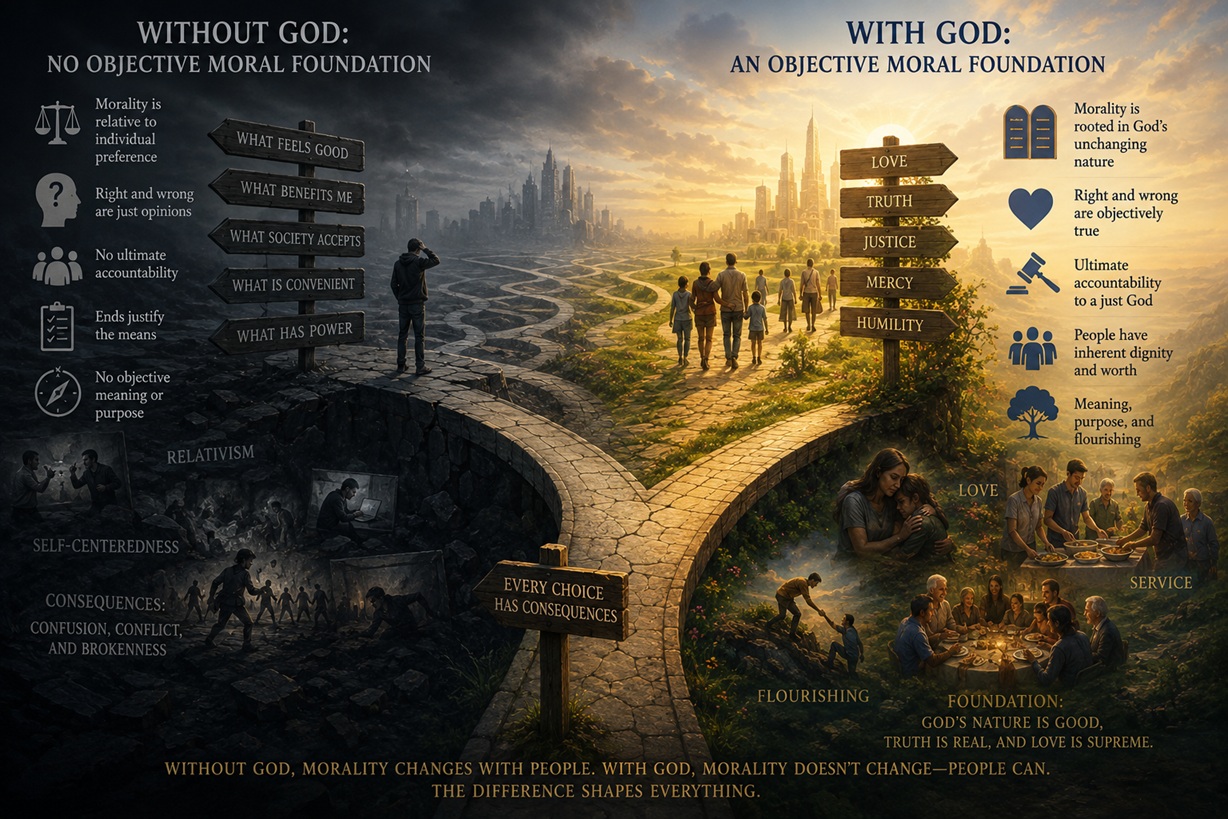
The Christian claim here is much narrower than it is usually taken
to be, and stating it narrowly is the only way to state it honestly.
It is not that unbelievers are wicked, nor that religion makes
people behave, nor that anyone needs Scripture to know that cruelty
is wrong. It is that one particular feature of morality (its
bindingness, the fact that we are obliged and not
merely inclined) is very hard to account for if the world is
matter and nothing else — the materialist picture most
unbelievers in practice hold, though atheism as such entails
neither it nor any particular account of morality — and
that the difficulty is not solved by any of the usual replies.
What This Argument Does Not Claim
Four concessions, all of them real, and none of them grudging.
Unbelievers do know the moral law; the Church says so, holding that
it is written on the heart and reached by reason, so that those who
never heard the commandments still “do by nature what the law
requires” (Rom. 2:14–15). Unbelievers often keep it
better than believers do. Evolution really has shaped our moral
emotions, and there is nothing embarrassing in that for a Christian
who thinks God made the world by secondary causes. And the record of
religious people is in places disgraceful: the defenders of
slavery quoted Scripture, and the argument of this page would have
told against them exactly as it tells against anyone else.
What remains after those concessions is a question about the
grounds, not about the behavior. Both sides can see the moral law.
The dispute is over what sort of thing it is that both sides are
seeing.
The Word That Needs Explaining
The sharpest statement of the problem was made not by an apologist
but by Elizabeth Anscombe, a Catholic philosopher writing for other
philosophers in 1958, and it is a strange fact that it is quoted
more often by ethicists than by believers. Anscombe noticed that our
moral vocabulary is legal vocabulary. Obligation,
duty, guilt, binding, and the peculiar
emphatic ought that appears in moral contexts and nowhere
else, are the words of a courtroom, and they entered
ethics from a conception of morality as divine law.
Her point was about coherence, not piety. A verdict requires a
court; a command requires someone who commands. If the lawgiver is
removed but the legal vocabulary is retained, we are left using
words that have outlived the framework which gave them sense,
as though a country abolished its legislature and went on
issuing statutes. Anscombe’s conclusion was severe, and it was
addressed to secular philosophers: the concept of moral obligation
ought to be jettisoned if it can be, because it is a survival from a
system they have abandoned. That is not a Christian scoring a point.
It is a description of the debt.
Euthyphro Has a Third Option
The dilemma is a real one against the crude view that morality is
whatever God happens to decree, and Christians who hold that view
deserve it. But the classical position has never been that. It is
not that God consults a standard of goodness above Him, nor that He
invents one by fiat, but that God is goodness, not a
being who possesses the property, but the reality in which anything
else that is good participates.
The objection that this makes “God is good” empty
mistakes the kind of claim being made. When we say that a
measurement is accurate we mean it corresponds to the standard, and
saying the standard is accurate is not a compliment to it but a
statement of what accuracy consists in. Nor is the anchor
arbitrary: a nature cannot be otherwise, so the worry that God might
have commanded cruelty asks what would follow if God had a different
nature, which is like asking what would follow if a triangle had
four sides. The horns of the dilemma are “arbitrary
command” and “independent standard,” and this is
neither. A residue of the dilemma remains and should be admitted:
to call God’s nature good, the objector says, is either to
apply a standard to it or to say nothing. The reply is that the
standard and the nature are one reality under two descriptions,
as the meter and the bar in Paris once were — a claim that
can be argued against, but not one that leaves the dilemma’s
two horns as the only options.
The Commands the Skeptic Quotes Back
The skeptic panel has already made the obvious rejoinder: Scripture
itself records commands to destroy the Canaanites, and rules that
regulate slavery rather than forbid it (Deut. 7:1–2;
20:16–17; Lev. 25:44–46). If God’s nature cannot
command cruelty, what are those?
Notice first what the objection borrows. To indict the conquest
texts as atrocity is to measure them against a standard of goodness
that stands above ancient Israel, above the churches that defended
slavery, above every age’s conscience — which is
precisely the objective standard this argument says exists and asks
the skeptic to ground. The objection’s force is evidence for
the premise.
What remains is a genuine question about texts, and the Church
answers it as one. Catholic teaching reads the Old Testament as a
divine pedagogy addressed to a people in a brutal age — the
Catechism says plainly that its books contain “matters
imperfect and provisional” (CCC 122) — and brought to
its term in Christ, who forbade retaliation and told Peter to put
up the sword. And within the conquest narratives the
“utter destruction” formula reads as the war-rhetoric
of its time: cities said to be annihilated are inhabited again
pages later, and Joshua’s “left none remaining”
stands beside Judges’ Canaanites everywhere. However those
texts are finally weighed, they pose a question about how God
condescended to speak — not a counterexample to what
goodness is. The standard by which the skeptic condemns them is
the standard whose existence this page defends.
Explaining the Feeling Is Not Explaining the Obligation
The evolutionary account is almost certainly true, and it is beside
the point, not because it is too weak but because it answers
a different question. It tells us why creatures like us have moral
emotions. It cannot tell us whether the content of those emotions is
correct, because a story about the causes of a belief is not
evidence for the belief. We can explain why humans fear the dark
without settling whether anything is in it.
And the account has a sting its friends do not always notice. If our
sense that some things are simply forbidden was installed because it
helped our ancestors cooperate, then it was installed for its
usefulness and not for its accuracy, and we have no reason to expect
it to track any truth. Michael Ruse, who has argued the
evolutionary case as forcefully as anyone, accepts this and says
plainly that ethics is an illusion put in place by our genes to make
us cooperate. That is not a defense of morality against the theist.
It is an agreement with the theist about what morality would have to
be if there is no God, offered by someone content with the result.
Free-Standing Values Are a Large Bill
The more serious reply says that objective moral facts exist as
brute necessities, like the truths of mathematics, requiring no
author. This deserves respect; it is not evasion, and it may be the
strongest position available to an unbeliever. But notice what has
to be bought.
Mathematical truths do not tell anyone to do anything. Moral truths
do, and obligation looks like a relation between persons
rather than a property floating free of them. I can be obliged to a
neighbor, to a promise, to a child; it is much harder to say what it
would mean to be obliged to an abstract fact, or how a necessary
truth about pain could impose a demand on me and hold me guilty
when I ignore it. This is the point C. Stephen Evans presses:
duties are the sort of thing that get laid on someone by someone, so
an account of obligation without a person in it has kept the word
and dropped the thing it named.
The contemporary versions deserve to be named, because they are
serious and their costs itemize differently. Erik
Wielenberg’s “robust realism” bites the bullet
whole: moral facts are non-natural, brutely necessary, and
causally inert — and our brains, shaped by forces with no
interest in moral truth, are said nonetheless to line up with
them, a lucky alignment his own book must labor to defend.
Reasons-based realism in the line of Parfit and Scanlon
translates goodness into facts about what we have reason to do
— which relocates the mystery rather than solving it,
since a normative reason binding every rational creature is
exactly the queer item in a smaller font. And constructivism,
which builds morality from what agents would agree to, delivers
obligation at the price of objectivity: what we construct we can
reconstruct, and the tyrant’s community constructs
otherwise. Each position buys the argument’s premise
— real, binding moral truth — on credit. The theist
can say where such truth lives and what gives it the right to
command: a Person whose nature is the Good.
The Best Atheist Philosopher Grants the Premise
It is worth noticing who agrees. J. L. Mackie, the most
formidable atheist writer on this subject, argued that objective
values would be entities of a very queer sort, unlike anything else
in the universe, requiring a faculty of moral perception unlike any
other faculty we have. He was right, and he drew the consistent
conclusion: since the world contains no such things, there are no
objective values, and ordinary moral talk is systematically
mistaken.
The theist accepts Mackie’s premise entirely and denies his
minor. Objective values are queer: strange, unlike
the furniture of a purely material world, exactly as he said. Where
the two part company is that Mackie inferred there are none, while
the theist observes that they show every sign of existing and asks
what sort of universe would contain them. The dispute is not about
whether moral facts fit comfortably into naturalism. Both sides
agree they do not.
What the Denial Costs
The price is usually paid quietly, so it is worth setting out.
“Torturing a child for entertainment is wrong” becomes a
statement about the speaker rather than the act. Moral progress
becomes unintelligible, since progress is movement toward something,
and if there is no standard there is only change, and abolition
was not an improvement on slavery, merely a later fashion. And the
lone reformer, who is right while his entire society is wrong, has
to be redescribed as someone deviating from his community’s
values, which is precisely what his enemies said at the time.
Almost nobody can live in that account, and the ones who defend it
do not try to. The man who says morality is a useful fiction still
resents being cheated, and resents it as a wrong done to him rather
than as a breach of a convention he happens to favor. That is not a
proof. But when a theory cannot be inhabited even by the people who
hold it, that is worth something.
The Reply in Brief
Grant everything that should be granted, that unbelievers
know the moral law and often keep it better, that evolution shaped
our moral feelings, that religious people have used God to justify
appalling things. One thing is still unaccounted for. Obligation is
law-language, and law is the sort of thing somebody lays down.
Explaining why we feel bound is not explaining that we are; brute
values keep the vocabulary of duty while removing the person to whom
duty could be owed; and the ablest atheist in the field agreed that
objective values would be very queer things indeed.
So the argument is not that the unbeliever cannot be good. He can,
and the Church says he can. It is that when he is good he is
obeying something he cannot quite account for, and that the
law he finds already written, which he did not put there and cannot
repeal, is better explained by there being someone who wrote it.
The full essay works through Anscombe’s 1958 argument in
detail, sets out Robert Adams’s account of God as the Good
itself against the Euthyphro dilemma, examines the evolutionary
debunking argument and what it does to the debunker’s own
beliefs, takes up Wielenberg’s brute ethical facts at their
strongest, and asks what natural law implies about the atheist who
keeps a commandment he does not believe in.