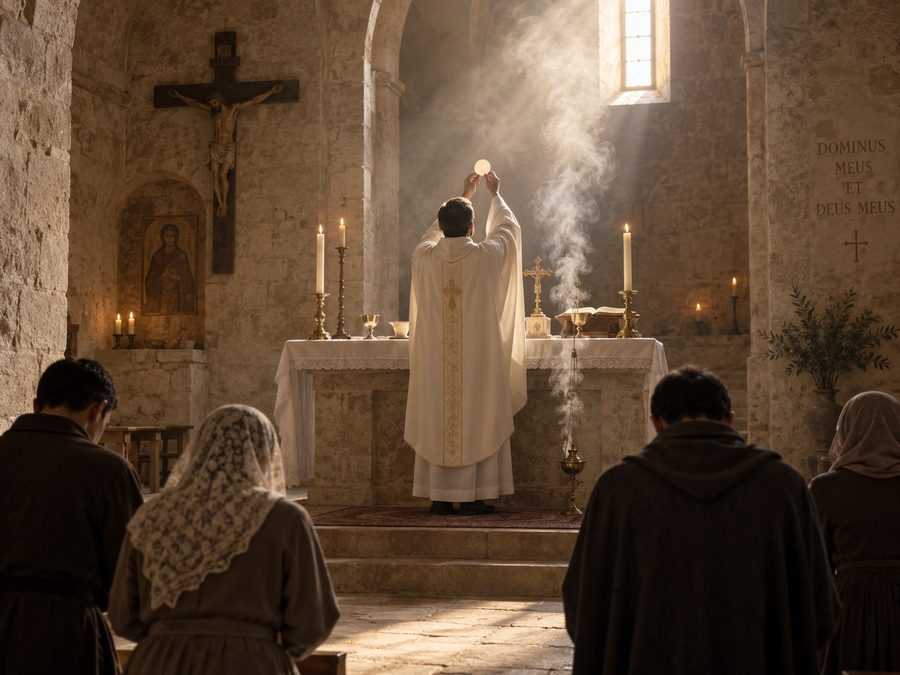
The Catholic Church agrees with every premise of the
objection: Christ’s sacrifice was offered once, is
complete, and can no more be repeated than the
Incarnation can. What she denies is that the Mass repeats
it — and the denial is not a modern dodge but the
council of Trent’s own careful sentence, and before
Trent, the New Testament’s.
What Trent Actually Said
Here is the definition the objection must engage:
“the victim is one and the same, the same now
offering by the ministry of priests, who then offered
Himself on the cross, the manner alone of offering being
different.” One victim, one priest, one sacrifice
— Calvary — made present under sacramental
signs. The Mass adds nothing to the Cross and could not;
it is the Cross, reaching the present the way Christ
arranged for it to reach the present. The charge of
“re-sacrificing” attacks a doctrine no
Catholic council ever taught.1
A picture may help here. The sun never actually rises or
sets; it shines all the time, and what we call sunrise is our
side of the earth turning around to face it. Morning is not a
new sun. It is the same sun, come into view. Calvary works the
same way: it happened once, it has never stopped (Heb. 7:25;
Rev. 5:6), and the Mass is not a second sunrise but the hour
when the Church turns to face the one sacrifice that is always
there. The picture has limits, as every picture of a sacrament
does. Sunlight reaches us whether we turn or not, while at the
altar Christ Himself is acting, through His priest. But it gets
the main thing right: what is always present never has to be
repeated.
The Night He Instituted It
The sacrificial language begins with Jesus, at the table.
“This is my body which is given for you…
This cup which is poured out for you is the new covenant
in my blood” (Luke 22:19–20) —
given, poured out: the vocabulary of
offering, spoken in the present tense the night before
the Cross, over a Passover, the sacrifice-meal in which
the lamb slain is the lamb eaten. “Do this in
remembrance of me” uses the word
(anamnēsis) that in Scripture’s
sacrificial usage means a memorial-offering made before
God, not a mental recollection. Paul completes the
picture: the cup and bread are a participation
in the blood and body of Christ, and he sets the
“table of the Lord” in explicit parallel with
the altars of Israel and of the pagans — those who
eat the sacrifices are partners in the altar
(1 Cor. 10:16–21). Nobody reasons that way
about a symbolic meal.2
Hebrews, Read Whole
Hebrews is the Catholic’s book, not his problem.
Its argument is that Christ’s priesthood, unlike
Levi’s, does not end: “he holds his
priesthood permanently… he always lives to make
intercession” (Heb. 7:24–25), a minister of
the true sanctuary who has entered heaven “now to
appear in the presence of God on our behalf”
(Heb. 9:24). The one sacrifice, offered once, is
eternally presented — the Lamb John sees
in heaven still “standing, as though it had been
slain” (Rev. 5:6). That is exactly what the Mass
claims to be: the earthly face of that heavenly
presentation. What Hebrews excludes is more victims and
new deaths — “not… to offer himself
repeatedly… for then he would have had to suffer
repeatedly” (Heb. 9:25–26). No suffering, no
new victim, no repetition: the Mass fails every mark of
the thing Hebrews forbids, and matches the thing Hebrews
describes.3
The Prophecy and the Earliest Witnesses
Malachi foresaw the age of the nations in sacrificial
terms: “in every place incense is offered to my
name, and a pure offering” (Mal. 1:11) — a
standing puzzle for any theory on which Christian
worship contains no offering at all, in every place,
among the nations. And the first Christians read it
exactly that way. The Didache — dated by most scholars to the late
first or early second century — calls the Sunday Eucharist “your
sacrifice” and quotes Malachi 1:11 of it; Justin
and Irenaeus do the same in the second. The sacrificial
understanding is not a medieval accretion; it is the
oldest interpretation on record, from the generation
that had known the apostles — the same witnesses
this site’s Eucharist page
calls on for the real presence.4
The Reply in Brief
The abuses were real — the traffic in stipends and
multiplied private Masses scandalized Catholic reformers
before Luther — and Trent legislated against them
while defining the doctrine they abused. But the doctrine
stands on the Lord’s own sacrificial words at the
table, Paul’s altar-logic at Corinth, Hebrews’
permanent priest, Malachi’s pure offering, and the
unbroken testimony of the first liturgical documents.
One sacrifice, offered once, never repeated, always
present: the Mass does not add to Calvary. It is where
Calvary finds you.5
The full essay works through the anamnēsis
vocabulary and its Old Testament background, the
Passover shape of the Last Supper, Hebrews chapter by
chapter, the Didache, Justin, and Irenaeus texts in
full, and Trent’s canons with the abuses they
corrected. Download it from the summary below —
and the comments are open, without your name if you prefer.
Endnotes
- Council of Trent, Session XXII (1562), ch. 2; Catechism of the Catholic Church §§1366–1367. ↩
- Luke 22:19–20; 1 Cor. 10:16–21; 11:24–26 (RSV). ↩
- Heb. 7:24–25; 9:24–26; Rev. 5:6 (RSV). ↩
- Mal. 1:11 (RSV); Didache 14; Justin, Dialogue with Trypho 41, 117; Irenaeus, Against Heresies 4.17–18 — all applying Malachi 1:11 to the Eucharist. ↩
- Trent, Session XXII, ch. 9 and the decree on things to be observed and avoided in celebrating Mass. ↩