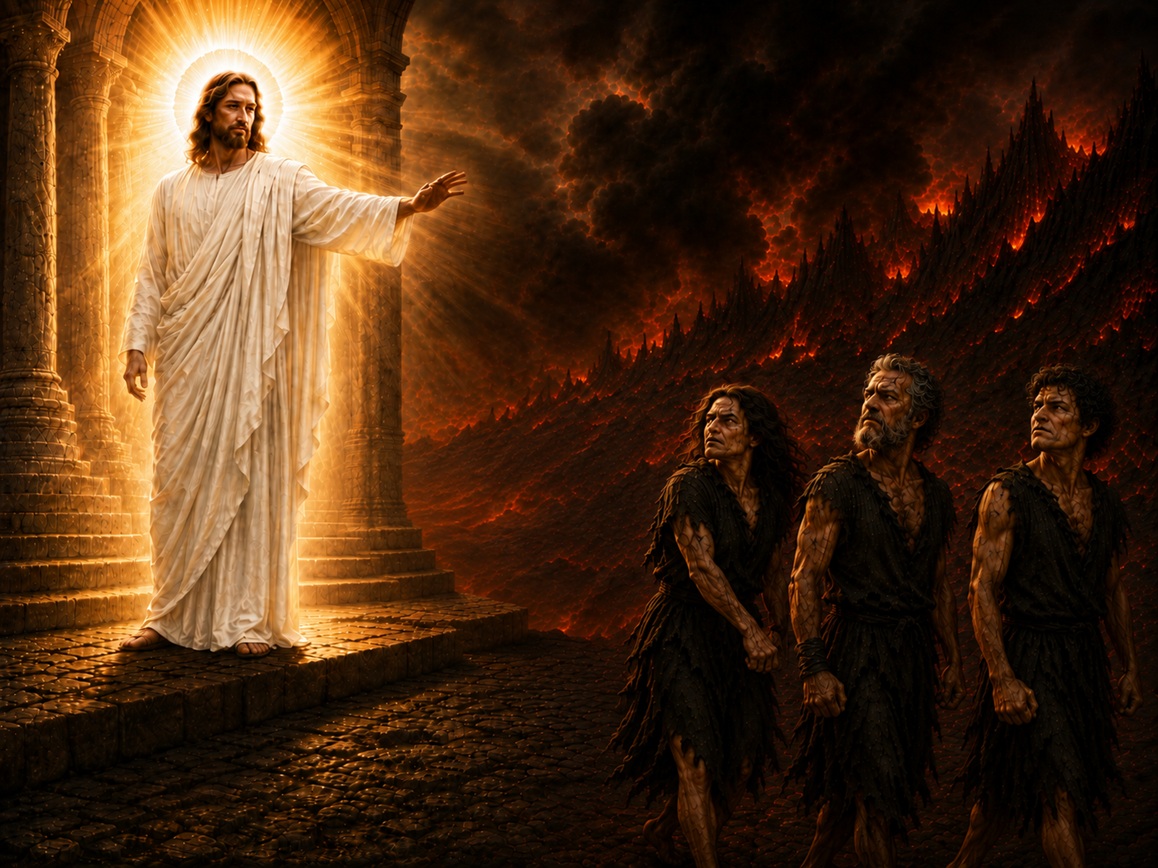
Hell: Annihilation, or Eternal Loss?

Hell

"These will go away into eternal punishment, but the righteous into eternal life."

Is there a hell? Jehovah's Witnesses say no — or rather, that “hell” is only the grave, that the dead are unconscious, and that the finally wicked are not punished forever but annihilated , destroyed out of existence. Eternal torment, they argue, would be an insult to a God of love.
The Catholic Church agrees that the cartoon hell of gleeful devils is a distortion — but holds that Jesus himself, who is also love, spoke plainly of a real, conscious, and eternal loss . The question is what he actually taught, and whether “destruction” means extinction or ruin.
Let's weigh the Watchtower's case against the words of Christ — the word Gehenna, the sentence of Matthew 25:46, the meaning of “destruction” — and ask ...
  • Are the lost simply snuffed out of existence, or is hell the self-chosen, eternal loss of the God for whom we were made — a door locked from the inside?
I invite your engagement with me on these questions. You may leave comments below, but please be sure to read our policy on commenting before doing so.

Watchtower View

Jehovah's Witnesses reject the traditional doctrine of hell entirely. There is no place of conscious, eternal torment; the very idea, they hold, slanders a God of love and was borrowed from pagan philosophy. The finally wicked are not punished forever but annihilated — destroyed out of existence.

What They Teach

“Hell” is just the grave. The words translated “hell” — Hebrew Sheol, Greek Hades — mean only “the common grave of mankind,” where the dead lie unconscious (Eccl. 9:5, 10). Even faithful men like Jacob and Job “went to hell” in this sense (Gen. 37:35; Job 14:13).1

No eternal torment. The dead are unconscious and feel nothing (Eccl. 9:5). A fiery hell of endless torture is “contrary to the Bible's teaching that ‘God is love’” (1 John 4:8) and is traced to Plato and the ancient Egyptians, not to Scripture.2

The wicked are annihilated. Those who finally reject God are not tormented but destroyed forever — “Gehenna” symbolizes everlasting destruction, nonexistence. The penalty for sin is death, not torment: “the wages of sin is death” (Rom. 6:23), and “dust you are and to dust you will return” (Gen. 3:19).3

The Reply in Brief

The Catholic reply is developed in the Catholic View panel and set out point by point in the Summary below, with the full exposition in the downloadable essay. In brief: much of this is granted — Sheol/Hades often do mean the grave, and the torture-chamber caricature is a distortion. But the word Jesus uses for final punishment is a different one, Gehenna, of which he says “the worm does not die, and the fire is not quenched” (Mark 9:48). Decisively, he set the two destinies in exact parallel: “These will go away into eternal punishment, but the righteous into eternal life” (Matt. 25:46) — the same word governs both, so if the life is everlasting, so is the punishment. The biblical “destruction” (apoleia) of the lost means ruin or loss, not extinction (the “lost” sheep and coin of Luke 15 still exist). And hell, rightly understood, is not God's cruelty but the self-chosen loss of God by those who refuse his love to the end — the door, as it were, locked from the inside.


Endnotes
  1. On “hell” (Sheol/Hades) as the common grave, see “Is Hell Real? What Does the Bible Say About Hell?” (jw.org), citing Psalm 16:10; Acts 2:31; Genesis 37:35; Job 14:13.
  2. On the rejection of eternal torment as unscriptural and pagan in origin, see “Is Hell Real?” (jw.org), citing Ecclesiastes 9:5; 1 John 4:8; Jeremiah 7:31; 32:35, and tracing the doctrine to Plato and Egyptian sources.
  3. On the annihilation of the wicked and death (not torment) as the penalty for sin, see “What Is Hell? Is It a Place of Eternal Torment?” (jw.org), citing Romans 6:23; Genesis 3:19; Matthew 10:28; the “second death” of Revelation 21:8 as everlasting destruction.

Catholic View

© 2026 Richard Whiting. All rights reserved. May be reproduced in whole, with attribution. See the full notice at the end of this article.

I. A Doctrine Worth Getting Right

Few Christian teachings are harder to speak of than hell, and few are easier to caricature. The Watchtower rejects it outright — not merely the lurid medieval imagery, but the very idea of any conscious, lasting loss beyond death. In its place it puts annihilation: the finally wicked are not punished forever but simply destroyed, snuffed out of existence. Many people, recoiling from cruder pictures of hell, find this a relief, and even an act of mercy on God's part.

The question, though, is not which doctrine we would prefer, but which one Jesus taught — for he spoke of hell more than anyone else in Scripture, and a Christian is not free simply to set his words aside. This page assumes the conscious survival of the soul, argued on its own page; the Watchtower's denial of hell follows from its denial of that survival, so the two stand or fall together. Granting that the soul lives on, the question here is precise: when Jesus warns of the destiny of the lost, does he describe annihilation — or a conscious, eternal loss?1

II. The Watchtower's Hell: The Grave and Annihilation

The Watchtower's teaching has two parts. First, there is no place of conscious torment: the word “hell” in older Bibles translates the Hebrew Sheol and Greek Hades, which mean only “the common grave of mankind,” where the dead lie unconscious. Second, the finally wicked — those not raised to life — are not tormented but annihilated: “Gehenna” is taken to symbolize everlasting destruction, that is, permanent nonexistence. Eternal conscious punishment, the Society argues, would be both unscriptural and a slander on a loving God, a pagan import from Plato and the Egyptians.2

III. What Is True in It

A fair reply must begin by granting what is right here, and a surprising amount is. The Watchtower is correct that Sheol and Hades frequently mean simply the grave or the abode of the dead, not the hell of final punishment; older translations that rendered every such word “hell” genuinely did breed confusion, and even good men like Jacob and Job are said to go to Sheol. The Catholic agrees, too, that the cartoon hell of gleeful devils and pitchforks is a distortion, and that a God who tortured creatures for the pleasure of it would not be the God of love. These are real points, and honesty concedes them.3

But none of this touches the actual question. That Sheol means “grave” tells us nothing about the destiny of the damned, because the word Jesus uses for that is a different word — and to that word we must now turn.

IV. Gehenna: The Word Jesus Used

When Jesus warns of final punishment, he does not say Sheol or Hades. He says Gehenna — a word drawn from the Valley of Hinnom outside Jerusalem, a place of ancient idolatrous child-sacrifice that had become an image of the place of the damned. It is Gehenna, not the grave, that he describes; and he describes it not as a quiet nonexistence but as a state of active and continuing ruin. There, he says, “the worm does not die, and the fire is not quenched” (Mark 9:48). He calls it “the outer darkness,” a place of “weeping and gnashing of teeth” (Matt. 8:12) — and the dead, on the Watchtower's own view, do not weep. He warns of being “thrown into the eternal fire” (Matt. 18:8). This is not the language of a man describing extinction.4

V. The Sentence That Settles It

One sentence of Jesus is, by itself, very difficult for annihilationism to survive. At the close of his account of the Last Judgment, he says of the two destinies: “These will go away into eternal punishment, but the righteous into eternal life” (Matt. 25:46). The two halves are built on a single word — the Greek aiōnios, “eternal,” “everlasting” — set in exact and deliberate parallel.5

And that parallel is fatal to the annihilationist reading. For the same word cannot mean two different things in the two halves of one sentence: it cannot mean “unending, conscious” when applied to the life of the righteous and “instant and final” when applied to the punishment of the wicked. If the life is everlasting — and no Christian doubts it — then the punishment is everlasting in the same sense. There is a further difficulty: a punishment that consists simply in ceasing to exist is no punishment to the one who undergoes it, for there is no longer anyone there to undergo it. The annihilated suffer nothing, lack nothing, regret nothing. Jesus calls it punishment — and punishment is something a person experiences.

VI. “Destruction” Does Not Mean Extinction

The Watchtower's reply leans on the Bible's language of “destruction” — the wicked will be “destroyed,” will suffer “eternal destruction” (2 Thess. 1:9), will die “the second death” (Rev. 21:8). Surely, it argues, to be destroyed is to cease to be. But this misreads the words. The Greek terms for “destroy” and “destruction” — apollumi and apoleia — do not normally mean annihilation. They mean ruin, loss, being lost. It is the same word Jesus uses for the “lost” sheep, the “lost” coin, the “lost” son in Luke 15 — and none of those had ceased to exist; they were ruined, or astray, or away from home, but fully real and able to be found.6

To “destroy” a thing, in this biblical sense, is to wreck it as the thing it was meant to be — to ruin its purpose and its flourishing. For a human person, made for God, the ultimate ruin is precisely the loss of God — a person still real, still himself, but undone, his whole reason for being forfeited. That is a destruction far more terrible than mere extinction, and it is one the person continues to suffer. “Eternal destruction,” Paul says, is to be “away from the presence of the Lord” (2 Thess. 1:9) — a separation, which presupposes someone who is separated.

VII. The Objection from Love

Beneath the exegesis lies the Watchtower's real and deepest objection, and it deserves to be met head-on, for it is felt by many tender consciences: how could a God who is love (1 John 4:8) condemn anyone to suffer forever? Is not eternal punishment simply incompatible with infinite love?

The objection has real force — against a caricature. If hell were a torture-chamber that a vindictive God built to inflict the maximum of pain on helpless victims, it would indeed be irreconcilable with love, and we should be right to reject it. But that is not the Catholic doctrine, and it is important to say so plainly. God “desires all men to be saved and to come to the knowledge of the truth” (1 Tim. 2:4). He predestines no one to hell. He pursues every soul with his grace to the very end. Hell is not something God does to those who longed for him; it is the home of those who, offered the love of God, finally and freely refuse it.7

VIII. What Hell Actually Is

So hell, rightly understood, is not first of all about fire, but about loss — the loss of God, freely chosen. We are made for God; he is the one Good in whom the human heart can finally rest. To reject him utterly and to the end is therefore to lose the one thing that could ever have made us happy, and to lose it by our own choice. The traditional “fire” is the image for the anguish of that loss; but the essence of hell, the theologians say, is the pain of loss itself — to have refused, forever, the Love for which one was made.8

Understood this way, hell is not the denial of human freedom but its most awful affirmation. God will not drag the unwilling into heaven; love cannot be coerced, and a heaven entered by compulsion would not be heaven. If a creature, to the last, says to God “I will not have you,” God in the end honors that “no” — and the honoring of it is hell. As one writer put it, the door of hell is locked on the inside. That is a far more sobering thing than annihilation, and a far more respectful one: it takes with full seriousness the dreadful dignity of a free “no” to God.

IX. Conclusion: The Door Locked from Within

The Watchtower is right to recoil from the caricature of hell, right that Sheol is often just the grave, right that God is love. But it is wrong to conclude that there is no hell — for Jesus, who is also love, spoke of Gehenna and its unquenchable fire, set “eternal punishment” in exact parallel with “eternal life,” and described a state of conscious anguish that annihilation cannot account for. The biblical “destruction” of the lost is not their extinction but their ruin — the forfeiting of the God for whom they were made.

Hell is real, then, and eternal, and conscious; but it is not God's cruelty — it is the terrible fruit of human freedom, the self-chosen loss of God by those who will not have him. And this, rightly seen, is not a doctrine that makes God less loving but one that makes his love more serious: he loves us enough to let our “yes” and our “no” be real. The gospel's answer to the fear of hell is not to deny that it exists, but to proclaim the One who went to the cross precisely so that we need never choose it: “God so loved the world … that whoever believes in him should not perish but have eternal life” (John 3:16). The door is locked from within — and Christ has done everything to give us the will to open it.


“These will go away into eternal punishment, but the righteous into eternal life.”

— Matthew 25:46


Copyright and Distribution

© 2026 Richard Whiting. All rights reserved.

This essay may be reproduced and distributed freely, in printed or electronic form, provided that it is reproduced in whole and without alteration, and that the author's name is retained. Excerpts may be quoted in reviews, scholarly works, or other writings consistent with fair use, with attribution. For any other use, including translation, adaptation, or partial republication beyond fair use, please contact the author.


Endnotes
  1. This page assumes the conscious survival of the soul, established on the companion page “When We Die: Does the Soul Survive?” The Watchtower's denial of any conscious hell follows directly from its doctrine of soul-sleep: if the dead are unconscious, there can be no conscious punishment. So the prior question governs this one. Granting that the soul survives — as the New Testament teaches — the question here is what Scripture says of the destiny of those who finally refuse God: annihilation, or eternal loss?
  2. The Watchtower denies any hell of conscious punishment. “Hell” translates the Hebrew Sheol and the Greek Hades, which it defines as merely “the common grave of mankind,” where the dead lie unconscious. Eternal torment is called “unscriptural,” of pagan (Platonic and Egyptian) origin, and “an insult to” God's love (1 John 4:8). The finally wicked are not tormented but annihilated — “Gehenna” symbolizing everlasting destruction (nonexistence), not torment. See “Is Hell Real? What Does the Bible Say About Hell?” (jw.org).
  3. It is true, and the Catholic grants it, that the Hebrew Sheol and the Greek Hades often mean simply the grave or the realm of the dead, and are not the “hell” of final punishment. The King James Version's uniform rendering of several distinct words as “hell” did cause confusion, which the Watchtower rightly notes. But the word that denotes the place of final punishment is a different one — Gehenna (from the Valley of Hinnom), used by Jesus for the destiny of the damned (Matt. 5:22, 29–30; 10:28; 23:33; Mark 9:43–48). The question is not what Sheol means but what Jesus means by Gehenna, and there he speaks of unquenchable fire and the undying worm.
  4. Other texts confirm conscious, continuing loss: “their worm does not die, and the fire is not quenched” (Mark 9:48, citing Isa. 66:24); “the outer darkness” where “there will be weeping and gnashing of teeth” (Matt. 8:12; 22:13; 25:30); the rich man “in anguish in this flame” immediately after death (Luke 16:23–24); and, in Revelation, “the smoke of their torment goes up forever and ever, and they have no rest, day or night” (Rev. 14:11), while the devil, the beast, and the false prophet are “tormented day and night forever and ever” (Rev. 20:10). Weeping, anguish, and unrest are states of a conscious being, not of nonexistence.
  5. Matthew 25:46 is the decisive text against annihilationism: “These will go away into eternal punishment, but the righteous into eternal life.” The one Greek word aiōnios (“eternal”) governs both destinies in perfect parallel. If the “eternal life” of the righteous is everlasting and conscious, then the “eternal punishment” of the wicked is everlasting and conscious too; one cannot make the same word mean “unending” in one half of the sentence and “snuffed out” in the other. A punishment that consists in ceasing to exist is, moreover, not experienced as punishment at all — the annihilated feel nothing.
  6. The Watchtower leans on the language of “destruction” (e.g., Matt. 10:28; 2 Thess. 1:9; the “second death,” Rev. 21:8) as proof of annihilation. But the Greek words for “destroy” and “destruction” (apollumi, apoleia) regularly mean ruin, loss, or being lost — not annihilation into nothing. The “lost” (apollumi) sheep, coin, and son of Luke 15 still exist; they are ruined or away, not extinguished. “The destruction” of a thing in Scripture is the wrecking of its purpose and flourishing, which for a person is the loss of the God for whom he was made — a ruin he continues to suffer, not a cancellation of his being.
  7. The Watchtower's strongest point is moral: that endless torment is incompatible with a God of love (1 John 4:8). The objection has real force against a caricature — a God who delights in inflicting pain. But the Catholic doctrine is not that caricature. Hell is not a torture-chamber God devises for those who sought him, but the self-chosen and definitive separation from God of those who refuse his love to the end. God “desires all men to be saved” (1 Tim. 2:4) and condemns no one who does not, in effect, condemn himself by rejecting the only Good there is. Hell is the terrible honoring of a free creature's final “no.”
  8. On hell as freely chosen self-exclusion rather than divine cruelty, see Catechism of the Catholic Church §§1033, 1037: “God predestines no one to go to hell; for this, a willful turning away from God (a mortal sin) is necessary, and persistence in it until the end.” The “fire” of hell is the traditional image for the pain of this loss (the poena damni, the pain of the loss of God, being its essence); the deepest torment of hell is simply to have refused, forever, the One in whom alone the heart can rest. “You have made us for yourself, O Lord, and our heart is restless until it rests in you” (Augustine, Confessions I.1).

Summary

Is hell a place of conscious, eternal loss — or are the wicked simply annihilated? The Watchtower denies any hell of torment: the dead are unconscious, “hell” is just the grave, and the finally wicked are destroyed out of existence. The Catholic Church teaches that hell is real, eternal, and conscious — but a freely chosen loss of God, not a torture he inflicts. (This rests on the soul's survival, treated on the companion page “When We Die.”)

What is rightly granted. Sheol and Hades often do mean simply the grave, not a place of punishment; older Bibles bred confusion by translating several words alike as “hell”; and the cartoon of a gleeful, torturing God is a real distortion. The Catholic concedes all of this.

But Jesus' word for final punishment is Gehenna. Of it he says “the worm does not die, and the fire is not quenched” (Mark 9:48); he calls it the “outer darkness” of “weeping and gnashing of teeth” (Matt. 8:12) — and the dead, on the Watchtower's own view, do not weep. The rich man is conscious “in anguish” immediately after death (Luke 16:23–24), and Revelation's torment goes up “forever and ever … no rest, day or night” (Rev. 14:11).

The sentence that settles it. “These will go away into eternal punishment, but the righteous into eternal life” (Matt. 25:46). One Greek word (aiōnios) governs both halves in exact parallel; it cannot mean “unending” for the life and “snuffed out” for the punishment. And a “punishment” that is mere nonexistence is no punishment — there is no one left to undergo it.

“Destruction” is not extinction. The Greek apollumi / apoleia mean ruin, loss, being lost — the same words used for the “lost” sheep, coin, and son of Luke 15, none of which ceased to exist. For a person made for God, the ultimate ruin is the loss of God — still real, but undone. “Eternal destruction” is to be “away from the presence of the Lord” (2 Thess. 1:9): a separation, which presupposes someone separated.

The objection from love. Endless torment would indeed be incompatible with a God of love — if hell were a torture-chamber. But God “desires all men to be saved” (1 Tim. 2:4) and predestines no one to hell. Hell is the self-chosen, definitive refusal of God's love. It is not God's cruelty but the honoring of a free creature's final “no” — the door, as it were, locked from the inside.

So hell is real, eternal, and conscious, yet freely entered: the loss of the God for whom we were made, by those who will not have him. The gospel's answer is not to deny hell but to proclaim the One who died so that we need never choose it — “that whoever believes in him should not perish but have eternal life” (John 3:16).