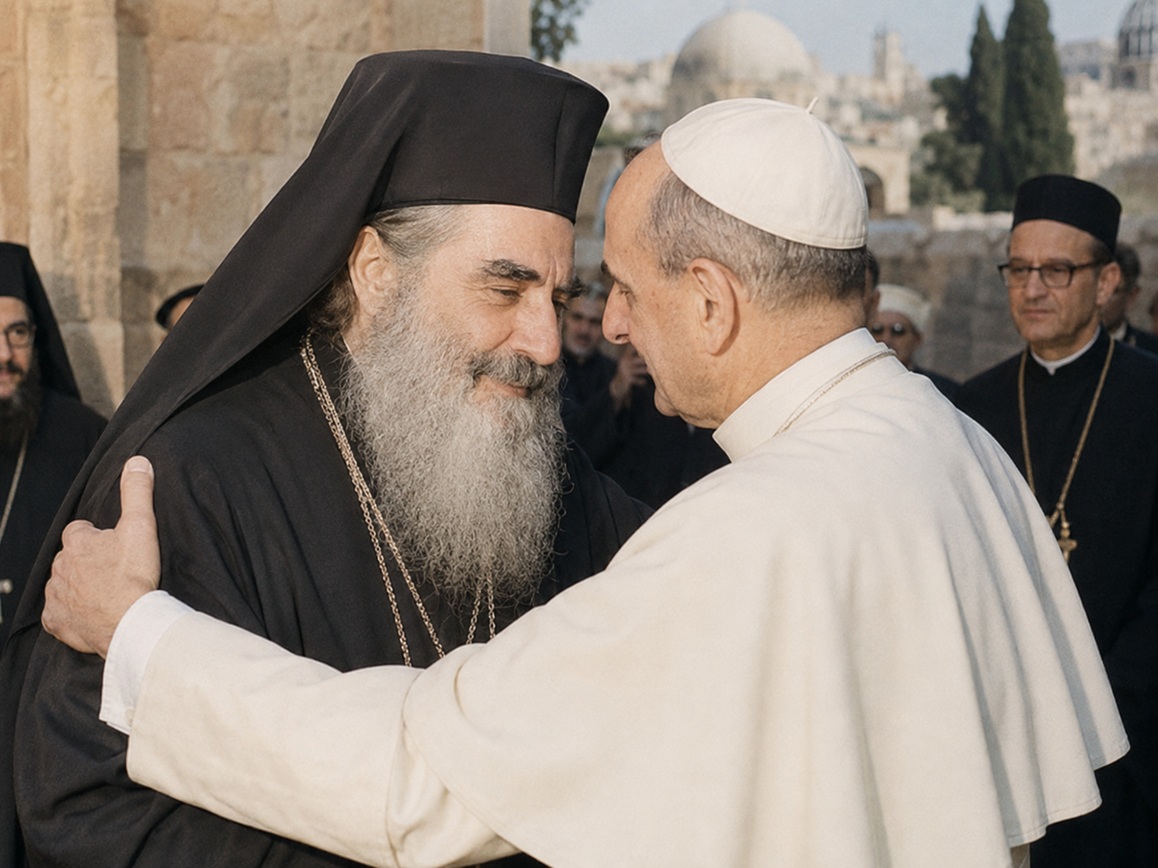
The Catholic answer begins with what is not in dispute, because a
great deal is not.
The Orthodox Churches are not a sect, and this is not the
Watchtower’s case in different clothes. They have valid
bishops in genuine apostolic succession, a valid Eucharist, and
the ancient liturgy; the Catholic Church says so herself, and says
the communion between us lacks little of the fullness that would
permit a common altar. The mutual excommunications of 1054 were
lifted in 1965 by Paul VI and Athenagoras together. The sack
of Constantinople in 1204 was a crime committed by men who called
themselves crusaders, and Rome has said so in those words. Nothing
here argues that the East left the
Church.1
Rome Acts Before Anyone Explains Why
The earliest evidence is not a theory of primacy but a pattern of
behavior. Around A.D. 96, while the apostle John was in all
likelihood still alive at Ephesus — far nearer Corinth than
Rome is — the church of Rome wrote to Corinth to settle a
quarrel about deposed presbyters, and wrote in a register that
expects to be obeyed. Nobody in Corinth appears to have asked what
business it was of Rome’s; the letter was kept and read aloud
in the Corinthian liturgy for generations. Taken alone, the letter
shows intervention and prestige rather than a theory of
jurisdiction; it is the first item in a pattern, not the
proof.2
Ignatius of Antioch, writing about 107 on his way to execution,
corrects every church he addresses except one: to the Romans he
gives no instruction, and of that church alone he says it presides
in love. By about 180 Irenaeus states the principle outright
— with the church of Rome, on account of its preeminent
authority, every church must agree. A decade later Pope Victor
threatened to cut off the churches of Asia over the date of
Easter, and Irenaeus rebuked him for the harshness of it. The
rebuke was about severity. That no one is recorded disputing his
standing is an argument from silence, and is weighed here as one;
what the episode shows without inference is a Roman bishop
attempting a reach no other see attempted, and being urged to use
it more gently rather than told he had none.3
Rome Hears Appeals
The Council of Sardica in 343 provided that a bishop who believes
himself wrongly deposed may appeal to the Bishop of Rome, who may
order a retrial. Honesty requires two qualifications: Sardica was
not an ecumenical council, and when its canons reached North
Africa in a Roman collection that labeled them Nicene, the African
bishops objected to the misattribution during the Apiarius affair
— rightly. What they disputed was the provenance of the
text, not the existence of the practice. At Ephesus in 431 the
papal legate told the assembled fathers that Peter lives and
exercises judgment in his successors, and no one contradicted
him.4
The Council That Rome Refused
Here is the fact that tells hardest against a merely honorary
primacy. In 449 a council met at Ephesus with imperial backing, a
full assembly, and a presiding patriarch. It deposed Flavian and
vindicated Eutyches. It is not an ecumenical council and no one
treats it as one, because Leo refused it and called it a
robbery rather than a synod. An assembly with everything except
Roman consent turned out to have nothing. Roman refusal was not
the only factor — Chalcedon’s reception, imperial
policy, and the doctrine itself all told against 449 — but
it was the factor the Robber Council’s convokers could not
supply and Chalcedon’s could.5
Read in reverse, the same test explains the Formula of Hormisdas.
To end the Acacian schism in 519, some two hundred and fifty
Eastern bishops, including the Patriarch of Constantinople, signed
a statement that in the Apostolic See the Catholic religion has
always been preserved unblemished. Eastern bishops signed that, in
the East, in the first millennium. The context was a union
settlement under a new emperor, Justin, who wanted the schism
ended; that explains why it was signed, not why this was the text
that could end it.6
Gregory Refused a Title That Meant Something Else
The letter must be met head-on, not softened: he wrote it, he
meant it, and he refused the title for himself as well. But read
what he says the title means. If one patriarch is called
universal, he writes, “the name of Patriarch in the case of
the rest is derogated” and the honor of all of them is
denied; and if the one so called should fall into error, “no
bishop will be found to have remained in a state of truth,”
so that the universal Church falls with him. That is the claim he
calls the mark of the forerunner of Antichrist — a title
that would swallow the episcopate rather than preside over it
— and the Catholic Church condemns it too: Vatican I
and Vatican II both teach that bishops are true successors of
the apostles in their own right, not papal delegates. What Gregory
refused is not what Rome later claimed. And the same Gregory, in
the same years, heard appeals from the East and intervened in sees
far outside his own
patriarchate.7
Honorius Defined Nothing
He was condemned by an ecumenical council, by name, and Catholics
should say so plainly — and should quote the sentence rather
than paraphrase it, because the council’s charge is heavier
than the usual summary admits. Its thirteenth session decreed that
Honorius be “expelled from the holy Church of God and
anathematized … because of what we found written by him to
Sergius, that in all respects he followed his view and confirmed
his impious doctrines.” That is not a reprimand for
silence.8
What can be said is narrower, and it is what the definition of
1870 actually turns on. Honorius defined nothing. The documents at
issue are two private letters to a bishop, answering a question
about how to speak; he addressed no definition to the whole Church
and did not purport to settle the matter by his authority. Leo II,
confirming the acts, described the fault as having let the
immaculate faith be subverted by profane treachery —
negligence rather than positive teaching, and Catholic apologists
have leaned on that word for centuries. It is fair to add that the
reading is contested, and that anyone who reads the acts will know
it. What is not contested is that the strongest counter-example
produced in nineteen centuries is a pope who defined nothing at
all. And Leo II’s confirmation repays a moment’s
thought: the council’s act was held to require Roman
ratification, which is an exercise of the very authority the case
is meant to disprove. The fuller treatment is at
Apostolic Succession.
Why the Canons Give Civil Reasons
Constantinople I and Chalcedon do explain
Constantinople’s rank by the dignity of the imperial city
— because that is the only argument available for a see with
no apostolic founder. It does not follow that Rome’s claim
rested on the same ground, and Rome consistently gave a different
ground for itself. Notice what became of canon 28: Rome rejected its
rationale, and though Constantinople’s elevated rank became
a practical reality in the East, the canon never entered the Western Church’s
canon law alongside the rest of Chalcedon. A
conciliar canon left standing outside the canon law for want of
Roman consent is a strange fate for a decree supposed to have
reduced Rome to first among equals.
Rite Is Not Faith, and the Wounds Are Real
On the disputes that actually triggered 1054, the Catholic answer
is that they were never matters of faith at all. Unleavened bread,
a celibate clergy, the Saturday fast — these are questions
of rite and discipline, and Rome has never required the East to
become Latin in any of them. As for Humbert’s legation,
it was indefensible, its commission had probably lapsed with the
pope who issued it, and nothing in the Catholic case depends on
defending it.
The Churches That Are Both
That is not a concession offered now for the sake of argument, and
the proof of it is a living one. Some twenty-three Churches
sui iuris are in full communion with the Bishop of Rome
while keeping their own liturgies, their own canon law, their own
hierarchies and their own traditions. The largest are Byzantine in
rite, celebrating the Divine Liturgy of St. John Chrysostom
as the Orthodox celebrate it; the full roster, from the Maronites
to the Syro-Malabar, is in the essay.
They use leavened bread. They ordain married men. They keep the
Eastern fasts and the Eastern calendar, and they confirm infants
at baptism and give them Communion, as the East has always done
and the West does not. None of it is tolerated as an eccentricity:
the Second Vatican Council declared that the Churches of the East
have the same dignity as those of the West, that none is superior
by reason of rite, and it told Eastern Catholics to
return to their ancestral traditions wherever Latin
influence had eroded them. Rome instructed them to become less
Latin, not more.9
If the Roman claim entailed the Latinizing of the East, these
churches could not exist. They do exist, and several have paid
for it: the Ukrainian Greek Catholic Church was liquidated by
Stalin in 1946 and lived underground for more than forty years
rather than be absorbed.
The other half of the account is owed as well. The Orthodox regard
these churches not as a model but as a wound — communities
detached from Orthodox communion, in several cases under political
pressure, standing now as a permanent argument against Orthodoxy
inside its own territory. That has weight, and Rome has conceded a
substantial part of it: at Balamand in 1993 the joint commission
stated that uniatism is not the way to unity, while affirming in
the same document that the Eastern Catholic Churches now existing
have the right to exist and to serve their faithful. Both halves
are Catholic teaching, and neither cancels the
other.10
What these churches settle is narrower than a polemicist would
like and more useful than he would expect. They do not prove the
Roman primacy. They prove that the Roman primacy, as Rome
understands it, is compatible with everything the East feared
losing — the liturgy, the married priesthood, the bread, the
calendar, the whole shape of Eastern Christian life. Whatever
divides Rome from Constantinople, it is not that.
Lyons, Florence, and Why the Reunions Failed
The reunions failed, and the reason matters. Lyons and Florence
were signed and then repudiated, and the Eastern account of why
— political duress, an emperor buying armies — is
substantially true. What follows from it is less clear than the
objection assumes. That a union was rejected tells us the terms
were not received; it does not tell us the terms were wrong.
Florence’s own Greek signatories were not all cynics:
Bessarion argued for the union on the merits for the rest of his
life.
Development Is Not Invention
The panel’s sharpest form of the charge is procedural, not
doctrinal: whatever the definitions say, no part of the Church
may define for the whole. But the first millennium’s own
hardest cases cut against the rule. When a council with imperial
backing met at Ephesus in 449, Roman refusal is what voided it;
when Chalcedon’s canon 28 elevated Constantinople, Roman
rejection is what kept it from the books the East itself later
cited. If Rome’s consent could unmake conciliar acts, then
Roman consent was already, in the undivided Church’s own
practice, part of what made a definition the Church’s
— and a communion that accepts those two vetoes has
already granted the principle it now protests.
As for the definitions themselves: the definition of 1870 is
fuller than anything the first
millennium put in those words, and pretending otherwise would be
dishonest. What Catholics claim is that it articulates what was
already being done — as Nicaea articulated a divinity
confessed before the word homoousios existed, and as the
canon of Scripture was recognized before it was listed.
Newman’s tests apply here as everywhere: a true development
preserves the type and adds without contradicting. And the
definition is narrower than critics usually allow. It is not
impeccability, not inspiration, not a licence to innovate; it is a
negative protection, in defined conditions, whose two most commonly cited uncontroversial exercises are the Marian definitions of 1854 and 1950 — the Church has issued no exhaustive list.
And the principle of development is not a Roman invention brought
in to license Roman claims. It is apostolic. Christ promised that
the Spirit of truth would guide the apostles “into all the
truth” (John 16:13), and the apostles proceeded to develop
the Church’s order within their own lifetimes: filling the
office Judas vacated, and creating an order of ministers that had
not existed before, ordained by prayer and the laying on of hands
(Acts 1:20; 6:1–6). If the Spirit was still leading the
Church into truth after the Ascension, episcopal developments were
to be expected rather than feared. A Church whose order was
forbidden to develop would be a Church the Spirit had finished
with — and that is a proposition neither Rome nor
Constantinople holds.
What Rome and the East Now Say Together
This page would be incomplete — and unfair to both
communions — if it left the impression that the
argument stands where Photius and Nicholas left it. Since
2007 the official Joint Commission of the two churches has
issued a series of agreed documents, and what they say
together has quietly narrowed the dispute. At Ravenna both
sides affirmed that in the undivided Church Rome occupied
the first place in the taxis — the canonical
order of the great sees — and that the bishop of Rome
was the protos among the patriarchs; what they
“disagree on,” the document records, is
“the interpretation of the historical evidence from
this era regarding the prerogatives of the bishop of Rome
as protos.” Not whether Rome was first, but
what the first place carried — the precise question
the first-millennium page
walks case by case.11
The Chieti document of 2016 gave the two churches a shared
reading of the first millennium: the order of the five
patriarchal sees was “based on and sanctioned by the
ecumenical councils, with the see of Rome occupying the
first place,” and primacy and synodality throughout
that era were interdependent — neither a papacy
without councils nor councils without a first. Alexandria
in 2023 pressed further into the present: the Church is
not properly understood as a pyramid with a supreme
pontiff at the top, the commission agreed, nor as
a federation of self-sufficient churches — and, in
the document’s striking double concession, for
Catholics synodality is not merely consultative, and for
Orthodox primacy is not merely honorific. Each side, in
writing, gave up the caricature the other had spent
centuries attacking.12
And Rome has moved on its own side of the ledger. John
Paul II invited the other churches to help him find
“a way of exercising the primacy which, while in no
way renouncing what is essential to its mission, is
nonetheless open to a new situation” — an
invitation no pope had made in a millennium — and in
2024 the Vatican’s unity dicastery published
The Bishop of Rome, gathering thirty years of
responses and proposing, with papal approval, a renewed
exercise of primacy for a reunited Church. None of this
settles the question; agreed descriptions of the first
millennium are not yet an agreed doctrine of the papacy.
But the deadlock is no longer what it was, and a reader
weighing the two communions should weigh them as they now
stand: agreed that the Church needs a protos,
agreed on where he sat, and arguing — at last, together
— about what his primacy is for.13
What Remains
This dispute is real and it is not settled here. But it is a
dispute within apostolic Christianity, between two
communions that both have bishops, both have the Eucharist, and
both trace their orders to the apostles. That is a different order
of question from the one the earlier pages examined. A reader who
has followed the argument this far is no longer choosing between
the Watchtower and Rome; he is standing inside the ancient Church,
deciding where its center is. Whatever he concludes about
Constantinople, the restoration hypothesis is already behind him.
This is the short answer. The companion
page
What About the Filioque?
takes up the one clause of the Creed that divides Rome from
Orthodoxy, where the procedural objection turns out to be this
same question of authority in another form.
Endnotes
- Second Vatican Council, Unitatis Redintegratio 14–15, on the Eastern Churches’ true sacraments and apostolic succession; Catechism of the Catholic Church §838. On the lifting of the 1054 anathemas, the Joint Catholic-Orthodox Declaration of 7 December 1965. Paul VI and John Paul II both expressed sorrow for 1204; Benedict XVI repeated it. ↩
- 1 Clement, esp. 59:1, on those who disobey “the things spoken by Him through us.” On the letter’s continued liturgical reading at Corinth, Eusebius, Church History 4.23, citing Dionysius of Corinth. ↩
- Ignatius, To the Romans, salutation (prokathemenē tēs agapēs); Irenaeus, Against Heresies 3.3.2, that with the Roman church, “on account of its preeminent authority,” every church must agree; on the Quartodeciman controversy and Irenaeus’ remonstrance with Victor, Eusebius, Church History 5.23–24. ↩
- Council of Sardica (343), canons 3–5: canon 3 directs that those who tried the case “write to Julius, the bishop of Rome, and if he shall judge that the case should be retried, let that be done, and let him appoint judges”; canon 4 forbids ordaining a successor to a deposed bishop who has appealed “unless the case shall have been determined in the judgment of the Roman bishop”; canon 5 provides for the rehearing. On the Apiarius affair and the African objection to canons transmitted as Nicene, the Councils of Carthage of 419–424. Council of Ephesus (431), session 3, the intervention of the legate Philip. ↩
- On the Second Council of Ephesus (449) and Leo’s judgment on it, Leo I, Ep. 95, calling it latrocinium — a den of robbers rather than a synod. ↩
- The Formula of Hormisdas (519): “At the Apostolic Chair the Catholic religion was always preserved unspotted.” Cited in Ludwig Ott, Fundamentals of Catholic Dogma, on the doctrinal primacy of the popes. ↩
- Gregory the Great, Register: Bk. V, ep. 18 (to John of Constantinople); Bk. V, ep. 20 (to the Emperor Maurice), “the Universal Church falls from its standing … when he who is called Universal falls”; Bk. V, ep. 43 (to Eulogius of Alexandria and Anastasius of Antioch), that if one patriarch is called universal “the name of Patriarch in the case of the rest is derogated”; and Bk. VII, ep. 33 (to Maurice), “whosoever calls himself, or desires to be called, Universal Priest, is in his elation the precursor of Antichrist.” On bishops as true successors of the apostles rather than papal delegates, Second Vatican Council, Lumen Gentium 27. ↩
- Third Council of Constantinople (680–681), session 13, the sentence against the Monothelites: Honorius is to be “expelled from the holy Church of God and anathematized … because of what we found written by him to Sergius, that in all respects he followed his view and confirmed his impious doctrines.” He is named again in the Definition of Faith. Leo II confirmed the acts and wrote that Honorius had let the immaculate faith be subverted by profane treachery; the Latin and Greek of that letter differ, and the sense of the charge is contested. On the limits of the 1870 definition, Pastor Aeternus, ch. 4. ↩
- Second Vatican Council, Orientalium Ecclesiarum 2–6, on the equal dignity of the Eastern rites and the duty of Eastern Catholics to preserve and, where necessary, restore their own traditions; Lumen Gentium 23. On the suppression of the Ukrainian Greek Catholic Church at the Lviv pseudo-synod of 1946 and its survival underground until 1989, see the standard histories of that church. ↩
- Joint International Commission for Theological Dialogue between the Catholic Church and the Orthodox Church, Uniatism, Method of Union of the Past, and the Present Search for Full Communion (Balamand, 1993), esp. §12 and §16, which rejects uniatism as a method while affirming the right of the Eastern Catholic Churches to exist and to serve their faithful. ↩
- Joint International Commission for Theological Dialogue, Ravenna document (2007), §41. ↩
- Chieti document (2016), §15, with §§16–21 on primacy and synodality as interdependent; Alexandria document (2023), on synodality and primacy in the second millennium and today. ↩
- John Paul II, Ut Unum Sint (1995), §95; Dicastery for Promoting Christian Unity, The Bishop of Rome — Primacy and Synodality in the Ecumenical Dialogues and in the Responses to the Encyclical Ut Unum Sint (2024). ↩