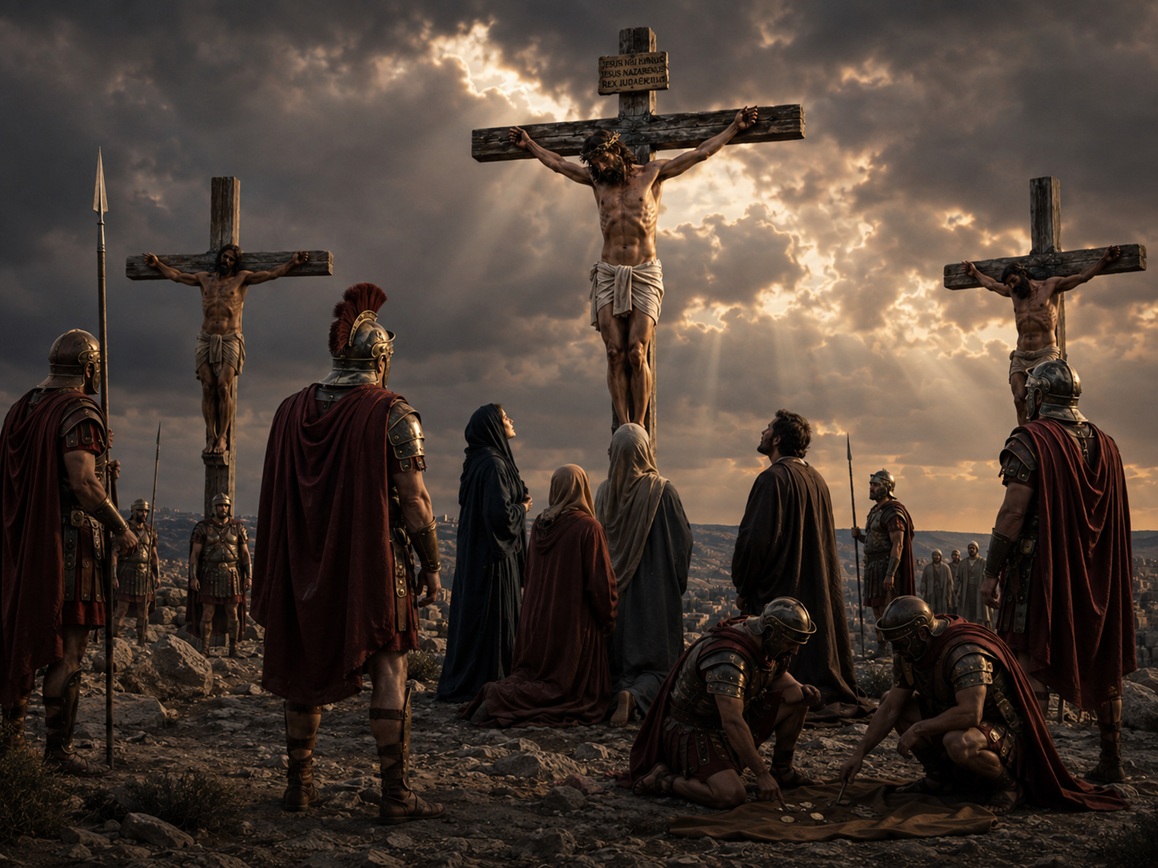
Torture Stake or Cross?

Golgotha

"And when they came to the place which is called The Skull, there they crucified him, and the criminals, one on the right and one on the left."

Every Sunday, in Catholic churches around the world, the faithful make the sign of the cross and lift their eyes to a crucifix. For Christians from the earliest centuries, the cross has been the central symbol of the faith — the sign of how the Lord laid down his life for the world.
Jehovah's Witnesses reject it. They teach that Jesus did not die on a cross at all, but on a single upright pole — a "torture stake", in the wording of their New World Translation — with his hands nailed together above his head. On their view the cross is not merely a historical mistake but a pagan emblem smuggled into a corrupted Christianity, so that those who venerate it are guilty of idolatry. The entire case turns on one Greek word, stauros, which they insist can mean only an upright stake.
So the question is a historical one, and it can be examined on the evidence: language, Roman practice, the New Testament text, archaeology, the earliest manuscripts, and the testimony of the earliest Christian writers. Did the stauros on which Jesus died have a crossbeam, or was it a bare pole?
  • Which account better fits the evidence: the Watchtower's torture stake, or the traditional cross?
I invite your engagement with me on these questions. You may leave comments below, but please be sure to read our policy on commenting before doing so.

Watchtower View

Jehovah's Witnesses hold that Jesus was not put to death on a cross, but on a single upright wooden pole — rendered "torture stake" throughout their New World Translation. On this view the cross is not the instrument of Christ's death at all, and the familiar two-beamed cross venerated by other churches is rejected.1

The argument rests primarily on a single Greek word. The Watchtower's Insight on the Scriptures states that the word stauros, rendered "torture stake" in their translation, "primarily denotes an upright stake, or pole, and there is no evidence that the writers of the Christian Greek Scriptures used it to designate a stake with a crossbeam." In support they cite John Denham Parsons' The Non-Christian Cross (1896), the Imperial Bible-Dictionary, and Hermann Fulda's The Cross and Crucifixion, each of which they take to show that the original sense of stauros — and of the Latin crux — was a plain upright pole.2

From this they conclude that, since the New Testament says Jesus died on a stauros, he died on a single vertical beam with his hands nailed together directly over his head, fixed by a single nail — the manner shown in Watchtower artwork and in the Justus Lipsius woodcut reproduced in earlier editions of the New World Translation.3

The Watchtower also presents a theological reason "why Jesus had to die on a stake." Citing Galatians 3:13 ("Accursed is every man hanged upon a stake") together with Deuteronomy 21:22–23, they argue that Jesus bore the curse of the Law by being hung upon a stake of wood, the Hebrew term there meaning simply a tree or wooden pole.4

Underlying the whole position is a further claim: that the cross is of pagan origin — an emblem they associate with pre-Christian sun-worship and even with phallic imagery — which entered a corrupted Christianity after the apostles and which faithful Christians must therefore reject as idolatry. For Jehovah's Witnesses, refusing the cross is part of keeping worship pure.5

The Reply in Brief

The Catholic reply is set out in full in the Catholic View panel and summarized in the Summary panel below. In brief: the argument freezes stauros at an ancient meaning it had long outgrown by the first century, when it was the ordinary Greek word for the Roman cross; the sources the Watchtower cites (Livy, Lucian, and others) say the opposite of what they are quoted to prove when read in full; and the New Testament's own details — the carrying of the crossbeam, the placard set above the head, and the plural nails in the hands — together with archaeology, the earliest manuscripts, and the unbroken witness of the earliest Christians, all point to a two-beamed cross. The Watchtower itself taught and wore the cross for more than fifty years before reversing the teaching under J. F. Rutherford.


Endnotes
  1. On the “torture stake” rendering throughout the New World Translation, see the NWT at Matthew 27:32–40, John 19:17–19, and elsewhere, and the article “Did Jesus Die on a Cross?” at jw.org. The teaching is summarized in Reasoning From the Scriptures (Watch Tower Bible and Tract Society of Pennsylvania, 1985, rev. 1989), pp. 89–93, under “Cross.”
  2. Insight on the Scriptures (Watch Tower Bible and Tract Society of Pennsylvania, 1988), vol. 2, under “Torture Stake”: the word “in classical Greek … primarily denotes an upright stake, or pole, and there is no evidence that the writers of the Christian Greek Scriptures used it to designate a stake with a crossbeam.” The supporting citations are John Denham Parsons, The Non-Christian Cross (London, 1896), pp. 23–24; the Imperial Bible-Dictionary, ed. P. Fairbairn (London, 1874), vol. 1, p. 376; and Hermann Fulda, Das Kreuz und die Kreuzigung (1878). All three are quoted selectively; see the Catholic View panel and the downloadable essay.
  3. On the single-nail depiction (both hands together above the head, one nail), see the illustrations in What Does the Bible Really Teach? (2005), p. 52, and earlier Watchtower publications. The Justus Lipsius woodcut of a crux simplex was reproduced in the Appendix to the 1950 and 1969 editions of the New World Translation and the Kingdom Interlinear Translation, with the caption stating “This is the manner in which Jesus was impaled” (altered in the 1984 edition). Lipsius in fact illustrated some sixteen forms of crucifixion, most with a crossbeam.
  4. On the “why Jesus had to die on a stake” argument from Galatians 3:13 and Deuteronomy 21:22–23, see Insight on the Scriptures (1988), vol. 2, under “Torture Stake,” and the article “Did Jesus Die on a Cross?” (jw.org). The NWT renders the relevant phrase “hanged upon a stake” (Gal. 3:13).
  5. On the cross as an alleged pagan emblem (associated with sun-worship and, in some Watchtower statements, with phallic symbolism) introduced into a corrupted Christianity, see Reasoning From the Scriptures (1989), pp. 90–92, and “Should You Use the Cross in Worship?” (The Watchtower). The charge of idolatry against those who venerate the cross is standard in the Society's literature. The historical and linguistic reply is given in the Catholic View panel.

Catholic View

© 2026 Richard Whiting. All rights reserved. May be reproduced in whole, with attribution. See the full notice at the end of this article.

I. The Claim, and Why It Matters

Jehovah's Witnesses hold that Jesus was not crucified on a cross at all, but executed on a single upright pole — a “torture stake,” in the language of their New World Translation — with his hands fixed together above his head by a single nail. The cross, on this view, is not merely a mistake but a pagan symbol smuggled into Christianity during its supposed apostasy, and those who venerate it are idolaters. The Watchtower puts its weight on one Greek word: stauros. Because in the classical Greek of Homer's day the word meant an upright stake, they conclude it can mean only that, and so the New Testament stauros on which Jesus died must have been a bare pole.1

As more than one writer on this question has observed, the shape of the instrument is not, in itself, a matter of salvation; what saves is that Christ died, not the carpentry of the thing he died on. The issue becomes worth answering only because the Watchtower has made it a test of true religion, using the cross as a marker to separate themselves from the rest of Christianity and to brand the historic Church as false. Once a claim is pressed that far, it deserves to be examined carefully — and when it is, it does not survive. The evidence of language, Roman history, archaeology, the New Testament text, and the earliest Christian writers converges on a single conclusion: the stauros of the first century routinely included a crossbeam, and Jesus died on a cross.

It is worth noting at the outset what kind of claim this is. The Watchtower offers, for the most part, no evidence at all — only the bare assertion that stauros means “stake.” Where it does cite ancient sources, it cites them selectively, and in at least two cases (the historian Livy and the satirist Lucian) it cites writers whose works, read in full, flatly contradict the point being made. The case that follows is built from the sources the Watchtower passes over.

II. The Linguistic Mistake: Words Change Meaning

The whole argument rests on a fallacy that linguists have a name for. To say that stauros must mean “stake” because that is what it meant eight hundred or more years before Christ is to assume that a word's oldest meaning is its only real meaning. It is not. Languages change over time — linguists call this the diachronic development of language — and the meaning of a word at one period is no guide to its meaning at another. As the Koine Greek scholar David Alan Black puts it, etymology used by itself cannot establish a word's sense, and “it is not legitimate to say that the ‘original’ meaning of a word is its ‘real’ meaning.”2

The point is easy to illustrate from English. The word “shuttle” once meant the small piece of wood a weaver passes back and forth across a loom. In the twentieth century it came to mean a bus running a fixed back-and-forth route; later still, a reusable spacecraft. To insist that NASA launched a wooden weaving instrument into orbit because that is what “shuttle” meant in the Middle Ages would be absurd. So would insisting that a person's computer “mouse” is a small rodent. Yet this is exactly the move the Watchtower makes with stauros: it freezes the word at its most ancient sense and ignores every later development.3

And the later development is not in doubt. The Greeks did not practice crucifixion; the Romans did. When Greek-speakers needed a word for the new Roman penalty, they did what every language does with a new thing — they took an existing word and gave it a new meaning. Stauros became the ordinary Greek term for the Roman cross, and stauroō the verb “to crucify.” The most authoritative lexicon of New Testament Greek, Bauer-Danker, gives “cross” as the meaning of stauros in this period. And the matter can be settled by simply looking: in modern Greek the word for “cross” is still stauros, and it is a cross, not a stake, that stands atop every Greek church.

III. What the Romans Actually Did

The decisive question is historical, not merely lexical: did the Romans of the first century use a two-beamed cross, and did they have a word for it? The answer to both is yes. Roman crucifixion grew out of two older practices fused together — the Phoenician execution-stake the Romans met in the Punic Wars, and a much older Roman punishment in which a condemned slave was made to carry a wooden crossbeam, the patibulum, through the streets while being whipped. When the two were combined, the victim no longer merely carried the crossbeam to his humiliation; he was nailed to it and hung from it.4

The vocabulary is precise and well attested. The upright beam, fixed in the ground at the place of execution, was the stipes or palus; the crossbeam the victim carried was the patibulum (or furca); the whole assembly was the crux. The Roman playwright Plautus, writing in the late third and early second century B.C. — two centuries before Christ — already describes all of it: the condemned man with “hands spread out and nailed to the patibulum,” made to “bear the patibulum through the city” and then “be nailed to the crux.” The two-beamed cross was not a later invention; it was Roman practice well before the New Testament era.5

This also disposes of a specific Watchtower claim. Their literature asserts that the Latin crux meant “a mere stake” even in the writings of the historian Livy. But Livy never says so. In all six places where Livy uses crux, he gives no description of its shape at all; and when he does mean a simple stake, he uses a different word, palus. The claim is not supported by the source cited for it — a pattern that recurs throughout the Watchtower's treatment of this subject.

IV. Stauros in the Greek Sources

What the Latin writers show for crux, the Greek writers show for stauros. By the first century stauros was the common Greek word for Roman crucifixion, and several writers are explicit that the thing had a crossbeam. The clearest is the satirist Lucian, in a comic courtroom scene in which the letter Tau is put on trial. Tau is condemned, the text says, because tyrants “taking his body as a model and imitating his shape” built the timbers on which men are crucified — and the device “is even named stauros after him.” The pun only works because the stauros was T-shaped.6

The same Lucian, elsewhere, describes the crucifixion of Prometheus with his hands stretched out “from crag to crag,” each hand nailed separately with its own nail — and calls the result a stauros. This is the very passage the Watchtower quotes in its own support, apparently without reading on to the lines that describe outstretched arms and two separate nails. The dream-interpreter Artemidorus is equally explicit: “the cross (ho stauros), like a ship, is made of wood and nails, and the ship's mast resembles a cross” — a comparison that only makes sense if the stauros, like a mast with its yard-arm, had a transverse beam.7

Beyond these explicit descriptions, a whole class of Greek texts refers to the condemned man carrying his stauros to the place of execution. Since no source anywhere describes a prisoner dragging a heavy upright pole — the upright was already planted in the ground — the thing carried can only be the crossbeam. The word stauros is used for exactly that. By the first century the term plainly covered the two-beamed cross.

V. The Witness of the New Testament

The Gospels are spare; they do not pause to describe the shape of the cross, because their first readers already knew what a Roman execution looked like. But several details, taken together, point unmistakably to a crossbeam.

First, the carrying of the cross. John says Jesus went out “carrying the cross by himself” (John 19:17), and the Synoptics say Simon of Cyrene was made to carry it behind him (Luke 23:26). The verb John uses, bastazō, is the same verb pagan writers use for carrying the patibulum. The thing carried to Golgotha was the crossbeam, exactly as in every other attested Roman crucifixion — never a bare upright pole, a practice for which there is no ancient evidence at all.8

Second, the placement of the charge. Matthew records that Pilate's inscription was set “above his head” (Matt. 27:37). On a simple stake, with the hands nailed above the head, there would have been no room above the head for a placard; the wording assumes an upright projecting above a crossbar — the familiar crux immissa. Commentators across traditions have drawn this inference from the text.9

Third, the testimony of Thomas, who speaks of seeing in Jesus' hands “the mark of the nails” — plural (John 20:25). Watchtower art shows both hands pinned together by one nail above the head; the text speaks of nails, in the plural, in the hands. Two outstretched hands, each nailed separately to a crossbeam, account for the wording exactly. The Watchtower has itself conceded that Thomas “could have meant a nail through each hand.”10

VI. The Witness of Archaeology and the Manuscripts

In 1968, in a burial cave at Giv'at ha-Mivtar in Jerusalem, archaeologists found for the first time the physical remains of a crucifixion victim — a man named Yehohanan, executed around A.D. 70, the era of the Gospels. The anatomist N. Haas, examining the bones, found the marks of nails driven through the forearms and the heel bones transfixed by a single spike. His reconstruction has the arms “stretched out, each stabbed by a nail in the forearm.” This is the most direct possible evidence of how a first-century crucifixion under Roman authority was carried out, and it shows outstretched, separately nailed arms — not hands pinned together overhead.11

The earliest Christian manuscripts give a second, independent confirmation. In the oldest surviving copies of the Gospels — papyri from around A.D. 175 to 250 — the scribes, when they wrote the word stauros, abbreviated it with a special device now called the staurogram: the Greek letters tau and rho superimposed, the tau forming the upright and crossbar of a cross and the loop of the rho suggesting the head of the crucified. These scribes lived when crucifixion was still practiced and knew well what the word meant. Their own shorthand for it was a picture of a cross.12

To this may be added the oldest surviving depiction of the crucifixion, the Alexamenos graffito scratched into a wall on the Palatine Hill in Rome around the turn of the third century. It is not a Christian image but a pagan mockery — a crucified figure with a donkey's head, arms spread wide on a crossbeam, captioned “Alexamenos worships God.” A hostile witness, drawing to ridicule, drew a cross. The shape was simply what everyone understood crucifixion to be.13

VII. The Witness of the Earliest Christians

The Watchtower's deeper claim is that the cross entered Christianity only later, as part of an apostasy. But the earliest Christian writers — well before Constantine — already describe the stauros as two-beamed, and they do so as something received, not newly invented.

The Epistle of Barnabas, written in the A.D. 130s — within about forty years of the Gospel of John — already treats the cross as tau-shaped, finding it prefigured in the Old Testament. Justin Martyr, around A.D. 150, describes the cross plainly as one upright beam with a second fitted across it, the ends projecting “like horns,” and sees it foreshadowed in the two crossed spits on which the Passover lamb was roasted. Irenaeus, about A.D. 180, is more precise still: the cross, he writes, “has five extremities, two in length, two in breadth, and one in the middle, on which the person rests who is fixed by the nails.” Five points — an upright, a crossbar, and a projecting top — describe the traditional cross exactly and a bare stake not at all.14

The same shape is presupposed by the universal early practice of tracing the sign of the cross. Tertullian, around A.D. 211, reports that Christians marked their foreheads with it “at every step and movement, at every going in and out,” and elsewhere identifies that sign with the Greek letter Tau; Hippolytus commends the same gesture. One does not trace a single vertical line as a recognizable sign; the habit only makes sense if the stauros had the cross shape these writers everywhere assume.15

This is the heart of the matter. If the two-beamed cross were a fourth-century corruption, it could not already be the settled, unargued assumption of Christian writers in the 130s, the 150s, and the 180s — men who treat it not as a novelty to be defended but as the obvious meaning of the word. The cross tradition is as old as the Christian literature itself.16

The very form of the cross, too, has five extremities, two in length, two in breadth, and one in the middle, on which last the person rests who is fixed by the nails.

— Irenaeus of Lyons, c. A.D. 180

The sign of the cross traced on the forehead, attested as a daily Christian habit by the early third century, presupposes the same shape.17

VIII. The Watchtower Once Taught the Cross

There is a final irony. For more than fifty years the Watchtower itself taught that Jesus died on a cross. Its founder, Charles Taze Russell, and his followers wore the cross-and-crown emblem as a lapel pin and carried it on the cover of The Watch Tower until 1931. Russell's associate J. F. Rutherford wrote in 1921 that “the cross of Christ is the greatest pivotal truth of the divine arrangement, from which radiate the hopes of men.” The organization depicted Jesus' death on a cross in its own publications and films, distributed to millions.18

The “torture stake” teaching was not the fruit of scholarship. It was introduced under Rutherford, who came to regard the cross as a pagan emblem and spent years purging it from the movement — removing it from the magazine cover in 1931 and recasting the manner of Jesus' death in his 1936 book Riches. By the organization's own account, the change was driven by a prior conviction that the cross was “Babylonish,” not by any new evidence about the first century. The history ran backwards: the conclusion came first, and the linguistic argument was assembled afterward to support it.

This raises a fair question on the Watchtower's own terms. In 1881 its founding generation declared that “a new view of truth never can contradict a former truth … ‘new light’ never extinguishes older ‘light,’ but adds to it.” Yet on the cross the later teaching did not add to the earlier one; it reversed it outright, turning the emblem of redemption that Russell prized into a symbol of Satan's organization. If a doctrine once held as “light” could be reversed so completely, the obvious question is how one is to know that today's teaching will not be overturned by tomorrow's.19

IX. Conclusion

The case for the “torture stake” rests on a single word, frozen at an ancient meaning it had long since outgrown, and on sources that — read in full — say the opposite of what they are quoted to prove. Set against it stands a remarkable convergence of evidence: the ordinary first-century sense of stauros in the lexicons; the explicit testimony of Plautus, Lucian, and Artemidorus that the Roman cross had a crossbeam; the New Testament's own details of cross-carrying, the placard above the head, and the plural nails in the hands; the physical remains of a crucified man with arms outstretched and separately nailed; the staurogram in the oldest manuscripts; the pagan mockery of the Alexamenos graffito; and the unbroken witness of Barnabas, Justin, Irenaeus, Tertullian, and the sign of the cross itself — all of it long before Constantine.

On a question of history, that is as decisive as such questions get. Jesus of Nazareth died, under Roman authority and by the ordinary Roman method, on a cross. The symbol that Christians have honored from the first century to the present is not a pagan intrusion but a faithful memory of how the Lord laid down his life. As Paul wrote — using the very word in dispute — “the message of the cross (ho stauros) is foolishness to those who are perishing, but to us who are being saved it is the power of God” (1 Cor. 1:18).


But far be it from me to glory except in the cross of our Lord Jesus Christ, by which the world has been crucified to me, and I to the world.

— Galatians 6:14


Copyright and Distribution

© 2026 Richard Whiting. All rights reserved.

This essay may be reproduced and distributed freely, in printed or electronic form, provided that it is reproduced in whole and without alteration, and that the author's name is retained. Excerpts may be quoted in reviews, scholarly works, or other writings consistent with fair use, with attribution. For any other use, including translation, adaptation, or partial republication beyond fair use, please contact the author.


Endnotes
  1. The New Testament was composed in Koine Greek, the common dialect of roughly 300 B.C. to A.D. 300, not the classical Greek of Homer's era. On the meaning of stauros in New Testament times, the standard reference is Walter Bauer, Frederick W. Danker, et al., A Greek–English Lexicon of the New Testament and Other Early Christian Literature, 3rd ed. (Chicago: University of Chicago Press, 2000), 941, which gives “cross” as the meaning in this period. The Watchtower's own primary authority for the “stake” reading is John Denham Parsons, The Non-Christian Cross (London, 1896), a non-specialist work of self-published advocacy, not a lexicon.
  2. David Alan Black, Linguistics for Students of New Testament Greek (Grand Rapids: Baker, 1988; 2nd ed. 1995), 122: the original meaning of a word is not necessarily its “real” meaning, and etymology used alone cannot establish current sense. The phenomenon is what linguists call the diachronic development of language. To fix stauros at its Homeric sense is an instance of what James Barr called the “root fallacy” (The Semantics of Biblical Language, Oxford, 1961).
  3. In modern Greek the word for “cross” remains stauros (σταυρóς) — not “pole” — as any Greek church, surmounted by a cross rather than a stake, plainly shows. The parallel examples of English “shuttle” and “mouse” (words whose dominant sense shifted entirely over time) are drawn from Trevor R. Allin, “Did Christ Die on a Cross or a Stake?” (2013, rev. 2014).
  4. On the origins of Roman crucifixion as a fusion of Phoenician practice with the older Roman patibulum-bearing punishment, see Martin Hengel, Crucifixion in the Ancient World and the Folly of the Message of the Cross (Philadelphia: Fortress, 1977), and Gunnar Samuelsson, Crucifixion in Antiquity (Tübingen: Mohr Siebeck, 2011). The description of patibulum-bearing is in Dionysius of Halicarnassus, Roman Antiquities 7.69.1–2; cf. Plutarch, Coriolanus 24.4–5.
  5. Plautus (c. 254–184 B.C.) repeatedly pairs the crux with the patibulum (crossbeam) carried by the condemned: Miles Gloriosus 359–360; Mostellaria 55–57, 359–360; Carbonaria fr. 2. The Watchtower's claim that Livy used crux to mean a mere stake is unsupported: in all six occurrences in Livy the word is undescribed, and where Livy means a simple stake he writes palus (Roman History 28.29.11). See the analysis in “Leolaia,” “Facts on Crucifixion: stauros, Torture Stake,” citing Packard's Concordance to Livy, 1011.
  6. Lucian of Samosata (c. A.D. 125–after 180), Trial in the Court of Vowels (Lis Consonantium) 12, where the letter Tau is condemned because tyrants “taking his body as a model and imitating his shape” fashioned the timbers on which men are crucified, the device being named stauros after the letter's form. In Prometheus 1–2, Lucian describes Prometheus crucified with hands outstretched “from crag to crag,” each hand nailed separately — the very text the Watchtower cites in its own favor, though it disproves their claim.
  7. Artemidorus Daldianus (second century A.D.), Oneirocritica 2.53: “For the cross (ho stauros), like a ship, is made of wood and nails, and the ship's mast resembles a cross.” Cf. 2.56 on the victim carrying the stauros (i.e., the patibulum) beforehand, and 1.76 on the “outstretched hands” of the crucified.
  8. John 19:17, “carrying the cross by himself” (bastazōn heautō ton stauron); cf. Luke 23:26 and Mark 15:21. The verb bastazō is the same used by Chariton (Chaereas and Callirhoe 4.2.6–7) and Artemidorus of carrying the patibulum. No ancient source ever describes a prisoner dragging a bare upright pole; the attested practice is the carrying of the crossbeam to an upright already fixed in the ground.
  9. Matthew 27:37, the charge placed “above his head” (epanō tēs kephalēs autou), which on a simple stake — with the hands nailed above the head — would have left no room for it. See J. H. Bernard, A Critical and Exegetical Commentary on the Gospel According to St. John (Edinburgh: T&T Clark, 1929), 2:628, who infers the crux immissa from this detail, “with a cross-bar for the arms, as painters have generally represented it.”
  10. John 20:25. The plural “nails” (hēlōn) is most naturally explained by the separate nailing of each outstretched hand, as on a crossbeam; a single upright with the hands together overhead would require but one nail. The Watchtower itself later conceded that Thomas “could have meant a nail through each hand” (The Watchtower, 15 August 1987, 29).
  11. N. Haas, “Anthropological Observations on the Skeletal Remains from Giv'at ha-Mivtar,” Israel Exploration Journal 20 (1970): 38–59. The remains of Yehohanan, a man crucified near A.D. 70 and recovered in 1968, show (in Haas's reconstruction) that “the upper limbs were stretched out, each stabbed by a nail in the forearm” — the first physical remains of a crucifixion victim ever found, and direct evidence of outstretched, separately nailed arms.
  12. On the staurogram (the tau-rho ligature used to abbreviate stauros/staur– in the earliest manuscripts, the tau forming the cross and the loop of the rho the head), see Larry W. Hurtado, “The Staurogram in Early Christian Manuscripts,” in New Testament Manuscripts, ed. T. J. Kraus and T. Nicklas (Leiden: Brill, 2006), 207–226. It appears in Papyri 66 and 75 (c. A.D. 175–200) and Papyrus 45 (c. 250), all in reference to the crucifixion.
  13. The Alexamenos graffito, discovered on the Palatine Hill in Rome in 1857, depicts a crucified figure with a donkey's head, arms outstretched on a transverse beam, mocked by the caption “Alexamenos worships God.” Dated to the late first to early third century (most often the early third). A hostile, non-Christian witness, it shows the crucified Christ on a cross, not a pole. Cf. Jack Finegan, Light from the Ancient Past (Princeton: Princeton University Press, 1959), 373.
  14. Epistle of Barnabas 9:7–8 (c. A.D. 130s), which finds the cross prefigured in the tau-shaped numeral (300, Greek T) of Genesis 14:14. That a Christian writer within roughly forty years of the Fourth Gospel already assumed a two-beamed stauros is strong evidence the word bore that sense from the first.
  15. Justin Martyr, Dialogue with Trypho 40 (the Passover lamb roasted on two crossed spits as a figure of the cross) and 91; and First Apology 55, describing the cross as one upright beam with a second fitted across it, the ends projecting like horns. Justin wrote c. A.D. 150–160.
  16. Irenaeus of Lyons, Against Heresies (Adversus Haereses) 2.24.4 (c. A.D. 180): the cross “has five extremities, two in length, two in breadth, and one in the middle, on which the person rests who is fixed by the nails.” The five-point description requires a crossbeam and a projecting upright, i.e., the crux immissa, and a bare stake not at all.
  17. Tertullian, De Corona 3 (c. A.D. 211): “At every step and movement, at every going in and out … we trace upon the forehead the sign” of the cross; and Adversus Marcionem 3.22, identifying that sign with the Greek Tau. Hippolytus, Apostolic Tradition 42, commends the same practice. One does not trace a single vertical line as a recognizable sign; the gesture presupposes a cross-shaped instrument.
  18. On the Watchtower's own earlier use of the cross, see Joseph F. Rutherford, The Harp of God (1921), 141 (“The cross of Christ is the greatest pivotal truth of the divine arrangement”), and the cross-and-crown emblem carried on The Watch Tower cover until the issue of 15 October 1931. The “torture stake” teaching was introduced under Rutherford, beginning in 1928 and formalized in Riches (1936), 27.
  19. The Watch Tower, February 1881, 3: “A new view of truth never can contradict a former truth … ‘New light’ never extinguishes older ‘light,’ but adds to it.” The reversal on the cross — from emblem of redemption to “pagan” symbol — is difficult to reconcile with that principle, and raises the question how one is to know that today's teaching will not likewise be overturned tomorrow.

Summary

The shape of the instrument on which Jesus died is not, in itself, a matter of salvation — what saves is that Christ died. The question is worth answering only because the Watchtower has made the "torture stake" a test of true religion and a reason to brand the historic Church as idolatrous. When the claim is examined, it does not survive.

The whole case rests on one word, frozen in time. The Watchtower argues that stauros must mean "stake" because that is what it meant in the classical Greek of Homer's day. But languages change; a word's oldest meaning is not its only meaning. By the first century stauros was the ordinary Greek word for the Roman cross — the meaning given by the standard lexicon (Bauer-Danker) — just as in modern Greek stauros still means "cross," and it is a cross, not a stake, atop every Greek church.

The Romans used a two-beamed cross, and had words for its parts. The upright fixed in the ground was the stipes or palus; the crossbeam the victim carried was the patibulum; the whole was the crux. The playwright Plautus describes all of it two centuries before Christ.

The Watchtower's own sources contradict it. It claims Livy used crux to mean a mere stake; Livy never describes its shape, and uses palus when he means a stake. It quotes Lucian's Prometheus in support, yet that passage describes hands stretched out "from crag to crag," each nailed separately; Lucian elsewhere says the cross is named after the T-shaped letter Tau. Artemidorus compares the stauros to a ship's mast with its crossbeam.

The New Testament points to a crossbeam. Jesus carried his cross (John 19:17) — the attested practice was carrying the crossbeam to an upright already planted, never dragging a bare pole. The charge was placed above his head (Matt. 27:37), which assumes an upright projecting above a crossbar, not hands nailed at the top of a stake. And Thomas saw the mark of the nails — plural — in Jesus' hands (John 20:25), which fits two outstretched hands nailed separately, not one nail through both. The Watchtower itself conceded Thomas "could have meant a nail through each hand."

Archaeology and the manuscripts agree. The remains of Yehohanan, a man crucified near A.D. 70 and found in 1968, show the arms outstretched and separately nailed through the forearms. The oldest Gospel papyri (c. A.D. 175–250) abbreviate stauros with the "staurogram," a tau-rho ligature that pictures a cross. The Alexamenos graffito — a pagan mockery from around A.D. 200 — draws the crucified figure with arms spread on a crossbeam.

The earliest Christians describe a cross, not a stake. Barnabas (A.D. 130s), Justin Martyr (c. 150), and Irenaeus (c. 180) all describe a two-beamed cross — Irenaeus naming its "five extremities" — as the settled, unargued meaning of the word, long before Constantine. A shape that is already obvious to writers in the 130s cannot be a fourth-century corruption. The early habit of tracing the sign of the cross presupposes the same shape.

The Watchtower once taught the cross. For more than fifty years the organization used the cross-and-crown emblem and taught that Jesus died on a cross; Rutherford called it "the greatest pivotal truth of the divine arrangement" in 1921. The "torture stake" teaching was introduced later, under Rutherford, out of a prior conviction that the cross was "pagan" — not from any new evidence about the first century. Since the organization's founders said "new light never extinguishes older light, but adds to it," the outright reversal raises a fair question: how is one to know today's teaching will not likewise be reversed?

In short: a single word frozen at an outdated meaning, propped up by sources that say the opposite when read in full, stands against the converging witness of language, Roman history, the New Testament text, archaeology, the earliest manuscripts, and the earliest Christian writers. On a question of history, the conclusion is as secure as such questions get: Jesus died, under Roman authority and by the ordinary Roman method, on a cross. As Paul wrote — using the very word in dispute — "the message of the cross (ho stauros) … is the power of God" (1 Cor. 1:18).