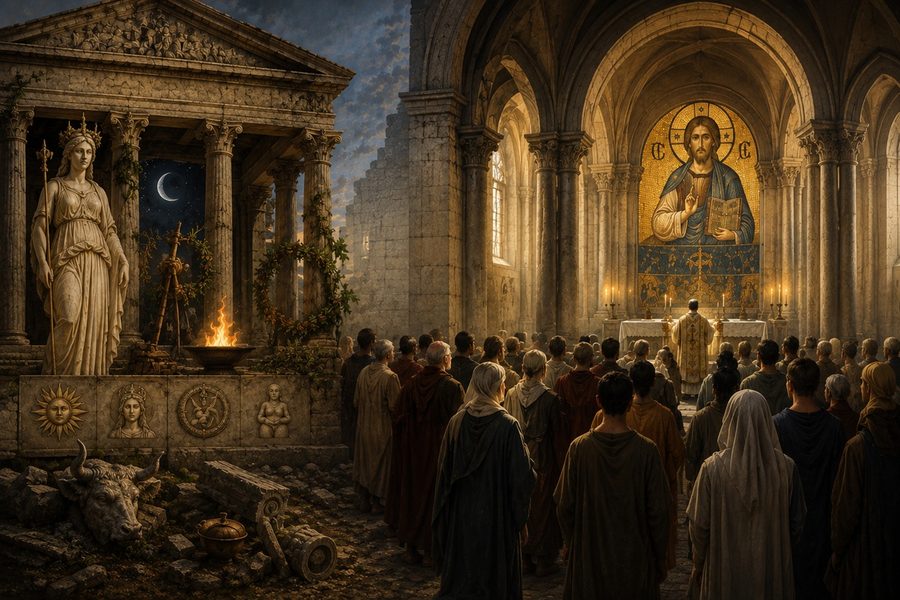
Pagan Origins?

“One man esteems one day as better than another, while another man esteems all days alike. Let every one be fully convinced in his own mind … He who observes the day, observes it in honor of the Lord.”

Jehovah’s Witnesses do not keep Christmas or Easter. The reason given is not that Scripture forbids them — it does not mention them — but that they are pagan in origin: December 25 was a Roman sun festival, Easter takes its name from a fertility goddess, the tree comes from the groves of Jeremiah 10. A Christian who keeps such days, the argument runs, is offering God a worship He never asked for and has already refused.

The holidays are only the visible edge of it. The same charge is brought against the Trinity, said to be assembled out of pagan triads; against the immortal soul, said to be Plato’s rather than Moses’; against hellfire, the cross, incense, holy water, vestments and images; and against the honors paid to Mary, above all the title Queen of Heaven, which Jeremiah condemns by name. The claim is not that the Church picked up a few bad habits. It is that she is paganism continued under Christian names.

The argument has two joints, and both are worth testing. The first is historical: are the origins what the claim says they are? The second is moral: if a custom did once belong to somebody else, does that settle what it means when a Christian does it now?

On the first, the history has moved a long way from the version in the pamphlets, and it has moved in an unexpected direction — not least because so much of that version descends from a single Victorian book, The Two Babylons, whose own most successful popularizer checked its sources and then spent a later book refuting it. On the second, the New Testament takes up the question directly, and the answer it gives the first-century Church is not the answer the Watchtower gives.

A note on what this page leaves out. Jehovah’s Witnesses also refuse birthdays, and that refusal is not treated here. Its ground is thinner than the case against the holidays — two birthdays in Scripture happen to end badly, and that is very nearly the whole of the biblical argument — and the rule has been softening for some years. It seems likely to me that the prohibition will be quietly dropped, as others have been, and there is little profit in arguing at length against a rule that may not outlive the argument. What follows is about the holidays, about the wider charge against Catholic doctrine and practice, and about the reasoning used to condemn them both.

Let’s take the history first, and then the principle, and ask …

  • Did the Church take December 25 from a pagan feast, and does the origin of a custom decide what it means when a Christian keeps it in honor of the Lord?
  • And if a resemblance to something pagan is enough to convict a practice, what happens to the incense, the lamps, the vestments and the washings that God Himself commanded for the Tabernacle?

I invite your engagement with me on these questions. You may leave comments below, but please be sure to read our policy on commenting before doing so.

Watchtower View

Jehovah’s Witnesses hold that Christmas and Easter are not Christian at all. Both, they teach, are pagan festivals wearing Christian names — taken over by an apostate Church that had already abandoned the faith of the apostles — and a Christian who keeps them is worshipping as the nations worship, which God has always refused.

What They Affirm

Scripture never commands it, and never records it. The Bible nowhere tells Christians to celebrate Christ’s birth, gives no date for it, and shows no first-century congregation doing so. What the apostles were told to commemorate was his death, not his birth (Luke 22:19; 1 Cor. 11:24–26). A festival unknown to the apostles cannot be apostolic Christianity.1

December 25 is a sun-god festival. The date belonged to the Roman feast of the Sol Invictus, the “Unconquered Sun,” and to the season of the Saturnalia, with its feasting, gift-giving and licence. The Church did not discover the date; it adopted a pagan one, to make conversion easy for pagans who were reluctant to give up their holiday.2

The Gospel account rules out December. Luke says the shepherds were “out in the field, keeping watch over their flock by night” (Luke 2:8). December in Judea is cold and rainy; flocks were under cover. The registration that brought Joseph to Bethlehem would not have been ordered in midwinter either. Christ was not born on the day the Church keeps.3

Easter is named for a goddess. The very name betrays it: Easter comes from Eostre, an Anglo-Saxon goddess of spring and fertility, whose symbols were the egg and the hare — both still attached to the festival, and neither having anything to do with the resurrection. Rabbits and coloured eggs are fertility emblems, not Christian ones.4

The tree is condemned by name. Jeremiah describes the custom of the nations: “a tree from the forest … they deck it with silver and gold; they fasten it with hammer and nails so that it cannot move” (Jer. 10:3–4). Evergreens, holly and mistletoe were sacred to pagan worship long before they stood in Christian houses.5

And it is not only the holidays. The same corruption runs through Catholic doctrine and practice. The Trinity was assembled out of pagan triads; the immortal soul is Plato’s, not Moses’; hellfire is the pagan underworld rebaptized; the cross was the sign of Tammuz long before it stood on a church. The incense, holy water, vestments, candles and images are the furniture of the temples, carried over intact. And Mary is the old mother-goddess renamed — given even the title Jeremiah condemns by name, the “queen of heaven,” to whom the women of Judah baked cakes and poured out drink offerings (Jer. 7:18; 44:17–19). Christmas is one symptom of a general return to Babylon.6

God rejects worship He has not asked for. This is the settled principle behind the whole refusal. Israel was told not to serve the Lord in the manner of the nations (Deut. 12:30–31); Nadab and Abihu offered fire God had not commanded and died for it (Lev. 10:1–2); Aaron’s golden calf was proclaimed “a feast to the Lord” and was idolatry regardless (Ex. 32:5). Sincerity does not sanctify a borrowed rite. “Come out from them, and be separate” (2 Cor. 6:17).7


Endnotes
  1. On the absence of any scriptural warrant for celebrating Christ’s birth, see “Should Christians Celebrate Christmas?” and “What Does the Bible Say About Christmas?” (jw.org), which note that the Bible gives no date, records no such celebration by the early Christians, and commands the memorial of Christ’s death instead.
  2. On the December 25 date as pagan in origin, see “Christmas Customs—Are They Christian?” (jw.org) and the article “Christmas” in Insight on the Scriptures (Watch Tower, 1988), which connect the date to the Roman Saturnalia and the birthday of the unconquered sun, and describe the Church as accommodating pagan converts.
  3. The shepherds argument appears in “Was Jesus Born on December 25?” (jw.org), citing Luke 2:8 and the rainy season in Judea.
  4. On the name and symbols of Easter, see “Easter or the Memorial—Which Should You Observe?” (jw.org) and Insight on the Scriptures, art. “Easter,” deriving the English name from the Anglo-Saxon Eostre and identifying eggs and hares as fertility symbols.
  5. Jeremiah 10:3–4 is regularly cited in this connection; see “Christmas Customs—Are They Christian?” (jw.org) on trees, holly, mistletoe and the yule log.
  6. On the wider claim that Catholic doctrine and practice are pagan in origin, see Babylon the Great Has Fallen! God’s Kingdom Rules! (Watch Tower, 1963), and the articles “Trinity,” “Soul” and “Torture Stake” in Insight on the Scriptures (Watch Tower, 1988). The framework was drawn in large part from Alexander Hislop, The Two Babylons (1858), a work the Society formerly recommended and distributed.
  7. On the principle that God rejects worship of pagan derivation however sincerely offered, see “Why Don’t Jehovah’s Witnesses Celebrate Certain Holidays?” (jw.org), citing Deuteronomy 12:30–31; Exodus 32:1–8; and 2 Corinthians 6:14–17.

Catholic View

Two things must be shown for the charge to hold: that the customs came from paganism, and that coming from paganism would settle what they mean now. The first is doubtful history. The second is answered in the New Testament, and not in the Watchtower’s favour.

One concession first, because it costs nothing. Scripture does not command Christmas, gives no date for the Nativity, and records no apostolic celebration of it. All true, and beside the point: Scripture does not command the Memorial be held once a year after sundown on Nisan 14 by a body governed from Warwick either. The question is not whether a practice is commanded but whether it is forbidden, and the answer given to the early Church was explicit.

Where the Charge Comes From

It is worth knowing where the particulars come from, because they come very largely from one book. Alexander Hislop, a Free Church of Scotland minister, published The Two Babylons in 1858, under a subtitle that states the thesis without ambiguity: The Papal Worship Proved to Be the Worship of Nimrod and His Wife. On his account the Catholic Church is not a corruption of Christianity but a continuation of the Babylonian mystery religion — Nimrod, his wife Semiramis and their son Tammuz surviving as a counterfeit trinity, with Mary as Semiramis, and the Mass, the mitre, the rosary, the round host and the feasts all Babylonian articles smuggled forward under Christian names.1

The method is association by resemblance without restraint: words from unrelated languages treated as cognates because they sound alike, medieval vestments compared with pagan headgear, and bare assertions — that Nimrod was born on December 25, that the ornaments are Babylonian — cited later as though established. And the book has a difficulty at its center that no detail can repair. Semiramis is a historical figure, the Assyrian queen regent Sammu-ramat of about 811–808 B.C.; Nimrod belongs to the early chapters of Genesis. They are separated by more than a millennium, and no ancient source anywhere describes the marriage on which the whole system rests. The central couple of The Two Babylons were never a couple.

This is not a Catholic complaint about an unfriendly book; Hislop is rejected by scholars of the ancient Near East generally, and by conservative Protestant scholars as firmly as by anyone. The most telling witness is not Catholic at all. Ralph Woodrow, an American evangelist, popularized Hislop in Babylon Mystery Religion (1966), which sold a quarter of a million copies. Years later he went back to the sources, found the parallels and etymologies would not survive examination, took his own successful book out of print at his own cost, and published its refutation as The Babylon Connection? in 1997.2

The Society promoted and distributed Hislop’s book and drew on its framework for decades. As his reputation collapsed the direct citations thinned, but the arguments were absorbed and now circulate with the author’s name removed — which is worth saying without malice, because a Witness explaining at the door that the mitre is the fish-head of Dagon is repeating a Victorian pamphleteer whom scholarship abandoned long ago, and whose most effective popularizer publicly repudiated him.

The Date Came From a Calculation, Not a Festival

The December 25 date has a documented derivation that has nothing to do with the sun. Ancient Jewish tradition held that a prophet died on the same day he was conceived or born — the “integral age.” Early Latin Christians, working hard to fix the date of the Crucifixion, settled on 25 March. Applying the integral-age principle, that became the date of the Annunciation, the conception of Christ. Nine months from 25 March is 25 December.3

The date is a conclusion drawn from a calculation about Good Friday. This is why the Church still keeps the Annunciation on 25 March, exactly nine months before Christmas: the two dates are one calculation, and the arithmetic is visible in the calendar to this day.

The Sun Feast Came Later

The chronology runs the wrong way for the accusation. 25 December had no religious significance in the Roman pagan calendar before the emperor Aurelian, who reigned from 270 to 275, and the cult of the sun was not prominent at Rome before him. The Christian reckoning was already in circulation. It is at least arguable, and has been argued by scholars, that the feast of the Sol Invictus was created as a pagan counter-attraction to a date the Roman Christians already observed.4

Notice also what is missing. If the Church had decided to schedule the Nativity against a pagan festival, some Christian somewhere would have said so — and the Fathers were not a reticent people. No such statement exists. The accusation rests on an inference, and its modern form traces to a Protestant scholar of the eighteenth century, Paul Ernst Jablonski, who was cataloguing what he took to be the paganizing of the Church. It is not ancient testimony. It is a theory about ancient testimony.5

The Shepherds Were Where They Should Be

The argument from Luke 2:8 assumes shepherds would not be in the fields in December. In the Levant that is backwards. Sheep are short-day breeders: they mate as daylight shortens in autumn, and with a gestation of about five months, lambing in Israel, Jordan and Syria falls in December and January. Shepherds keep watch through the night precisely at lambing, when the flock most needs them. Far from excluding a winter birth, the detail fits it.6

None of which proves Christ was born on 25 December. The Church has never claimed the date as certain, and nothing in the faith depends on it. It shows only that the confident objection is not as strong as it sounds.

“Easter” Is an English Problem

The name argument is an accident of language. In Greek the feast is Pascha; in Latin Pascha; in French Pâques, Italian Pasqua, Spanish Pascua, Dutch Pasen, Danish Påske — the Passover, in every case. Only English and German use anything else. A feast celebrated for centuries across the Christian world under the name of the Passover did not derive from a goddess whose name reached it in one corner of northern Europe, late, and in one language.7

The goddess herself is thinly attested. Our single early source is Bede, writing in the eighth century, who says the Anglo-Saxons named a month after her; no other ancient writer mentions her, and some scholars doubt she existed at all. Whatever the truth of that, the feast is older than the English word for it by centuries.8

What Jeremiah Was Talking About

Jeremiah 10 is about carving idols. The passage describes a workman felling a tree, shaping it with a tool, plating it with silver and gold, and fastening it upright so it will not topple — and then the prophet says of the finished thing that it must be carried because it cannot walk, and cannot speak, and can do neither harm nor good (Jer. 10:5). That is an idol on its plinth, not a fir tree with candles. Nobody prays to a Christmas tree, asks it for rain, or fears its displeasure. The decorated tree itself is a German custom of the sixteenth century, some two thousand years after Jeremiah wrote.

Origin Does Not Fix Meaning

Suppose every historical claim in the accusation were true. The argument would still fail, because the New Testament faced exactly this question and answered it. The Corinthians asked about meat that had been offered in a pagan temple — genuinely pagan in origin, no dispute possible. Paul’s answer is that “an idol has no real existence” and the meat is nothing in itself (1 Cor. 8:4). Buy it and eat it, he says, raising no question of conscience (1 Cor. 10:25). He restricts this only out of charity toward a weaker brother, never because the food carried contamination from its past.

On days he is blunter still, and it is the passage the whole controversy turns on: “One man esteems one day as better than another, while another man esteems all days alike. Let every one be fully convinced in his own mind … He who observes the day, observes it in honor of the Lord” (Rom. 14:5–6). The one thing forbidden is to make the observance a test of fellowship: “let no one pass judgment on you in questions of food and drink or with regard to a festival” (Col. 2:16). A rule that divides the Church over days is the thing Paul actually prohibits.

The Rule Nobody Can Keep

Applied consistently, the principle consumes far more than Christmas. The names of the weekdays honour Norse and Roman gods; Sunday is the day of the Sun, and Witnesses meet on it. January is Janus’s month, March is Mars’s, and the Watchtower dates its literature by them. The wedding ring has a documented pagan pedigree and is worn. Even the Memorial is kept on a date fixed by a calendar the Babylonians shaped during the exile.

The rule is not applied to these because it cannot be. What is left is a principle invoked where it is wanted and set aside where it is not, which is not a principle but a preference.

The Wider Charge: Doctrine, Image and Title

The calendar is the visible edge of a much larger accusation, and the same method drives all of it: observe a resemblance, infer a derivation. Biblical scholarship has a name for the habit — Samuel Sandmel called it “parallelomania” in 1962 — and the objection is not that parallels are never real but that resemblance by itself establishes nothing about descent.9 Two religions may wash before prayer, burn something fragrant and set a light before a holy place because human beings are the same everywhere, not because one copied the other.

And the method has a consequence its users have not noticed: turn it on the Old Testament and it destroys the religion God gave Israel. The Tabernacle had an altar of sacrifice, a holy place and a holy of holies, a lampstand kept perpetually burning (Ex. 25:31–40), incense compounded to a fixed formula and burned twice daily (Ex. 30:1–8), a priesthood in linen with turban, ephod and jeweled breastpiece (Ex. 28), ritual washings at a bronze laver (Ex. 30:17–21), water of purification mixed with ashes (Num. 19), and a festal calendar reckoned by new moons. Every one of these has a close parallel in the ancient Near East, and every one was commanded by God Himself in detail. If parallels prove paganism, God gave Israel a pagan religion.

With that in hand the particulars answer quickly. Pagan triads are three gods, which is polytheism; the doctrine of the Trinity is one God in three Persons, a formula no polytheism ever produced. The immortality of the soul is said to come from Plato, but the Christian hope is the resurrection of the body — the one doctrine Greek philosophy found ridiculous, and it was laughed at on exactly that ground at Athens (Acts 17:32). The cross is said to be the sign of Tammuz, yet the earliest evidence is Christian and early: Tertullian describes Christians tracing it on the forehead before the year 200, and a pagan scratched the Alexamenos graffito on the Palatine at about the same date to mock a Christian for worshipping a crucified man. The Church’s enemies knew what she venerated.

The charge that presses hardest concerns Mary, because here the accusation can point to a phrase Scripture condemns by name. Jeremiah denounces the women of Judah for baking cakes for the “queen of heaven” and pouring out libations to her (Jer. 7:18; 44:17–25), and that queen is a real goddess, Ishtar or Astarte. Catholics call Mary Queen of Heaven. The inference looks irresistible — until one asks what the two titles mean.

Jeremiah’s queen of heaven receives sacrifice: cakes made in her image, incense, drink offerings poured out. That is worship, and offering it to anyone but God is precisely what the Church means by idolatry. Mary is offered no sacrifice. There is no Mass said to Mary and no petition addressed to her that is not a request for her prayers — the same request Christians make of one another (Jas. 5:16), made to someone the Lord has told us is alive, since “he is not God of the dead, but of the living” (Matt. 22:32).

The title itself is not from Babylon but from the throne room of David. In the kingdom of Judah the queen was not the king’s wife but the king’s mother, the gebirah, and she held a recognized office: when Bathsheba comes to Solomon the king rises, bows to her, and has a throne set at his right hand (1 Kings 2:19). To call Mary queen is therefore to say something about her Son — that He is the son of David and reigns — and her title is wholly derivative of His.10

One last point disposes of the whole class of arguments from shared vocabulary. Baal is simply the Hebrew for lord or master. Scripture calls God “Lord” on nearly every page while denouncing the Baals in the same breath, and Hosea plays on the collision deliberately: “you will call me, ‘My husband,’ and no longer will you call me, ‘My Baal’” (Hos. 2:16). A shared word is not a shared identity — and the same holds for Theotokos, God-bearer, which was defined at Ephesus in 431 to settle a question about Christ rather than about His mother: if the one born of Mary is a single Person who is God from the first instant, then His mother is the mother of God, and to deny the title is to divide Christ in two.

The Reply in Brief

The charge needs two things to be true, and it has neither. The history is not what it assumes: the date descends from a calculation about the Crucifixion rather than from a festival, the sun feast is fifty years later than the Christian reckoning, and no ancient Christian anywhere says the Church timed the Nativity against a pagan rite. Much of the remaining material descends from Hislop’s The Two Babylons, a book whose central couple never existed.

And the principle fails even where the history holds, which is the half that matters. Paul faced the question in its hardest form — meat sacrificed that week in a temple — and ruled that the idol is nothing, that the day may be kept to the Lord, and that no one is to be judged over a festival. Nor can the test be applied evenly: run it consistently and it convicts the Tabernacle first, whose incense, lamps and vestments God commanded and every one of which has a pagan parallel.

The full essay sets out the calculation hypothesis and its sources at length, Hislop’s method and Woodrow’s repudiation of it, the evidence for and against the Eostre goddess, the documented history of the Christmas tree, Paul on temple meat and on the keeping of days, the Fathers and Augustine on the Christian use of what the nations made, and the Watchtower’s own shifting record — Christmas having been kept at Bethel until 1926.


Endnotes
  1. Alexander Hislop, The Two Babylons: The Papal Worship Proved to Be the Worship of Nimrod and His Wife (pamphlet 1853; expanded edition 1858). Semiramis is the Assyrian queen regent Sammu-ramat, c. 811–808 B.C.; no ancient source links her to Nimrod or describes the marriage on which Hislop’s system depends.
  2. Ralph Woodrow, Babylon Mystery Religion (1966), withdrawn from print by its author, and The Babylon Connection? (1997), which sets out in detail why Hislop’s parallels, etymologies and quotations do not survive examination.
  3. On the “integral age” tradition and the derivation of 25 December from 25 March, see William J. Tighe, “Calculating Christmas,” Touchstone (December 2003). The 25 March dating of the Passion is attested in the West by the early third century.
  4. Tighe, “Calculating Christmas”: 25 December “had no religious significance in the Roman pagan festal calendar before Aurelian’s time, nor did the cult of the sun play a prominent role in Rome before him.” Aurelian reigned 270–275; his feast of the Sol Invictus is dated to 274.
  5. The derivation of Christmas from a pagan feast in its modern form goes back to Paul Ernst Jablonski (1693–1757). No patristic source states that the Nativity was timed to coincide with a pagan festival.
  6. Sheep are short-day (negative photoperiod) breeders, mating as daylight decreases in autumn; with a gestation of roughly 150 days, lambing in Israel, Jordan and Syria falls in December and January, as recorded by the Food and Agriculture Organization of the United Nations. Shepherds keep night watch at lambing rather than in the mating season.
  7. Greek and Latin Pascha; French Pâques, Italian Pasqua, Spanish Pascua, Portuguese Páscoa, Dutch Pasen, Danish and Norwegian Påske, Swedish Påsk, Welsh Pasg — all from the Hebrew pesach. Only English and German depart from it.
  8. Bede, De temporum ratione (A.D. 725), ch. 15, is the sole early witness to Eostre, and says only that the Anglo-Saxons named a month for her. No other ancient source mentions the goddess; some scholars hold that Bede inferred her from the month-name, while others defend her existence from place-names and personal names. The feast itself is attested from the second century, long before the English word.
  9. Samuel Sandmel, “Parallelomania,” Journal of Biblical Literature 81 (1962): 1–13, on the extravagance of inferring dependence from resemblance.
  10. On the queenship of Mary and the Davidic gebirah, see Pius XII, Ad Caeli Reginam (1954), and Catechism of the Catholic Church §§966, 971. On the distinction between the adoration due to God alone and the honor paid to the saints, see Catechism §§2096–2097.

Summary

Jehovah’s Witnesses refuse Christmas and Easter as pagan in origin. The charge needs two things to be true: that the customs came from paganism, and that such an origin would decide what they mean now. The history is not what the charge assumes, and the New Testament settles the principle the other way.

Most of the case descends from one discredited book. Alexander Hislop’s The Two Babylons (1858) argued that the Catholic Church is the Babylonian mystery religion continued. Its central couple, Nimrod and Semiramis, were never a couple — she is an Assyrian queen of about 811 B.C., a millennium too late — and its etymologies are invented. Ralph Woodrow, who popularized it to a quarter of a million readers, checked the sources, took his own book out of print, and published its refutation. The Society distributed Hislop for decades; the arguments survive with his name removed.

The date came from a calculation about Good Friday. Ancient Jewish tradition held that a prophet died on the day he was conceived. Early Latin Christians fixed the Crucifixion at 25 March, which therefore became the date of the conception of Christ; nine months later is 25 December. The Church still keeps the Annunciation on 25 March, exactly nine months before Christmas — the arithmetic is still visible in the calendar.

The sun feast is later, and nobody in the Church ever mentions it. 25 December had no significance in the Roman pagan calendar before Aurelian (270–275), so the borrowing may well run the other way — a pagan counter-attraction to a date Roman Christians already kept. And had the Nativity been scheduled against a pagan festival, someone would have written it down; the Fathers were not a silent people. The accusation in its modern form dates to the eighteenth century.

The shepherds argument runs backwards. Sheep in the Levant mate as the days shorten and lamb in December and January, and shepherds keep night watch at lambing, not in the mating season. Luke’s detail fits a winter birth rather than excluding it — which does not prove the date, but the confident objection is weaker than it sounds.

“Easter” is an accident of English. The feast is Pascha in Greek and Latin, Pâques in French, Pasqua in Italian, Pascua in Spanish — the Passover, everywhere. Only English and German use anything else, and the goddess Eostre rests on a single eighth-century sentence in Bede. The feast is older than the English name for it by centuries.

Jeremiah 10 is about idols. The passage describes a carved image plated with metal and fastened upright so it will not topple, which then must be carried because it cannot walk and can do neither harm nor good. That is an idol on its plinth. Nobody prays to a Christmas tree, and the decorated tree is a German custom of the sixteenth century.

Origin does not fix meaning — and Paul says so. Grant every historical claim and the argument still fails. Meat offered in a pagan temple was pagan beyond dispute, and Paul’s ruling is that “an idol has no real existence” and the food is nothing in itself (1 Cor. 8:4). On days he is plainer still: “He who observes the day, observes it in honor of the Lord” (Rom. 14:5–6). What he forbids is making it a test of fellowship — “let no one pass judgment on you … with regard to a festival” (Col. 2:16).

The rule cannot be applied consistently. The weekdays are named for Norse and Roman gods, Sunday for the sun, January for Janus; the wedding ring has a pagan pedigree; the Memorial falls on a date set by a calendar the Babylonians shaped. None of these is refused. A principle invoked where it is wanted and dropped where it is not is a preference wearing a principle’s clothes.

The same method would condemn the Tabernacle. The charge reaches past the calendar to the Trinity, the soul, the cross, incense and images. But God Himself commanded a lampstand kept burning, incense burned twice daily, a vested priesthood, ritual washings and a calendar of new moons (Ex. 25–30; Num. 19), and every one of these has a pagan parallel. If resemblance proved derivation, God gave Israel a pagan religion.

“Queen of Heaven” is a Davidic title, not a Babylonian one. Jeremiah’s queen of heaven receives sacrifice — cakes, incense, libations poured out (Jer. 7:18) — which is worship, and is what the Church calls idolatry. Mary is offered none of it; what is asked of her is her prayers. And in Judah the queen was the king’s mother, the gebirah, enthroned at his right hand (1 Kings 2:19). The title says her Son reigns. A shared phrase proves nothing anyway: Baal means “lord,” and Scripture calls God Lord on every page.

In short: the pagan-origins case is weaker in history than it looks and fails in principle even where it holds. A Christian who kneels on 25 December before the God who became a child is not worshipping the sun.