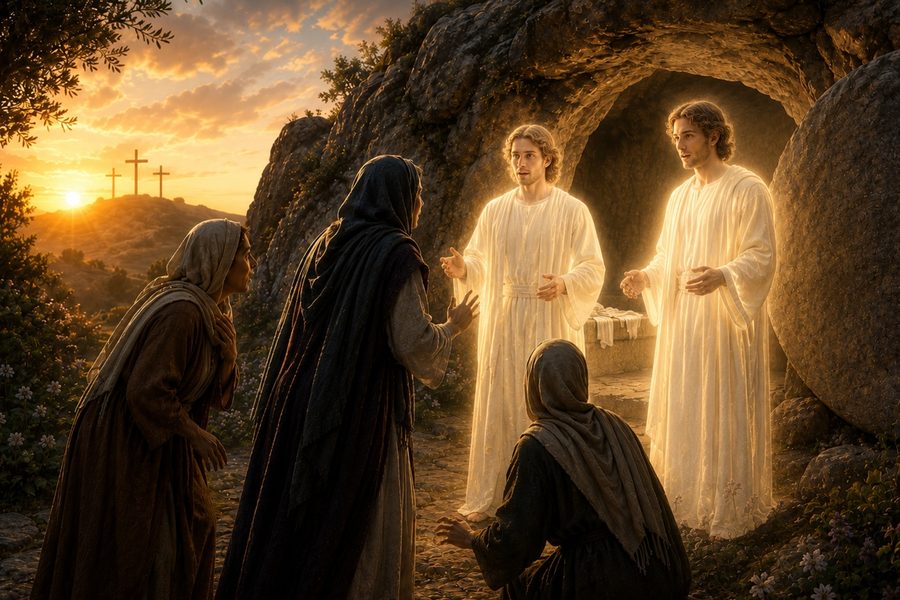
The Christian answer accepts the skeptic’s framing gladly,
because the resurrection is the one article of faith that presents
itself as a checkable event. Paul states the stakes in the founding
document itself: “if Christ has not been raised, then our
preaching is in vain and your faith is in vain”
(1 Cor. 15:14). What follows is not a proof — history
does not deal in proofs — but a case that facts most scholars grant — some nearly all, the empty tomb a strong majority — are explained by the resurrection and by nothing
else yet proposed.
A Creed Older Than the Gospels
The objection from late sources breaks against the earliest one. In 1 Corinthians 15:3–6, written about AD 55, Paul recites a formula he “received” and “delivered” — the technical vocabulary of tradition. The demonstration that this is an older creed embedded in the letter goes back to Joachim Jeremias and is now common property of the discipline. It can be dated: Paul was converted about AD 33, went up to Jerusalem three years later, and spent a fortnight with Peter and James — two of the named witnesses (Gal. 1:18). As William Lane Craig puts it, “the list of witnesses goes back to within the first five years after Jesus’ death.” The proclamation is not a legend that grew over generations; it is the founding announcement, recited while the people it names could still be asked. Paul says so himself: of the five hundred who saw at once, “most… are still alive” — a remark with no point except as an invitation to check.1 Two limits belong on the record. The dating is not universal — not every scholar ties Paul’s reception of the creed to the Jerusalem visit — but even the cautious proposals leave it within two decades of the event and inside the witnesses’ lifetimes, which is all the argument needs. And only Paul mentions the five hundred; the Gospels do not. That appearance rests on a single early source which names itself as tradition and invites verification, and it is weighed here at that value.
The Empty Tomb
The tomb’s discoverers are women, whose testimony carried little legal weight in that culture; no inventor would have chosen witnesses who discredited the story in advance. The criterion has been questioned — women were not barred from all testimony, and a narrator might have had reasons of his own for the detail — so it is weighed here as one strand among several, not as proof. The narrative is plain to the point of dryness, without the apologetic flourish the later apocryphal gospels supply. Behind Mark stands an older source still, which refers to the high priest without naming him — as one speaks of the man currently in office — placing it within Caiaphas’s tenure, within seven years of the crucifixion. The resurrection was proclaimed first in Jerusalem, minutes’ walk from the tomb, before audiences with every motive to refute it; the movement could not have survived a body. And the earliest counter-story on record — that the disciples stole the body (Matt. 28:11–15) — is known only through Matthew, so it is not an independent Jewish source; but even as Matthew reports it, it shows the shape of the first dispute: theft, not a tomb still occupied. On that report the first argument was not over whether the body was gone, only over how.2
Paul’s silence about the tomb is the argument from the wrong direction: his creed says Christ “was buried” and “was raised,” and to a Pharisee that sequence means the grave was vacated — a “resurrection” leaving the body in place would not have been a resurrection in his vocabulary at all. The creed’s “on the third day” most plausibly preserves the very day the women found it empty.
Appearances That Resist the Vision Theory
The appearances came to individuals and to groups, indoors and out, to grieving women and to men who had given up — and at least twice to unbelievers: James, the Lord’s brother, and Paul, the persecutor. Hallucinations are private events; they do not come to five hundred at once. They strike the bereaved and expectant, not enemies. And they leave tombs occupied: a vision, in a Jewish frame, would have meant precisely that the man was dead — exalted perhaps, but not risen. The disciples’ own first response to the women is preserved without flattery: “these words seemed to them an idle tale, and they did not believe them” (Luke 24:11). These are not portraits of men primed to see what they longed to see.3
A Belief Without Precedent
The deepest puzzle is the belief itself. N. T. Wright’s survey of the ancient world yields a double result: paganism had no category for bodily resurrection — ghosts and visions, yes; returned bodies, never — and Judaism had the category but not the timing, a resurrection of all the righteous at history’s end, never of one man in its middle. Nobody was expecting this. A crucified messiah was a refuted messiah; every comparable movement of the period either scattered or found a new messiah in the family. This one proclaimed, at once and in Jerusalem, that God had raised its founder. Beliefs that unprecedented do not condense out of grief; something produced it, and the historian is obliged to ask what.4
The Trajectory, and the Discrepancies
The growth-of-legend argument reads the four Gospels in canonical order and watches the risen body grow more solid from Mark to John. But legends grow in time, and the texts refuse the timeline: the earliest resurrection text of all, the creed of 1 Corinthians 15, already lists more appearances than any Gospel — to Peter, to the Twelve, to five hundred at once — within a few years of the event, while Mark, written decades later, narrates none. If physicality were legend accreting, the leanest account should be the oldest; instead the fullest is. And Mark’s spare ending knows what it is not narrating: “he is going before you to Galilee; there you will see him” (Mark 16:7). The short ending is a literary fact about one book, not an early stage of a growing story.
The discrepancies — how many women, how many angels, Galilee or Jerusalem — are real, and they are the ordinary signature of independent testimony. Witnesses who agree in every detail have compared notes; witnesses who differ in the seams while agreeing on the event have not. Every strand has the tomb found empty, found by women, on the third day, with appearances following — and the variations sit precisely where honest memories vary. Galilee and Jerusalem is not even a contradiction: forty days leave room for both, and the accounts place appearances in both. A Church editing freely would have smoothed all this; that nobody did is why the seams still show.
The Alternatives, Each in Turn
Theft founders on the transformation and deaths of the alleged conspirators, and on the fact that the charge, as Matthew reports it, explains an empty tomb rather than denying one. The swoon theory asks a scourged, speared, half-dead man to present himself as the conqueror of death; Strauss buried it a century and a half ago. Hallucination fails on the groups, the enemies, and the tomb. Legend fails on the creed: not because legends never grow quickly, but because this one would have had to grow in the one city and generation able to check it, with the witnesses alive to object. Each theory can be patched by borrowing from the others, but a hypothesis assembled from four failed ones inherits their failures.5
Hume’s Bar, Reconsidered
There remains the in-principle objection: grant every fact, and is an unknown natural cause not still likelier than a miracle? Two answers. First, Hume’s rule is not an argument from evidence but a rule for ignoring it: if no testimony could establish a miracle even in principle, the verdict preceded the witnesses. Uniform experience that dead men stay dead is what the Christian claim asserts too — that is what makes the event a sign — and invoking that uniformity as disproof assumes the question at issue. Second, the probability of a resurrection depends on what else is true. If there is no God, Hume wins. But whether there is a God is the question argued across this whole section — and if there is, a resurrection is not a random violation but a purposeful act, and its probability is no longer governed by the frequency of corpses reviving. Hume’s own test invites the comparison: which is more miraculous — an act of God, or a collective hallucination striking enemies and skeptics, coincident with a body’s unexplained disappearance, issuing in a belief without precedent? The skeptic may still answer “the latter.” He is not entitled to call it the neutral verdict of history. Nor is the resurrection one wonder-story among the world’s many, to be credited or dismissed as a class: rival claims characteristically surface late, far from the events, in devotional literature, with no hostile audience to check them — this one was proclaimed within years, in the city, by named witnesses who could be questioned and were, and the earliest counter-story on record explained an empty tomb rather than denying one. That is the difference in kind. Even the ablest opponent fixed the floor: Antony Flew — the century’s foremost philosophical atheist, who never accepted the resurrection — judged its evidence “better than for claimed miracles in any other religion … outstandingly different in quality and quantity.”6
And Yes, He Existed
Mythicism deserves one paragraph. Tacitus records the execution under Pilate; Josephus mentions Jesus twice, once in a core that survives every critical pruning and once in passing as the brother of James. The refutation has come as vigorously from the skeptical side of the field as the believing one — Ehrman wrote a book against it. The scholars best placed to judge, whatever they think of the resurrection, do not take it seriously.7
What rose — how the thing raised relates to the thing buried
— is its own question with its own opponent, and it is
answered on the
companion page against the Watchtower’s spirit-resurrection
teaching. The two support each other: the empty tomb is
evidence about what rose, and the glorified body explains why the
appearances were what they were.
A word to the reader who came here from the Watchtower pages. You were taught that the body laid in the tomb was disposed of by God and that Jesus rose as a spirit who materialized bodies to be seen; the companion page on the Watchtower’s teaching takes that up from the texts. What matters here is narrower. Every argument on this page, from the creed of the 50s to the empty tomb, stands whether or not you ever trusted the organization that taught you about it, and losing that trust is not evidence about what happened on the third day.
This is the concise case. The full essay adds Hume’s argument in his own words and at length, the dating of the pre-Markan passion source, the fate of the era’s other messianic movements, and complete documentation. It is available as a Word document at the end of this page.
Endnotes
- 1 Corinthians 15:3–8, RSV. Joachim Jeremias’s demonstration and the dating through Galatians 1:18 are set out in William Lane Craig, “Contemporary Scholarship and the Historical Evidence for the Resurrection of Jesus Christ,” Truth 1 (1985), from which the quoted sentence comes. ↩
- William Lane Craig, “The Historicity of the Empty Tomb of Jesus,” New Testament Studies 31 (1985), 39–67 — eight lines of evidence, summarized here — and “The Guard at the Tomb,” New Testament Studies 30 (1984), 273–281, on the polemic’s history of assertion and counter-assertion. ↩
- Luke 24:11, RSV. On the psychology of the witnesses and the failure of the subjective-vision hypothesis, see the essay, sections V and VII. ↩
- N. T. Wright, “Jesus’ Resurrection and Christian Origins,” Gregorianum 83/4 (2002), 615–635; at full length, The Resurrection of the Son of God (Fortress, 2003). ↩
- D. F. Strauss, A New Life of Jesus (1865), vol. 1, §48, on the swoon theory; summarized here. ↩
- Hume’s sentences are quoted in full in the skeptic’s panel, from the critical text at davidhume.org. For the book-length case that his argument fails on its own probabilistic terms, see John Earman, Hume’s Abject Failure (Oxford, 2000), cited on the miracles page, where the argument is treated in its own right. Flew’s estimate: Flew and Habermas, “My Pilgrimage from Atheism to Theism,” Philosophia Christi 6.2 (2004), 209 — given while explicitly declining to affirm the resurrection. ↩
- Tacitus, Annals 15.44; Josephus, Antiquities 18.3.3 and 20.9.1; Bart Ehrman, Did Jesus Exist? (HarperOne, 2012). ↩