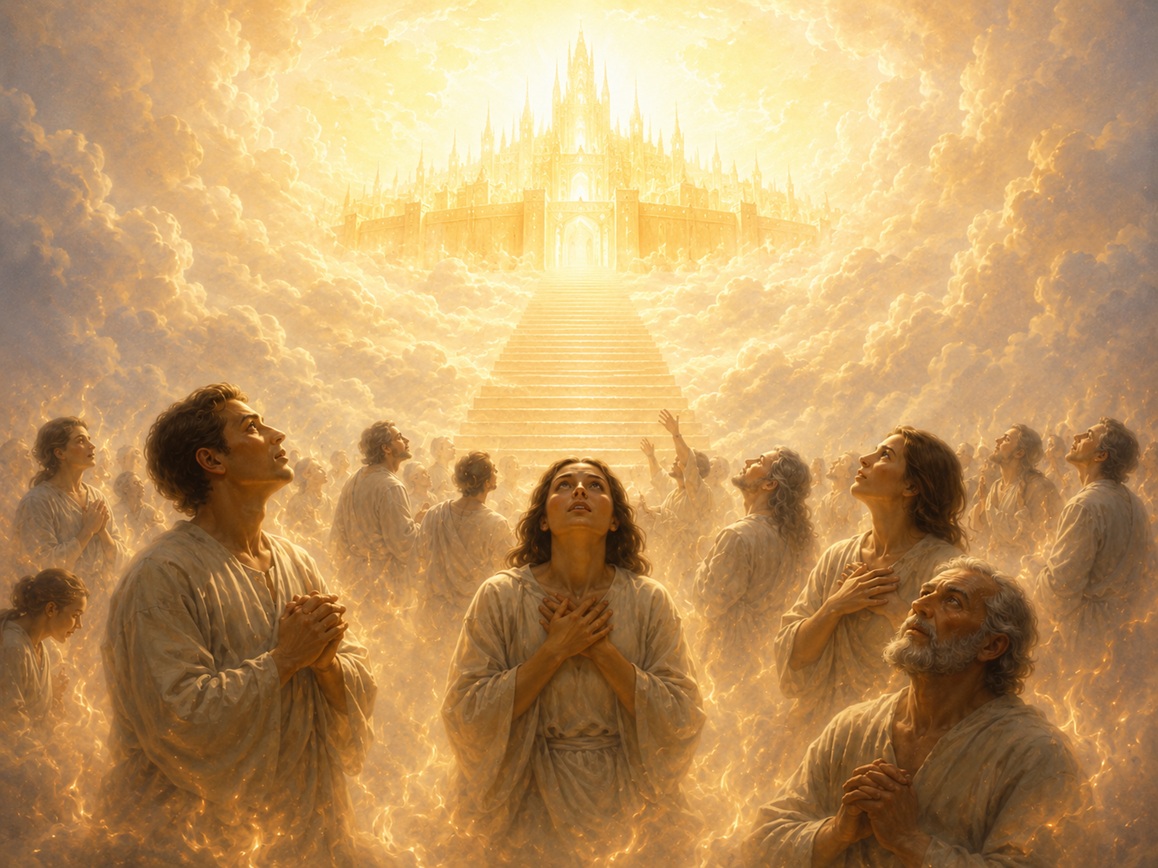
The Catholic Church teaches that those who die in God’s grace
but imperfectly purified undergo a
final purification of the saved
before entering heaven. The Watchtower rejects it, but chiefly
because it has first denied that anyone survives death to be
purified. Grant the survival of the soul (argued on the
companion page) and purgatory ceases to be merely possible
and begins to look necessary, for reasons drawn from two things
Scripture states plainly.1
What It Is, and What It Is Not
Three things in the definition are easy to miss and essential. Purgatory is only for the saved: everyone in it died in grace and friendship with God, and every soul there is infallibly bound for heaven. Not one will be lost. It is a purification, not a trial: no one’s eternal fate still hangs in the balance, and it is not a second chance for the unrepentant, whose state is fixed at death. And it is therefore not a third place between heaven and hell but the threshold of heaven: the antechamber where those destined for glory are made ready for it. Whatever the fire of purgatory is, it is not the fire of the damned but the fire of a love that finishes what it began. Benedict XVI taught exactly that: “the fire which both burns and saves is Christ himself, the Judge and Saviour” — a “blessed pain, in which the holy power of his love sears through us like a flame” (Spe Salvi 47).2
The Watchtower’s Answer, Examined
The Watchtower’s case rests on four claims: the word is absent from Scripture; the blood of Jesus “cleanses us from all sin” (1 John 1:7); the dead are unconscious and so cannot be purified; and “the wages of sin is death” (Rom. 6:23). The first is answered by a rule this site applies everywhere — the absence of a word is not the absence of a teaching, as “Trinity” and “Governing Body” both attest — and the second is taken up below in Not Against the Cross, but From It. The two that remain get their answers here.3
Third, the unconscious dead. Here the article reasons: “A person who has died cannot feel anything and therefore cannot be cleansed by any fire of purgatory.” Notice the premise doing all the work — that the dead are unconscious. That is not a finding of Scripture but the Watchtower’s own doctrine of the soul, the very point in dispute, so the argument is circular: it refutes purgatory only for a reader who has already accepted the Watchtower’s anthropology. And the premise is not scriptural in any case. Paul expects that to depart is to “be with Christ” (Phil. 1:23) and that to be away from the body is to be “at home with the Lord” (2 Cor. 5:8); John sees the souls of the martyrs awake beneath the altar, crying out for judgment (Rev. 6:9–10); and the Lord Himself says that God “is not God of the dead, but of the living” (Matt. 22:32). Ecclesiastes 9:5, taken as a doctrine of the grave, is the mail carrier’s reading again: the address correct, the household unknown. That reading is answered in full on the companion page What Is the Soul?4
Last, the wages of sin. From “the wages of sin is death” (Rom. 6:23) the article concludes that death is sin’s full punishment, leaving nothing for purgatory to do. But punishment and purification answer different questions: punishment concerns the guilt of sin; purification concerns what sin has done to the sinner — the disordered attachments and half-healed habits it leaves behind. A debt can be paid in full while the damage is still being repaired. The fuller exegesis, including Romans 6:7 and the connection to imputed versus infused righteousness, is in the essay.5
Nothing Unclean, and No One Perfect
The strongest argument is not from a proof-text but from two truths Scripture sets side by side. First, nothing unclean enters heaven: “nothing unclean shall enter it” (Rev. 21:27), and “without holiness no one will see the Lord” (Heb. 12:14). Second, most of the saved do not die perfectly holy. They die in grace, truly God’s friends, but with disordered attachments, half-healed wounds, small sins unrepented, the work of sanctification real but unfinished.
Put those together and the conclusion follows on its own. If nothing unclean can enter heaven, and yet the saved who die imperfectly purified are truly going there, then something must lie between their death and their entrance: a purification completing what was unfinished. That necessary something is what the Church calls purgatory. Deny it and one must either lower the holiness heaven requires or despair of the imperfect. Affirm it and both are honored. The doctrine is not an awkward addition to the gospel but a consequence of taking two of its plainest statements seriously at the same time.6
Saved, but as Through Fire
Paul supplies the nearest thing in Scripture to a description, and
its limits should be stated: the passage is about the testing of
builders’ work on the Day, not a map of the afterlife. Writing of the day of judgment, he says each person’s lifework will be tested by fire: “if the work that anyone has built on the foundation survives, he will receive a reward. If anyone’s work is burned up, he will suffer loss, though he himself will be saved, but only as through fire” (1 Cor. 3:14–15).
Read the description carefully, because it fits nothing else. Here is a man who is saved, so this is not hell, from which no one is saved. Yet he suffers loss and passes through fire, so this is not heaven as anyone conceives it, for in heaven there is no loss to suffer and nothing left to burn away. Paul is describing a third thing: a saved man passing through a purifying fire that consumes his worthless work while he himself comes through to glory. It is not a doctrine of purgatory; it is the shape of one — a salvation that is certain, reached through a cleansing.7
Forgiveness in the Age to Come
Christ drops a quiet but telling hint. Warning of the gravity of blasphemy against the Holy Spirit, He says it “will not be forgiven, either in this age or in the age to come” (Matt. 12:32). The phrasing repays attention. To say that a particular sin is forgiven in neither age implies that some sins may be forgiven in the age to come; the qualification would be pointless if no sin could ever be forgiven after death. Augustine and Gregory the Great drew exactly that inference. This is not a second chance for the damned but the loosing of lesser debts in those already bound for heaven.8
Prayer for the Dead
A further witness comes from practice rather than argument. After a battle, Judas Maccabeus has sacrifices offered in Jerusalem for his fallen soldiers, “that they might be delivered from their sin,” and the writer commends it: “it is a holy and wholesome thought to pray for the dead, that they may be loosed from sins” (2 Macc. 12:44–46).
The Watchtower does not accept that book as canonical, and the argument does not require that it should. Even read purely as history, the passage records what faithful Jews believed and practiced before Christ, and the logic of the practice is what matters. One does not pray for the dead in heaven, who need no help, nor for the dead in hell, who are beyond it. Prayer for the dead makes sense only if there is a state in which the dead can still be assisted toward final purity. That practice became universal in the early Church, whose catacomb inscriptions and earliest liturgies are full of prayers for the departed, and neither Christ nor the apostles ever rebuked it.9
Not Against the Cross, but From It
The serious objection remains: that purgatory detracts from the finished work of Christ, as though His sacrifice had left something for us to pay. The answer is that purgatory does not add to the cross; it applies it. The purification is not a rival source of salvation but the final stage of the one salvation Christ won: the completion, in the believer, of the holiness the cross purchased for him.
Consider the parallel. Nobody says that growth in holiness during this life (the slow and often painful work of being conformed to Christ) detracts from the cross. It flows from it (Phil. 2:12–13). Purgatory is that same sanctification carried to completion in those for whom it was unfinished at death. The fire is the fire of Christ’s own purifying love, and it cleanses by His merits and not the soul’s own. “The blood of Jesus cleanses us from all sin” (1 John 1:7) is not a text against purgatory but a description of how purgatory works.10
The Abuse Was Real, and What It Proves
The objection with the most history behind it is the traffic in indulgences, and the first thing a Catholic should say is that the charge is true. Men sold what cannot be sold; relief for the dead was hawked like grain; and the scandal was great enough that the Council of Trent abolished the office of the pardoner outright. The Church’s own judgment on that trade is not gentler than Wittenberg’s.
But notice what the objection assumes. Luther’s theses of 1517 attack the sale while presupposing the souls: they argue about what an indulgence can and cannot do for the dead in purgatory, and the eighty-second asks why the pope, if he can free souls, does not empty purgatory “for the sake of holy love.” An abuse does not abolish the thing abused, or the Lord’s Supper would have ended at Corinth, where it was being profaned by drunkenness and contempt for the poor (1 Cor. 11:20–22). Paul’s remedy was to correct the abuse and keep the sacrament. Trent’s was the same.
Death, Then Judgment: What Comes in Between?
The Protestant case leans hardest on Hebrews 9:27: it is appointed for men to die once, and after that comes judgment. Read as excluding purgatory, the verse has to be doing more work than it says. It denies reincarnation (one death, not many) and it affirms that judgment follows. It says nothing whatever about the interval, and a purification that is the working out of that judgment does not contradict it.
The same holds for Paul’s longing to depart and be with Christ (Phil. 1:23), and for being away from the body and at home with the Lord (2 Cor. 5:8). Both are true on the Catholic account, which is why the Church says the souls in purgatory are among the saved and certain of heaven. Purgatory is not a third destination alongside heaven and hell; it is the doorway of one of them. A man being made ready to see God is already Christ’s and already going home.
What the Orthodox Ask, and What Rome Defined
One more voice belongs in this conversation, because it is not a Protestant voice. The Orthodox East has prayed for the dead from antiquity and prays for them still — in every Divine Liturgy, in the memorial services appointed at set days after a death, in the whole fabric of Eastern piety. On the practice, and on the reality it presupposes — that the faithful departed can be helped by the prayers of the living — East and Rome stand together against the Reformation. What the Orthodox have objected to is the Latin packaging: a material fire, a mapped third place, the satisfaction arithmetic of the medieval schools, and the indulgence machinery that grew beside it.
Set the objection against what Rome actually defined, and it grows quiet. The union decree of Florence — negotiated with the Greeks in the room — is deliberately spare: if the truly penitent die in God’s love before making satisfaction by worthy fruits of repentance, “their souls are cleansed after death by cleansing pains; and the suffrages of the living faithful avail them in giving relief from such pains” — masses, prayers, almsgiving. No fire, no geography, no duration, no ledger: every image the East distrusts is imagery the definition never canonized, and the Catechism today is just as reserved. On the dogma itself — purification after death, aided by the Church’s prayer — the two ancient communions say the same thing, and the quarrel turns out to be with the medieval imagination, not the definition.11
The Reply in Brief
That the word is absent from Scripture settles nothing; so are “Trinity” and “omnipresent.” What Scripture does contain is a man saved “as through fire,” a Lord who distinguishes sins forgiven in this age from sins forgiven in the age to come, a people praying that their dead may be loosed from sin, and two fixed truths (that nothing unclean enters heaven, and that the saved do not all die spotless) which admit of only one reconciliation.
Rightly seen, the doctrine is among the gospel’s tenderest mercies. It means God’s answer to the imperfect is not rejection but readiness: He will not turn away the friend who dies still flawed, but will finish in him the good work He began (Phil. 1:6). Purgatory is the love of God refusing to leave His children half-made.
This is the short answer. The full treatment adds the patristic and liturgical evidence in detail, the development of the doctrine and what the Councils of Lyons, Florence, and Trent actually defined, the distinction between the guilt of sin and its temporal effects, what indulgences are and are not, the Eastern Christian understanding of the same reality, and full documentation for everything asserted here. It is available as a Word document at the end of this page.
Endnotes
- The Watchtower’s rejection follows from its denial of the soul’s survival: if the dead are unconscious, there is no one to purify. That prior question is treated on the companion page What Is the Soul?, and the two stand or fall together. ↩
- Catechism of the Catholic Church §§1030–1032: purgatory is the final purification of “all who die in God’s grace and friendship, but still imperfectly purified,” so that they may “achieve the holiness necessary to enter the joy of heaven.” The Church has defined that purgatory exists and that the souls there are helped by the prayers of the faithful; she has not defined its duration or the nature of its fire. The burns-and-saves passage is Benedict XVI, Spe Salvi (2007), 47, quoted exactly with the encyclical’s British spellings. ↩
- “Is Purgatory Mentioned in the Bible?” (jw.org), quoted more fully, with citations, in the left panel; its quotations of Scripture are from the New American Bible. ↩
- Phil. 1:21–23; 2 Cor. 5:6–8; Rev. 6:9–10; Matt. 22:31–32. Ecclesiastes 9:5 is the Preacher’s observation of life “under the sun” — what death looks like from the mortal side — not a doctrinal pronouncement on the soul; the companion page linked in the text takes up the exegesis. ↩
- On the death in view in Rom. 6:3–11: “all of us who have been baptized into Christ Jesus were baptized into his death” (v. 3), and the baptized are to consider themselves “dead to sin and alive to God” (v. 11). On imputed versus infused righteousness, see the companion page linked in the text. ↩
- Revelation 21:27 and Hebrews 12:14 on the holiness heaven requires. The argument is a deduction rather than a proof-text: given both that nothing unclean enters heaven and that the saved do not all die perfectly purified, some purification between death and entrance is entailed. ↩
- 1 Corinthians 3:10–15. The man in view is saved, so the passage cannot describe hell; he suffers loss and passes through fire, so it cannot describe heaven as entered. The Fathers read it of a purification after death; see Augustine, Enchiridion 69, and City of God 21.26. ↩
- Matthew 12:32, with the inference drawn by Augustine, City of God 21.24, and Gregory the Great, Dialogues 4.39: that a sin forgiven in neither age implies some are forgiven in the age to come. ↩
- 2 Maccabees 12:44–46. The book is deuterocanonical and not received by the Watchtower; the argument here does not depend on its canonicity, since even as a historical record it attests the belief and practice of faithful Jews before Christ. On the early Christian practice, see the catacomb inscriptions and the intercessions for the dead in the earliest liturgies, together with Tertullian, On Monogamy 10, and Cyril of Jerusalem, Catechetical Lectures 23.9. ↩
- On purgatory as the application rather than the supplement of Christ’s work, see CCC §1031 and the parallel with sanctification in this life at Philippians 2:12–13. The purification is worked by Christ’s merits; the soul contributes nothing of its own. ↩
- Council of Florence, bull of union Laetentur Caeli (6 July 1439); the quoted clause is from the decree’s statement on the departed. On Orthodox prayer for the dead, Timothy Ware (Kallistos), The Orthodox Church, on the departed and the memorial services. CCC §§1030–1032 defines the doctrine with the same reserve — purification, not geography. The related machinery of indulgences is treated on its own page. ↩