The Catholic claim is that Christ founded a visible Church with
officers, that those officers were empowered to appoint others, and
that the office has never lapsed. From that follows everything
else: a college of bishops who teach with His authority, and among
them a successor of Peter who holds the keys. Those are distinct
claims, and the evidence for each is different: that the office
was handed on is the best attested; that Peter’s see holds a
primacy is the next; what that primacy’s scope is, and when
it may not err, was defined last and is argued on its own pages. The case does not
begin with a medieval council. It begins with what the apostles
themselves did in the ten days after the Ascension.
The Office Outlived the Man
Judas died, and the eleven did not treat the number as reduced by one. Peter stands up, applies a psalm to the situation, “his office let another take” (Ps. 109:8), and they elect Matthias in his place (Acts 1:15–26). The Greek word Peter quotes is episkope: the overseership, the bishopric. Before a word of the New Testament was written, the apostles had established that what Christ gave them was an office, and that an office outlives the man holding it.1
That is the whole principle in one paragraph, and it is worth noticing where it comes from. Not from Rome, not from the second century, and not from an argument about authority, but from the apostles solving a practical problem the only way that occurred to them.
Nor were they improvising in a vacuum. Christ had told them that the Spirit of truth would guide them “into all the truth” (John 16:13) — a promise that plainly left something still to be unfolded after He had gone. What they then did is the pattern. They filled a vacant office. When the Greek-speaking widows were being overlooked, they created an order of ministers that had not existed the week before, and ordained seven men to it by prayer and the laying on of hands (Acts 6:1–6). Within a generation Paul is directing Titus to appoint elders town by town. The structure of the Church developed under apostolic hands, in the lifetime of the apostles, under the Spirit they had been promised. A Church forbidden to develop would be a Church the Spirit had finished with.
Paul Built It Into the Structure
Paul does not treat the transmission as an emergency measure. He leaves Titus in Crete precisely to “appoint elders in every town as I directed you” (Titus 1:5). He reminds Timothy of the gift conferred by the laying on of hands (2 Tim. 1:6; 1 Tim. 4:14) and warns him not to be hasty in laying hands on anyone (1 Tim. 5:22), a warning that presupposes the act confers something worth being careful about.
And in one verse he lays out four generations: what Timothy heard from Paul, he is to entrust to faithful men, who will teach others also (2 Tim. 2:2). Paul, Timothy, the faithful men, the others. That is succession described, in the very letter Protestants quote for the sufficiency of Scripture.
As for whether “bishop” and “elder” were once interchangeable words: they plainly were, and the Church has never denied it. Titles settle less than the objection needs. What matters is whether apostolic authority was handed on, and Timothy and Titus are exercising it: ordaining, correcting doctrine, judging accusations against elders. If a monarchical office exists in the New Testament, it is not hiding under the label “bishop.” It is operating under the label “apostle.”
The opposing panel cites Francis A. Sullivan, and he deserves a direct answer, because his history is largely right and his conclusion does not follow. That the churches of the New Testament era were led by colleges of presbyters is true, and beside the point, because above those colleges stood the apostles and deutero-apostles, ordaining and correcting — the very function whose transmission is in question. And the staggered arrival of the monarchical title tells against invention rather than for it. When Ignatius writes, about the year 107, he does not argue for the office as something new; he assumes it as the settled order of church after church, and exhorts obedience to it as a given. A change of name provokes no protest, because there is nothing to fight about.
The Generation That Knew Them Says So
The witnesses here are unusually early. Clement, writing from Rome to Corinth about the year 96 (while the apostle John was probably still alive) says the apostles knew there would be strife over the office of bishop, and therefore appointed successors and gave instruction that when those died, other approved men should succeed them in their ministry. That is not an inference; it is a statement of what the apostles arranged, by a man in a position to know.2
Notice also what Clement is doing. He is a Roman bishop writing to a church in Greece, intervening in its internal quarrel, telling it to reinstate deposed presbyters, and expecting to be obeyed. Corinth had an apostle’s letters of its own and John was far closer geographically. Rome wrote anyway.
Irenaeus, about 180, makes the argument explicit against the Gnostics: the apostolic churches can name their bishops in order from the apostles, and he lists the Roman line from Linus down to his own day. The Gnostics could produce no such list, which was his point. A century later the same test was still being applied, and it only works if everyone concerned already accepted that succession was the mark of a true church. His conclusion over the list says what the register is for: “In this order, and by this succession, the ecclesiastical tradition from the apostles, and the preaching of the truth, have come down to us.”3
The Keys, and the Royal Steward
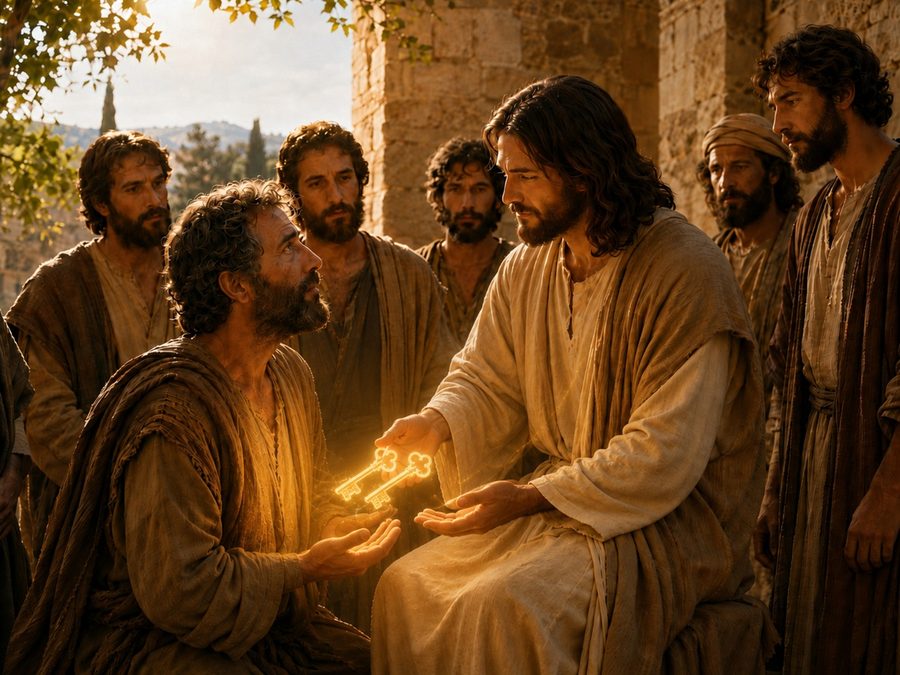
“I will give you the keys of the kingdom of heaven, and whatever you bind on earth shall be bound in heaven” (Matt. 16:19). The image is not invented for the occasion. It comes from Isaiah, where God removes the steward Shebna from office and gives his position to Eliakim: “I will place on his shoulder the key of the house of David; he shall open, and none shall shut” (Isa. 22:20–22).
Two things follow. The steward of a royal house is not the king; he governs in the king’s absence and by the king’s authority, which is exactly what Catholics claim and exactly what the objection usually assumes they do not. And the office in Isaiah has a succession: the whole passage is about one man replacing another in it. Christ hands Peter an office His hearers already knew to be transferable.4
On the wordplay: Christ was speaking Aramaic, where there is one word, Kepha, and John preserves it (John 1:42). Greek forced the shift, because petra is feminine and would make an odd man’s name. And if the rock were merely Peter’s confession, the renaming makes no sense: nobody is given a new name to commemorate somebody else’s foundation. That Paul rebuked him at Antioch is beside the point; the rebuke was about conduct, not teaching, and popes have been rebuked by saints ever since without anyone concluding the office was vacant. Nor does the plural foundation of Ephesians 2:20 and Revelation 21:14 tell the other way: twelve stones in one apostolic foundation is precisely the Catholic claim — but only one of the twelve was handed the steward’s keys.
A Church That Decides
The clearest evidence that the apostles thought they could settle a question is that they did. A doctrinal dispute arises over circumcising Gentile converts, a question on which Scripture, as it then stood, was not obviously on their side. They do not settle it by a text alone. They convene, argue, and issue a decree, and the decree says: “It has seemed good to the Holy Spirit and to us” (Acts 15:28). James does cite the prophets — but after the decision has taken shape, to show that “with this the words of the prophets agree” (Acts 15:15): the text confirms the judgment; it does not replace it.
Then they send it to churches that had sent no delegates, as binding. Whatever that is, it is a living teaching authority claiming the Holy Spirit’s backing for a decision, which is precisely what a Magisterium is. And Luke reports it without a hint that it was extraordinary.
The opposing panel’s sharpest particular from this chapter — that it is James, not Peter, who pronounces the judgment — deserves a straight answer, and the answer begins with a concession: James does speak last, does say “my judgment is” (Acts 15:19), and Catholic tradition itself names him the first bishop of Jerusalem, presiding in his own city. But the objection confuses chairing a meeting with settling its question. The doctrinal question — must Gentiles take the Mosaic yoke to be saved? — was settled by Peter: he rises after “much debate,” recalls that God chose “that by my mouth the Gentiles should hear the word of the gospel,” and declares that all are saved through grace — and “all the assembly kept silence” (Acts 15:7–12). The debate ends when Peter speaks. What James then proposes is the pastoral application, the terms on which Jewish and Gentile believers could live together. Nor has Rome ever claimed the pope must chair every council; most ecumenical councils were not presided over by the pope in person. The distinction Acts 15 actually draws — a local bishop presiding, Peter’s voice deciding the doctrine — is not an embarrassment to the Catholic conception of primacy. It is a description of it.
What Infallibility Is Not
Most of the historical objections dissolve once the doctrine is stated as the Church states it rather than as the polemic states it. Infallibility is not impeccability: it says nothing about a pope’s holiness, and the tenth century is exactly the embarrassment it appears to be. It does not mean inspiration: no pope receives new revelation, and the definition explicitly denies it. It is a negative protection, in narrow conditions, that a pope defining a doctrine of faith or morals for the whole Church will not define error. In that solemn form the Marian definitions of 1854 and 1950 are the two modern cases most commonly cited as uncontroversial exercises; theologians debate whether earlier papal acts also meet the conditions, and the Church has issued no exhaustive list.5
Honorius. He was condemned by an ecumenical council, by name, and Catholics should say so plainly; the council’s language is severe, and whether Leo II’s confirming letter softened it to negligence is genuinely disputed. But rest the answer where it does not depend on that quarrel: whatever Honorius was condemned for, he had defined nothing. The two letters at issue were private correspondence to a bishop, never proposed as binding on the Church — and that is not a technicality but the whole of what infallibility claims and does not claim. The strongest counter-example anyone has produced in nineteen centuries is a man who never defined anything at all.
The Great Western Schism. Forty years of genuine confusion, and nobody pretends otherwise. But notice what was disputed: not whether there is a successor of Peter, but which of three men was he. That is a crisis about a fact, and no doctrine promises that the fact will always be easy to establish. Saints were on opposite sides because the question was genuinely hard, which is an argument about the visibility of the office, not its existence.
And 1870. Doctrines are defined when they are denied; that is the pattern of every council. Nicaea defined the divinity of Christ in 325 and nobody concludes He was not divine in 324. The canon of Scripture was fixed in the fourth century. The definition of 1870 followed Gallicanism and the pressure of the modern state on the Church, and it settled a question those movements had raised.
And the Canon Comes Back
There is one difficulty the objection cannot walk around. Nothing in Scripture lists the books of Scripture. The table of contents in every Protestant Bible was received from the fourth-century Church, from councils of bishops, exercising exactly the authority being denied. To keep the canon while rejecting the authority that identified it is to trust the Church’s judgment on the most important question it ever decided and no other. That argument is developed at Is Sola Scriptura
Scriptural?
Priests, and a Priesthood
The Protestant panel is right that its theological argument matters more than its historical ones, so meet it squarely: every believer is a priest. The Catholic Church teaches exactly that — the baptized share a royal priesthood, offering spiritual sacrifices of prayer, work, and life. But notice where Peter got the phrase. He is quoting Exodus 19:6, “you shall be to me a kingdom of priests and a holy nation” — spoken to Israel at Sinai. And Israel, from the day those words were uttered, also had an ordained priesthood: the royal priesthood of the whole people and the appointed ministry of Aaron’s line stood together, in the very covenant that coined the phrase, for over a thousand years. The words cannot exclude what they always coexisted with. So in the New Testament: the same apostles who called the whole Church priestly also appointed elders in every church (Acts 14:23), left Titus in Crete to do the same (Titus 1:5), and handed on office by the laying on of hands (1 Tim. 4:14; 2 Tim. 1:6). The priesthood of all believers is not the alternative to apostolic succession; in Scripture the two have never existed apart.
The Watchtower’s Version, and What It Costs
The Witness objection is not a stronger form of the Protestant one. It is a different claim, and it has to carry a much heavier load. To say that no succession is worth anything because the congregation apostatized is to say that Christ’s Church failed, that the gates of hell did prevail, for something like eighteen centuries, over the thing He promised they would not. That is a large thing to assert, and it is asserted without a date, a place, or the name of a man who resisted the change. It is answered at length on Was There a Great Apostasy?
What deserves noticing here is narrower. Having rejected a teaching authority handed on from the apostles, the Watchtower did not do without one. It identifies the “faithful and discreet slave” with its own Governing Body, dates the appointment to 1919, and expects its direction to be accepted throughout the worldwide congregation. So the dispute is not really whether Christ left a teaching office. Both sides say He did. The dispute is whether that office has a documented line running back to men who knew Him, or begins in Pennsylvania in the twentieth century with no line at all.
And on titles: “call no man your father” (Matt. 23:9) cannot be a rule about the word, or Paul broke it (“I became your father in Christ Jesus through the gospel,” 1 Cor. 4:15) and so did Stephen addressing the council, and John writing to the fathers of his congregations. What Christ forbids in that chapter is the appetite the Pharisees had for place and honor, which He names three verses earlier. A rule against the syllable would convict the New Testament.6
The Reply in Brief
The apostles’ first recorded act after the Ascension was to fill a vacant office. Paul spent his last letters arranging for men to be appointed and for those men to appoint others. Clement, a generation later, says the apostles set it up that way deliberately, foreseeing the quarrel. Irenaeus could recite the list. None of this is a later accretion argued into the record; it is the record.
What the objections establish is that the men holding the office have often been poor, sometimes wicked, and occasionally impossible to identify. All of that is true and none of it is news: Christ chose Judas, and Peter denied Him before the office was three years old. The promise was never that the successors would be good men, but that the gates of hell would not prevail, which is a promise about the Church surviving them.
If the office is real, then the question “by what authority?”
has an answer that can be traced, named, and checked against the
documents, and the references in the sidebar are where to
begin checking. The companion pages on
the Great Apostasy and
sola scriptura
take up the two ways the claim is most often denied.
Endnotes
- Acts 1:15–26, quoting Psalm 109:8 (Ps. 108:8 LXX). The Greek at Acts 1:20 is ten episkopen autou labeto heteros, “let another take his overseership.” ↩
- Clement of Rome, Letter to the Corinthians 42–44 (c. A.D. 96): the apostles “appointed those [ministers] already mentioned, and afterwards gave instructions, that when these should fall asleep, other approved men should succeed them in their ministry” (44:2, in the Ante-Nicene Fathers translation, read free at New Advent). The text is also in William A. Jurgens, The Faith of the Early Fathers, Vol. 1, whose rendering differs slightly. ↩
- Irenaeus, Against Heresies 3.3.1–3 (c. A.D. 180), which gives the succession of the Roman church from Linus to Eleutherius. On Irenaeus’s own link to the apostle John through Polycarp, 3.3.4. See also Ignatius of Antioch, Letter to the Trallians 3 and Letter to the Smyrnaeans 8 (c. A.D. 107), on doing nothing apart from the bishop. ↩
- Isaiah 22:15–25, where Shebna is deposed and Eliakim invested with the key, the robe, and the title “father to the inhabitants of Jerusalem.” The binding-and-loosing formula of Matthew 16:19 is repeated to the apostles collectively at Matthew 18:18, which is the basis of the Catholic distinction between the college and its head. ↩
- First Vatican Council, Pastor Aeternus (1870), ch. 4, which states that the Holy Spirit was promised to Peter’s successors “not that they might, by his revelation, make known some new doctrine, but that, by his assistance, they might religiously guard and faithfully expound the revelation.” The two undisputed exercises of the solemn form are Ineffabilis Deus (1854) and Munificentissimus Deus (1950). See also Catechism of the Catholic Church §§888–892. On Honorius, Third Constantinople (681), Session XIII, anathematizes him by name, saying he followed Sergius and confirmed his teaching; Leo II’s letter confirming the acts charges him with permitting the immaculate faith to be stained by profane treachery, while elsewhere using the milder language of negligence. Whether Leo softened the council’s judgment is genuinely disputed among historians, and the Catholic reply above is deliberately not made to rest on it. ↩
- Matthew 23:1–12, where the rebuke is aimed at men who “love the place of honor at feasts and the best seats in the synagogues” (v. 6). On the apostolic use of the term, 1 Corinthians 4:15; Philippians 2:22; 1 Thessalonians 2:11; 1 John 2:13–14; and Acts 7:2, where Stephen addresses the Sanhedrin as “brethren and fathers.” Paul also calls himself the father of Onesimus (Philem. 10). ↩