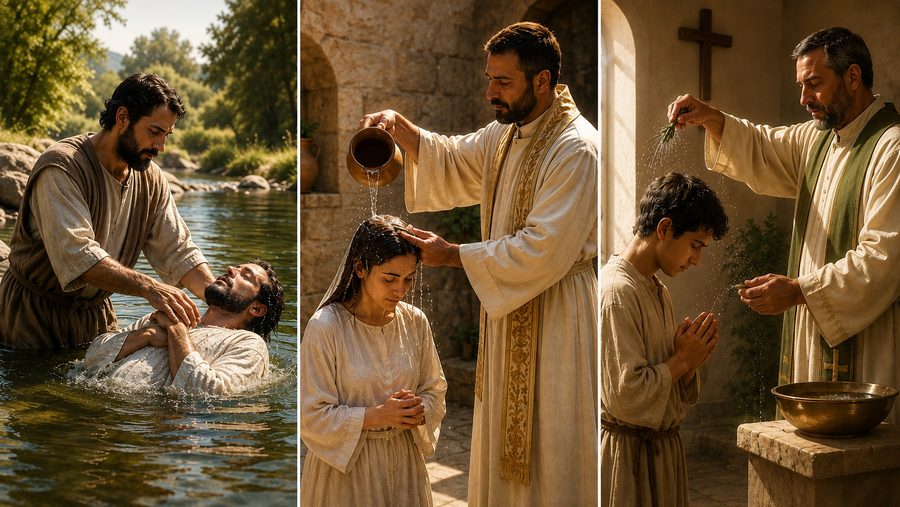
Set the vows side by side. Christ commanded baptism
“in the name of the Father and of the Son and of the
Holy Spirit” (Matt. 28:19) — and for twenty
centuries, across every communion that calls itself
Christian, that is what the baptismal words have named:
God. No apostle asked a candidate to acknowledge an
organization. The history of the Watchtower’s own
questions shows what happens when one does.
A Vow That Kept Being Rewritten
Three questions should be kept apart: what words are spoken, what
the rite intends, and whether the second question works as a
commitment to an organization. This page is about the third, and
it claims only what the wording supports. An unchanging God might
be expected to receive an unchanging vow. Instead the questions
have been revised again and again: the early forms asked about sin and
faith; by 1985 the second question required the candidate
to acknowledge himself “one of Jehovah’s
Witnesses in association with God’s spirit-directed
organization”; in 2019 the wording was simplified
and “spirit-directed” disappeared,
leaving “Jehovah’s organization.” Each
revision was answered aloud by thousands of candidates as
though it were the fixed condition of salvation. A vow
that requires periodic editing by its beneficiary is not
the baptism of Matthew 28; it is a membership pledge, and one that keeps being revised.1
Who Entered the Promise in 1985
The 1985 change was not cosmetic. Before it, in the form used from 1973, neither
question named Jehovah’s Witnesses or the organization at
all: the vow ran between the person and God. After it, the organization stood inside the
baptismal formula itself. The wording arrived in the years when the Society was
formalizing its disassociation policies — and a vow
that names the organization converts every later
disagreement with the organization into apostasy from the
vow. Baptism, the door Christ opened to God, was fitted with a second doorkeeper.2
What Baptism Actually Is
The New Testament’s baptism does things the
Watchtower’s symbol cannot. It forgives:
“Repent, and be baptized every one of you in the
name of Jesus Christ for the forgiveness of your
sins” (Acts 2:38). It saves: “Baptism, which
corresponds to this, now saves you”
(1 Pet. 3:21). It buries and raises: “we were
buried therefore with him by baptism into death, so that
… we too might walk in newness of life”
(Rom. 6:4). Nothing in these texts is a symbol of a prior
private act; the act of God is in the water. That is why
the formula names God and only God — the candidate
is being joined to the Father, through the Son, in the
Spirit, not enrolled in anything less. The Church a
Christian enters at baptism is Christ’s Body, and
entry into it is entry into Him — which is
precisely why no human corporation may write itself into
the words.3
A Witness may answer that the Catholic rite names the Church too:
the candidate professes faith in “the holy catholic
Church” before the water. So he does, in the words of the
creed, as an article of faith beside the resurrection of the body;
he is not asked to identify himself with an organization or to
acknowledge its direction over him. The difference is the
difference between confessing that Christ has a Church and
swearing membership in a corporation, and it is why the Catholic
questions have not changed in substance since the third century.
The Vow You Actually Made
Here is the pastoral heart of the page, for the reader
who answered those questions in a stadium years ago and
fears that leaving the organization means breaking faith
with God. Read your vow again. What you promised God
— repentance, dedication to His will, acceptance of
salvation through His Son — every Catholic renews
at every Easter, and nothing on this site asks you to
retract a word of it. What the second question added was
not God’s requirement but the organization’s;
an addition to Christ’s formula binds only as far
as the authority of those who added it — which is
the very question
the authority page
examines. Leaving a publisher is not leaving God. One practical point
should be stated plainly rather than softened: the Catholic Church
does not recognize Watchtower baptism as valid. No Trinitarian
formula is spoken over the candidate — the immersion
follows the two questions — and the meaning the community
gives the rite is not the meaning Christ’s words carry; so a
Witness received into the Church is baptized, not conditionally
but absolutely, and diocesan guidelines list the Society among the
communities whose baptism is not recognized. That is no judgment
on the sincerity of what you promised. It is the reason the
promise can be made again, this time in the words Christ gave.4
The full essay traces every revision of the questions
with dates and sources, examines dedication as a
doctrine, and takes up the practical question of what
the Catholic Church holds about the validity of
Watchtower baptism and what reception into the Church
involves. Download it from the summary below —
and the comments are open, without your name if you prefer.
Endnotes
- The 1985 wording: The Watchtower, June 1, 1985, p. 30; the 2019 wording: The Watchtower (study edition), May 2019. Earlier forms of the questions appeared in, e.g., The Watchtower of 1956 and 1973. ↩
- On the disassociation arrangements of the same period, see the discipline page and its timeline. ↩
- Acts 2:38; 1 Pet. 3:21; Rom. 6:4 (RSV); the argument in full on the sacraments page and the baptism page. ↩
- On the conditions of valid baptism, Catechism of the Catholic Church §§1239–1240, 1256; diocesan sacramental guidelines list Jehovah’s Witnesses among the communities whose baptism is not recognized, and a convert is baptized absolutely. ↩