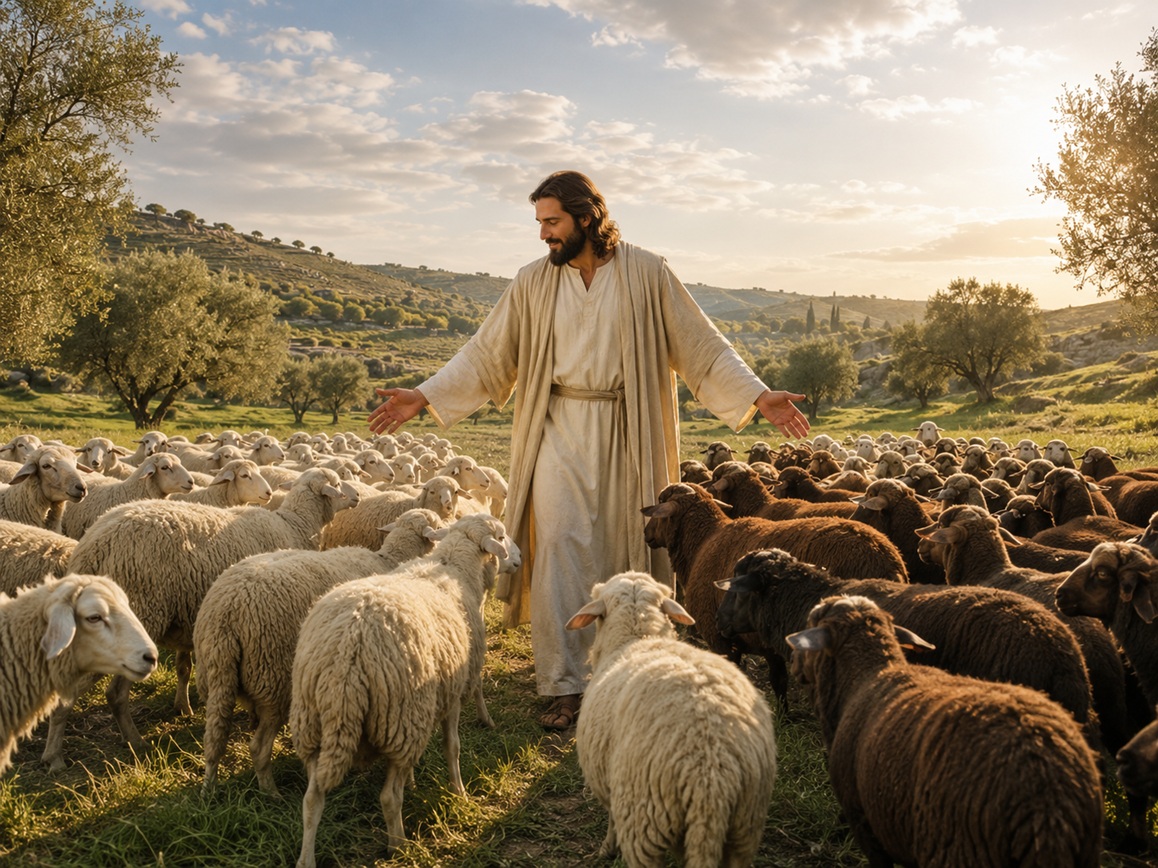
The Catholic Church holds that there is one people of God with one
hope. The other sheep of John 10:16 are the Gentiles, gathered with
believing Israel into a single flock, which is exactly what the
verse goes on to say. The whole two-class system rests on that one
sentence, and the sentence just does not support it.
The Other Sheep Are the Gentiles
Put the question as a first-century disciple would have heard it.
Why would Christ mention in passing a class of Christians His
hearers would never meet, who on the Watchtower’s account
would not begin to be gathered for nineteen centuries, and then
say nothing further to explain it? The natural reading is the one
the apostles reached within a few years: the fold is Israel, and
the sheep “not of this fold” are the gentiles.
The grammar itself indicates this: Christ says these sheep are not
of this fold (Greek ek, “out of, from”)
which is language of origin, not of destination.
The contrast is not between sheep bound for two different places
but between sheep drawn from two different starting points, Jew
and Gentile, who are then made one. The setting confirms it: He
is speaking to Pharisees who took for granted that the Jews alone
were God’s flock (John 9:40–10:16). To such hearers
“other sheep not of this fold” could mean only the
gentiles. To read a second, earthly destiny into them is the
mail carrier’s reading
again: the address correct, the household unknown.1
John supplies the interpretation himself a chapter later, telling
us Christ would die “not for the nation only, but to gather
into one the children of God who are scattered abroad”
(John 11:51–52). And the disciples would have remembered
these words exactly when Peter baptized Cornelius and his household
and the gospel went out to the nations.
One Flock, One Shepherd
The decisive word stands in the very verse the doctrine is built on.
Christ does not say there will be two flocks, or one flock in two
divisions with two destinies. He says the opposite:
“there shall be one flock, one shepherd”
(John 10:16). The entire point of bringing in the other sheep is
that the two become one. To read the verse as the charter
of a permanent two-class system is to make it say the reverse of
what it says.2
An older English rendering, “one fold,” once blurred
this. The Greek is unmistakable: mia poimnē, one
flock. There is one Shepherd and one flock that heeds His voice.
The favorite proof-text, read to the end of its own sentence, is
among the clearest refutations of the Watchtower doctrine it is
used to support.
The Number That Refutes Itself
The Watchtower insists the number is literal. Very well, but the
rule must then be applied evenly, because the passage that gives
the number gives the description in the same breath and the same
plain words.
Revelation says the 144,000 are sealed “from every tribe of
the sons of Israel,” and then names them: twelve thousand
from Judah, twelve thousand from Reuben, and so on through the list
(Rev. 7:5–8). It adds that they are men “who have not
defiled themselves with women, for they are virgins”
(Rev. 14:4). If the number is literal, so are these. Heaven would
then be reserved for exactly 144,000 celibate Jewish men, which
shuts out the apostle Peter, who was married; shuts out the Virgin
Mary, who was not male; and shuts out Charles Taze Russell, founder
of the movement, who was not of the tribes of Israel. A reading
that locks the founder of the Watchtower out of heaven has refuted
itself.3
The escape from that absurdity is to read the tribes, the celibacy,
and the maleness as symbolic, which is precisely what is
refused for the number standing beside them. One cannot have it
both ways. If “Israel” and “virgins” are
figures for the whole people of God and their purity, then 144,000
is a figure too; the passage gives no hint that the number is to
be treated differently from the description surrounding it. Taking
one literally and the rest symbolically is not exegesis. It is
selection, governed by the doctrine the number is needed to support.
The Multitude Before the Throne
Immediately after the sealing, John lifts his eyes and sees what
the two-class scheme cannot accommodate: “a great multitude
that no one could number, from every nation, from all tribes and
peoples and languages, standing before the throne and
before the Lamb” (Rev. 7:9). The
great crowd
is assigned to earth. But the text could hardly be plainer that
they are in heaven: they stand before the throne of God, they
“serve him day and night in his temple,” and the Lamb
at the center of the throne shelters them and leads them to springs
of living water (Rev. 7:15–17).4
This is the same throne-room in which John has already seen the
twenty-four elders seated (Rev. 4:4), the living creatures, and
the numberless angels. To place the multitude there,
before that throne, and then declare them an earthly class is to
read into the vision a geography it does not contain. John sees
one scene, one throne, one redeemed people gathered before it,
heard as 144,000 in the first image and beheld as an uncountable
host in the second. That is one people seen twice, not two crowds
in two places.
The decisive word is “temple.” The Greek of 7:15 is
naos, the inner sanctuary that only priests could enter,
not hieron, the outer courts open to all. The Watchtower
itself conceded in 2002 that the great crowd serve in the
naos, and kept them on earth by reading the word broadly
enough to take in the courtyard, citing Matthew 27:5 and John
2:20 for a wider sense. Its older answer, that the naos
here means “the earthly courtyard of God’s spiritual
temple,” reads the word backwards, and Revelation is not
loose with it: the book sets “the court outside the naos”
apart from it (Rev. 11:2), while every other naos in the
book stands in heaven (Rev. 11:19; 14:17; 15:5).
No Room for the Martyrs
The arithmetic fails before the argument does. If exactly 144,000
in all of history are taken to heaven, and the calling was, on the Society’s teaching
from 1935 to 2007, all but closed in 1935 — it has since
allowed that the anointing continues, without saying how the count
is kept — the count cannot accommodate the Christian dead of
the first three centuries alone — among them the generations
who went to their deaths rather than deny Christ. Revelation shows them where
the scheme cannot put them: under the altar, “the souls of
those who had been slain for the word of God,” crying out and
given white robes (Rev. 6:9–11). And the early Church read
them there from the beginning — Tertullian, writing around
A.D. 200, takes the blood of the saints with which Babylon is
drunk in
Revelation 17:6
to be the blood of the Christian martyrs.
So the question presses itself: whom did the first Christians
believe those martyrs to be, and where did they believe they had
gone? A doctrine that must find room for the martyrs of the
catacombs, the apostles, and every saint since, inside a number it long said was nearly filled by 1935, has run out of room in its own
heaven.
The Meek and the Earth
Against this stand the texts promising that the meek will inherit
the earth (Ps. 37:29; Matt. 5:5). But Christ is quoting the psalm,
and in both the language is the covenant language of
inheritance: the promised land as the pledge of what God
will give His people. Hebrews says exactly what the patriarchs
understood by it: they died without receiving the promises, because
they desired “a better country, that is, a heavenly one”
(Heb. 11:13–16). Nor does the Christian hope despise the
earth. Scripture ends with “a new heaven and a new earth”
and the holy city coming down (Rev. 21:1–2), one renewed
creation for one redeemed people, not two destinations for two
classes.5
The wider appeal to the Hebrew Scriptures fails at the same point,
and for a plainer reason: those promises were made to a
nation, not to individuals about their eternal destiny. When
the psalm says the righteous will possess the land, when Isaiah
says they will build houses and plant vineyards, when Micah puts
every man under his own vine and fig tree, the subject is Israel
in the land God swore to Abraham — a covenant people, in a
territory, promised security in place of exile and dispossession.
Not one of these texts is discussing who goes to heaven, because
the question is not yet being asked; the fullness of the life to
come is disclosed in Christ, who brought life and immortality to
light through the gospel (2 Tim. 1:10). To read a permanent
earthly class out of them is to answer a New Testament question
with an Old Testament promise addressed to somebody
else.5
Not a Government, but a Vision
Heaven is not primarily a government. The scheme assumes
it is — an administration with a fixed number of seats, a
premise examined at
What Is the Kingdom Good News? Scripture does
promise that the saints will reign with Christ, and Catholics
confess it — but the reign is shared by all the redeemed,
not a portfolio handed to a chosen few, and it is not what heaven
most deeply is. Heaven is the vision of God: to see Him face to
face and be satisfied in Him. There is no queue for that, and no
vacancy limit on it. The Beatitude does not say “blessed are
the 144,000” but “blessed are the pure in heart, for
they shall see God” (Matt. 5:8) — a condition of the
heart, not a place in a count.
And the apostles write to whole congregations as though the hope of
every member were heavenly: “the hope laid up for you in
heaven” (Col. 1:5); an inheritance “kept in heaven for
you” (1 Pet. 1:4); “our commonwealth is in
heaven” (Phil. 3:20); “holy brethren, who share in a
heavenly call” (Heb. 3:1). These are letters to ordinary
Christians at Colossae and Philippi and across Asia Minor, not to a small anointed class.
The Watchtower’s answer is that these writings were meant for
the anointed in the first place. Its own reference work says the
Christian Greek Scriptures are “of universal importance,
interest, and concern primarily to spiritual Israel, which is
the congregation of God, but, additionally, to all persons who
seek the approval of God.” That is a costly answer. If those
letters were addressed chiefly to a class of which the great crowd
is no part, then their commands about marriage, work, speech and
forgiveness were addressed chiefly to that class too — yet
every Witness is taught to obey them as written to him. The rule
shifts with the subject: the epistles are read as speaking to every
Christian until they speak of
heaven.6
One Body, One Hope
What John states in the image of the flock, Paul states in the
language of the body: “there is one body and one Spirit,
just as you were called to the one hope that belongs to
your call, one Lord, one faith, one baptism, one God and Father
of all” (Eph. 4:4–6). One hope, named explicitly, for
all the baptized. A doctrine of two hopes (heavenly for the few,
earthly for the many) runs straight against a confession that
hammers the word “one” seven times.7
And the unity Paul means is precisely the joining of the two folds.
Christ “has made us both one, and has broken down the
dividing wall of hostility … that he might create in himself
one new man in place of the two” (Eph. 2:14–16). The
Gentiles, once “strangers to the covenants of promise,”
are “brought near” and made “fellow citizens with
the saints and members of the household of God”
(Eph. 2:12–19). The whole movement of the gospel is from two
into one. The two-class system runs it backward, rebuilding inside
the Church the very dividing wall Christ tore down, no longer
between Jew and Gentile, but between a heavenly 144,000 and an
earthly multitude.8
One Mediator, One Table
The division cannot be confined to the future hope; it works
backward into the present life of the congregation. Paul writes
that “there is one God, and there is one mediator between
God and men, the man Christ Jesus, who gave himself as a ransom
for all” (1 Tim. 2:5–6). The two-class scheme
requires that most believers relate to God as friends rather than
children, and to the new covenant at one remove.
It shows most painfully at the Lord’s table, where only the
anointed partake, so that the great majority pass the bread and
the cup along untasted. But Christ made partaking the
condition of life — “unless you eat the flesh
of the Son of man and drink his blood, you have no life in
you” (John 6:53) — and said, “drink of it,
all of you” (Matt. 26:27), and the covenant He was
inaugurating in that cup is the one He shed His blood to make.
When He sent the apostles to make disciples of all nations, the
commission was to teach them “to observe all that I have
commanded you” (Matt. 28:19–20), the command of the
Supper included. A
system that turns most of the body of Christ into spectators at
His own table has mistaken the nature of the gift.9
This is the short answer. The full treatment adds the history of
how the two-class doctrine was arrived at and when the earthly
class was first announced, what the New Testament means by the
new covenant and who is party to it, the “friends of God”
language and what Scripture actually does with it, and full
documentation for everything asserted here. It is available as a
Word document at the end of this page.
Endnotes
- John 10:16, with the preposition ek denoting origin. The setting runs continuously from John 9:40, where the Pharisees are the immediate audience. The identification of the other sheep with the Gentiles is as old as the Fathers: Augustine, Tractates on the Gospel of John 47.2–4, reads them as the Gentiles called into the one Church, around A.D. 400 and long before the question was controversial. So too the New Catholic Encyclopedia, s.v. “Christianity,” which glosses John 10:16 as Christ’s announcement of “the future extension of his Kingdom” to the nations (cf. Matt. 8:11; 28:19). ↩
- The Greek is mia poimnē, heis poimēn, one flock, one shepherd. The King James rendering “one fold” follows the Latin ovile and obscures the distinction between the fold (aulē) of v. 16a and the flock (poimnē) of v. 16b; modern versions correct it. ↩
- Revelation 7:4–8 for the tribal enumeration and 14:4 for the description of the sealed as male virgins. The point is not that these details must be pressed literally, but that the Watchtower does not press them literally while insisting the number in the same sentence must be. ↩
- Revelation 7:9–17. The multitude stands “before the throne,” serves God “day and night in his temple,” and is sheltered by the Lamb “in the midst of the throne,” the same heavenly setting as Revelation 4:4 and 5:11. Locating them on earth requires importing a geography the vision does not supply. ↩
- Matthew 5:5 quotes Psalm 37:11; compare Psalm 37:29. On the land-promise as pledge of a greater inheritance, Hebrews 11:13–16, where the patriarchs are said to have sought “a better country, that is, a heavenly one.” On the renewed creation, Revelation 21:1–2 and Romans 8:19–23. The Christian hope includes a redeemed earth; what it does not include is two peoples with two destinies. ↩
- On the beatific vision, see Catechism of the Catholic Church §§1023–1029, with Matthew 5:8; 1 John 3:2; 1 Corinthians 13:12. On the heavenly hope held out to congregations at large, Colossians 1:5; 1 Peter 1:3–4; Philippians 3:20; Hebrews 3:1; and Hebrews 12:22–23, where the readers are told they “have come” to “the assembly of the first-born who are enrolled in heaven.” On the saints reigning with Christ, Revelation 20:6 and 2 Timothy 2:12, which the Catholic tradition reads of all the redeemed. The quoted statement that the Christian Greek Scriptures are of concern “primarily to spiritual Israel, which is the congregation of God, but, additionally, to all persons who seek the approval of God” is from Insight on the Scriptures (Watch Tower Bible and Tract Society of Pennsylvania, 1988), Vol. 1, entry “Christian Greek Scriptures,” 444; “spiritual Israel” and “the Israel of God” are the Watchtower’s terms for the anointed 144,000. ↩
- Ephesians 4:4–6. The sevenfold repetition is deliberate and is the passage’s whole rhetorical point. ↩
- Ephesians 2:11–22, on the dividing wall, the one new man, and the Gentiles as fellow citizens rather than resident aliens. Compare Galatians 3:28 and Colossians 3:11. ↩
- 1 Timothy 2:5–6; Matthew 26:27–28, with Mark 14:23–24 and Luke 22:20 on the cup as the new covenant in Christ’s blood. The restriction of the emblems is treated on the companion page Do This in Memory of Me? ↩