Start with what the Watchtower got right, because your
instincts were not the problem.
The Instincts Were Sound
You believed that truth is definite — that God has
not left His will a matter of opinion. You believed that
Christianity is a body, not a mood; that somebody must be
able to say this is the faith when readers
disagree; that worship should cost something and mean
something; that God gathers a people. Every one of those
convictions is correct, and most of the modern world has
lost them. The Watchtower held you by real instincts. It
failed you not in the hunger but in the meal: the
authority it offered began in 1919, the certainty it
offered kept being revised, and the people it gathered
were held together by fear of the door.
An Authority You Can Check
The Catholic claim is the same kind of claim the
Watchtower made — a teaching authority commissioned
by Christ — with the opposite evidential shape. It
does not begin in the nineteenth century; it is checkable
in the first. Christ named a rock and gave keys
(Matt. 16:18–19); the apostles appointed successors
by the laying on of hands, and the men they appointed
wrote letters you can read this afternoon —
Clement, commanding Corinth while John lived; Ignatius,
naming the bishops of seven cities on his way to the
lions. The chain from that room to the present is
documented link by link on
the succession page.
Set it beside the Watchtower’s chain, which is
examined on the authority page
and reaches to 1879 and stops. The difference is not
confidence. It is evidence.
A Certainty That Does Not Blink
You were promised “the truth,” and the truth
kept changing — the generation, the presence, the
blood fractions, the slave. The Church’s record on
her defined faith is of another order: the creed she
professes this morning is the one the councils of 325 and
381 settled, and a Christian of the fifth century would
recognize it at once (one Western clause, the
Filioque,
came later and has its own page). Development happens
— doctrine grows the way an oak grows from an acorn,
and disciplines and prudential judgments do change —
but no solemnly defined dogma has ever been undefined, no
promised date has ever been unsaid, and no masthead has
ever been edited to move a deadline. That is not a claim
that the Church’s history has been frictionless; the
schisms, the reforms, and the sinners are on the record,
and on this site. It is a claim that what she defined as
the faith, she has kept.
Worship That Is More Than a Meeting
The Kingdom Hall gave you talks about God. The Catholic
claim is that the Mass gives you God Himself: that in the
Eucharist Christ gives Himself truly, really, and
substantially, under the appearances of bread and wine.
That is the whole difference, and it is why the
Eucharist stands at the center of everything this site
defends: “this is my body” meant what it
said (the evidence is here),
and the earliest Christians — the same ones who
certify the canon your Bible depends on — staked
their lives on it. The memorial you attended once a year,
passing the plate untouched, is offered every day in the
Church, and no one passes the plate. What the Watchtower
reserved for a remnant, Christ offers to you.
A People Without a Trapdoor
And the gathered people you rightly wanted comes, here,
without the machinery of fear. No one is told to shun a
Catholic who walks away. The Church has penalties, and
excommunication is the gravest of them, but they touch the
sacraments and church office, never a family’s table.
The door out stands permanently open, which is exactly why
walking in means
something. The saints are the proof of what the Church
grows when it works — not a class of 144,000 but
a communion open to
everyone. Failures? The Church’s are cataloged on
their own page
of this site, without excuses — a thing the
Watchtower has never once done with its own.
To Whom Shall We Go?
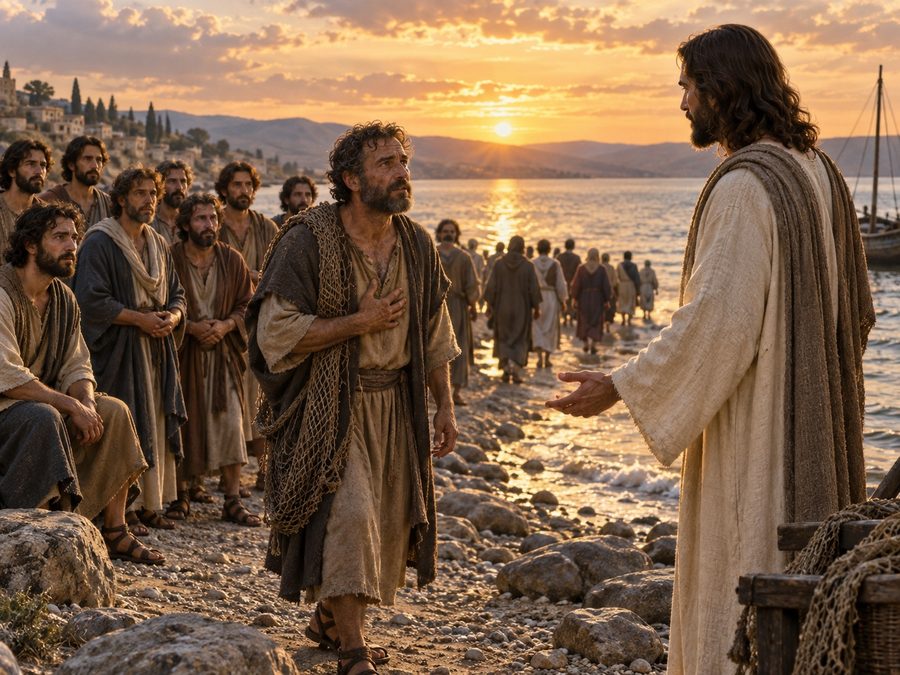
Peter’s question was not rhetorical; he was
standing in front of the alternatives, and so are you.
The answer is not an address but a Person — and the
Person founded something findable. Test everything on
this site against the sources; that is what the site is
for. And when you are ready to see rather than read,
Your First Mass
will walk you in and back out again, a guest with no
obligations. And if what holds you back is the suspicion that
the Church is simply another Governing Body with older
furniture, that suspicion has its own page. The words of eternal life have had the same
custodian for two thousand years. She has kept your
place.