My Long Journey of Faith

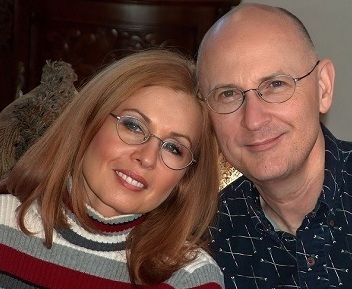
Rich and Suzanne

"For I am sure that neither death, nor life, nor angels, nor principalities, nor things present, nor things to come, nor powers, nor height, nor depth, nor anything else in all creation, will be able to separate us from the love of God in Christ Jesus our Lord."

My name is Rich Whiting. For many years I was one of Jehovah's Witnesses — baptized as a boy, and later a member of the Bethel family in Brooklyn, where the religion's books and magazines are written. I left, and after a long search I was received into the Catholic Church. This website is my attempt to set down, honestly and plainly, why I made that journey.
I want to say at the outset that I hold no anger toward Jehovah's Witnesses. They are, in my experience, sincere, hard-working, and devoted people, and I count many among them as family and friends. My quarrel is not with them but with the teachings of the organization that directs them. My aim here is not to win an argument but to lay out the evidence as I came to see it, and to let you weigh it for yourself.
The site is woven around two questions, the way a cloth is woven from threads running two directions:
  • Which religion matches the beliefs and practices of the earliest Christians: Jehovah's Witnesses or the Catholic Church?
  • And beneath that, which worldview better explains the world we actually find ourselves in: materialistic atheism or Christianity?
The two panels below introduce each question. The first looks at the claims of the Watchtower; the second at the larger question of whether the Christian picture of reality holds up better than a godless one. The pages linked from each take up these matters in depth.
Please bear in mind that I do not have a perfect answer for every question — my memory is not what it was, and where I do have an answer I may not always find the best words for it. But the absence of an answer is not the absence of one's existence, any more than a refusal to accept an answer makes it wrong. What follows is simply the fruit of my own years of investigation, offered in the hope that it may help someone else along the same road. An honest mind, free of self-deceit, can only be the better for the journey.
You may leave comments or questions below, but please read our policy on commenting before doing so.

The Watchtower vs The Catholic Church

Are Jehovah's Witnesses the restoration of first-century, apostolic Christianity, as they teach? Or are they — like the Latter-day Saints ("Mormons") and Seventh-day Adventists, whom they themselves regard as man-made — a religion of fairly recent and human origin? I spent years inside the organization, including time at its Brooklyn headquarters, and longer still examining the question from outside. The honest answer, as I came to see it, is that the Watchtower is a man-made religion: sincere in its people, but mistaken in its distinctive claims.
I did not reach that conclusion from a single objection but from a pattern that surfaces wherever its unique teachings are tested against Scripture read in context and against the witness of the earliest Christians. A few of the clearest examples — each taken up at length in its own page — group naturally into four:

A church that supposedly failed, then restarted on a private timetable. The Watchtower's whole authority rests on the belief that the Church Christ founded fell into total apostasy soon after the apostles died, and had to be restored in modern times. On that footing it teaches that Christ began his reign invisibly in 1914, that the "last days" started that same year, and that he then appointed its leaders as his sole channel on earth in 1919 — dates, and an arrangement, unknown to every previous Christian century. But Jesus promised the gates of hades would never prevail against his Church (Matt. 16:18), and to be with it "to the close of the age" (Matt. 28:20); and the New Testament places the "last days" in the apostles' own time, not ours. A faith that had to be re-founded in the twentieth century is, by its own account, one that first disappeared — the very thing he said would not happen.

Doctrines built on isolated verses. Again and again, a teaching unique to the Watchtower turns on a handful of texts read apart from their context, against the plain sense the early Church always held: the denial that God is a Trinity; the claim that Jesus died on a stake rather than a cross, and the "corresponding ransom" theory of why he died that follows from denying his deity; the insistence that one English form of the divine name ("Jehovah") is the badge of true worship — though the Society's own scholars admit "Yahweh" is the more accurate form; the redefinition of the Kingdom of God and of the gospel itself; and the prohibition on blood transfusions that has cost lives. Much of this rests on the organization's own New World Translation, a Bible shaped, in key places, to fit beliefs already decided upon.

One flock divided into two. Perhaps the clearest sign of a human system is the way the Watchtower splits faithful Christians into two classes with two destinies — a heavenly "anointed" of exactly 144,000 who will rule with Christ, and an earthly "great crowd" of "other sheep" who may never share that hope, and who are not even to take the bread and cup at the Lord's Supper. Yet the very verse this rests on (John 10:16) ends by declaring the opposite: "there shall be one flock, one shepherd." Paul knows "one body … one hope … one Lord, one faith, one baptism" (Eph. 4:4–6), and the gospel as the tearing down of the dividing wall to make "one new man" of the two (Eph. 2:14–16). The two-class system rebuilds inside the Church the very wall Christ tore down.

Hope narrowed and the dead misread. Following from that division, the Watchtower teaches that nearly everyone faces simple annihilation. Its account of the soul and of what happens at judgment leaves no room for heaven for the ordinary believer, denies the reality of hell, and dismisses purgatory — again reading a few verses in a way the Church never did.

I offer these not as a list of accusations but as the honest reasons a man can come to believe, after long looking, that the Watchtower is not the first-century Church restored, but a religion made in the nineteenth and twentieth centuries by well-meaning men. The pages in this section set out each point so you can judge for yourself.

Atheism vs Christianity

Beneath the question of which church is true lies a deeper one: which worldview better explains the world we actually live in — the Christian one, or the materialist one that says matter and energy are all there is? I have come to think the Christian picture fits the evidence far better, and not as a leap in the dark but for reasons that can be set out and examined.

That anything exists at all. Why is there something rather than nothing? A universe that began to exist, and that is finely balanced for life in ways that grow more striking the closer we look, sits far more easily with a Creator than with blind chance.

That the world makes sense to the mind. The cosmos is orderly, intelligible, and describable in mathematics — and we are the kind of creatures who can read it. On the Christian view that is exactly what we should expect; on a purely material one it is a happy accident in need of explaining away.

That right and wrong are real. Most of us know that cruelty is genuinely wrong, not merely unfashionable. But objective good and evil, along with real meaning and purpose, are hard to ground in a universe of mere particles. They point beyond matter to their source.

That God has acted in history. The Christian claim is not only philosophical but historical: that God revealed himself, supremely in the life, death, and resurrection of Jesus — events with real evidence behind them, recorded in documents we have good reason to trust.

None of this is meant to belittle the honest doubter; I take the arguments against God seriously, and weigh them in these pages too. I simply find that, taken together, the world we meet — its existence, its order, its moral weight, and the figure of Christ at the center of history — is better accounted for by a reasonable Christian faith than by materialism. The pages in this section make the case.

Summary

Some will immediately accuse me here of begging the question, since I have already made the assumption that God exists and created the world (not to mention the exclusive adoption of Christianity as the true and proper relationship to God). But that is what I believe can be shown from the facts.

What I cannot show from the facts — but hope and pray — is that the Governing Body of Jehovah's Witnesses will repent of their unwarranted arrogation of the authority given by Christ only to His Church in the First Century, and release those precious souls of Jehovah's Witnesses from a man-made religion to hear and respond to the Holy Spirit and the Bride of Christ, the Catholic Church. (Rev. 22:17)