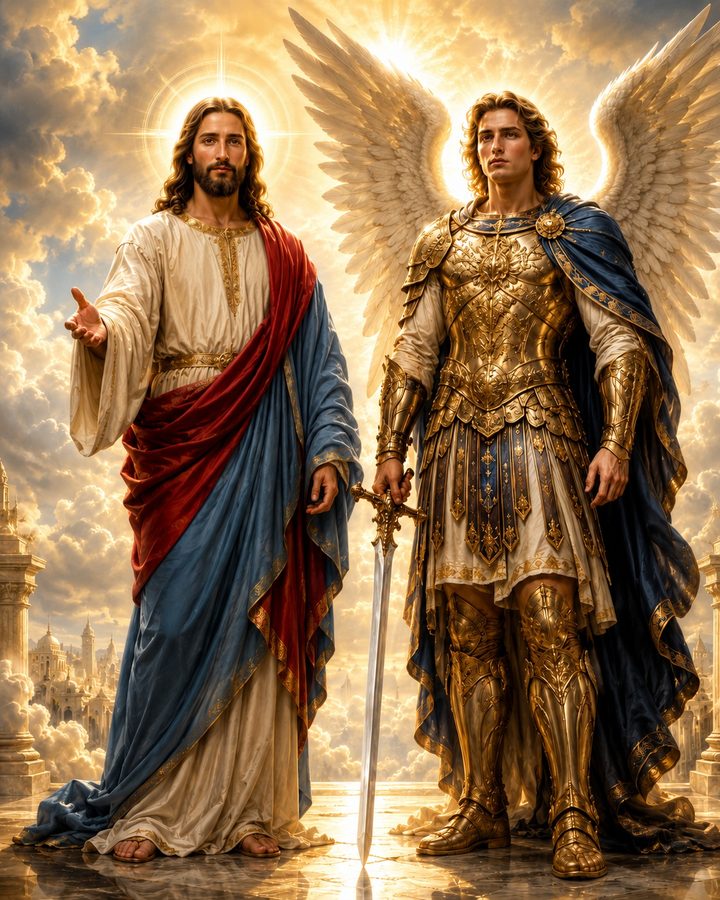
Michael is named five times in all of Scripture —
three times in Daniel, once in Jude, once in Revelation.
Nothing else exists to build on. So the honest procedure is
to read all five, read the two texts the doctrine leans
hardest on, and then read the one chapter of the Bible
written to answer precisely this question.
One of the Chief Princes
Daniel introduces Michael as “one of the chief
princes” (Dan. 10:13) — one of several. That
single phrase already sits badly under the doctrine, for
Scripture never calls the Son one of anything: He is
“the only Son from the Father” (John 1:14),
with “the name which is above every name”
(Phil. 2:9). Daniel’s Michael is a great prince
with peers, charged with the care of Israel
(Dan. 10:21; 12:1) — the very role the angel of
Revelation fills toward the churches. Nothing in Daniel
hints that this prince is the Messiah; Daniel’s
Messiah appears elsewhere, as “one like a son of
man” who receives everlasting dominion from the
Ancient of Days (Dan. 7:13–14) — the very title
Jesus takes as His own.1
The Angel Who Dared Not, and the Lord Who Did
Jude supplies the test case. “When the archangel
Michael, contending with the devil, disputed about the body
of Moses, he did not presume to pronounce a reviling
judgment upon him, but said, ‘The Lord rebuke
you’” (Jude 9). Michael, at the height of his
authority, dares not rebuke Satan in his own name; he
appeals to the Lord’s. Now watch Jesus — not
enthroned in glory but standing hungry in the wilderness:
“Begone, Satan!” (Matt. 4:10), and Satan goes.
He silences demons with a word and they obey Him
(Mark 1:25–27). If Jesus is Michael, then the same
person who dared not judge the devil in heaven commanded
him at will on earth, in the days of His humiliation. The texts read more naturally as two persons of different ranks
— the servant who invokes the Lord, and the Lord he invokes
— than as one person in two estates. Taken alone the
contrast is supportive rather than conclusive; a Witness can reply
that the incarnate Christ acted with a delegated authority. It
points the way the decisive chapter, Hebrews 1, will settle.2
A Voice, a Shout, and a Trumpet
The doctrine’s chief proof-text proves less than it
must. “The Lord himself will descend from heaven with
a cry of command, with the archangel’s call, and with
the sound of the trumpet of God”
(1 Thess. 4:16). The Lord descends with an
archangel’s call — amid it, accompanied by it
— as He descends with a cry and with God’s
trumpet. The three phrases are parallel, and no one reads
the first or the third as saying what the Lord is;
only the middle one is asked to carry that weight. The
picture is the royal
arrival Paul’s readers knew: the king comes, and the
herald’s voice and the trumpet announce him. The
herald’s voice announcing the King is strange proof
that the King is the herald. Grammar alone does not
exclude the Society’s reading — “with an
archangel’s voice” could describe the Lord’s own
voice — so the verse decides nothing either way; it is
simply too thin to carry a doctrine, and the weight rests on
Hebrews 1. And Revelation 12
adds nothing more: Michael commands “his
angels” in one battle scene, as captains of the host
do throughout Scripture; the Lamb, meanwhile, is
worshiped in the same book by “every creature in
heaven” (Rev. 5:13) — a line no creature,
however chief, can stand on the receiving side
of.3
The Chapter Written to Answer This
Hebrews 1 reads as though its author had heard the
doctrine coming. The Son is “much superior to
angels” (Heb. 1:4) — and then the questions
fall like hammer blows. “For to what angel did God
ever say, ‘You are my Son, today I have begotten
you’?” (Heb. 1:5). Of the Son: “Let all
God’s angels worship him” (Heb. 1:6). “But
to what angel has he ever said, ‘Sit at my right
hand…’?” (Heb. 1:13). The chapter’s
whole architecture is a line drawn between the Son and
every angel whatsoever — the angels on the side of
“ministering spirits” (Heb. 1:14), the Son on
the side of the God they worship, addressed as
“God” and “Lord” who
“founded the earth” (Heb. 1:8–10). And
the next chapter closes the last exit: “it was not
to angels that God subjected the world to come”
(Heb. 2:5). If Jesus were the archangel, Hebrews 1 would
not merely be mistaken; it would be arguing against its
own conclusion in every verse.4
Still a Man, and Still Not Michael
The Society holds that at His resurrection Jesus returned to
heavenly life as a spirit and took up the name Michael again. The
New Testament, written entirely after the resurrection, never once
calls Him that. What it calls Him is a man — in the present
tense. Paul tells the Athenians that God will judge the world
“by a man whom he has appointed,” and has given proof
of it “by raising him from the dead” (Acts 17:31): the
risen One is the man. Years later, to Timothy: “there is one
mediator between God and men, the man Christ Jesus”
(1 Tim. 2:5) — a man now, mediating now. And to the
Colossians: “in him the whole fulness of deity dwells
bodily” (Col. 2:9) — dwells, not dwelt;
bodily, not as a spirit who once wore a body. The apostles
had every occasion to say that the Lord they preached was the
archangel restored. They said instead that He is the man in whom
God’s fullness lives, bodily, still. An archangel is neither.
Where the Doctrine Comes From, and What It Costs
Notice, finally, what the identification is built from:
two inferences — a singular noun, and a
“with” read as “as” — set
against the direct statements of Hebrews 1, the worship
scenes of Revelation, and Jude’s explicit contrast
of rank. No verse says Jesus is Michael. The earliest
Christians never say it; the identification entered the
Watchtower’s bloodstream from nineteenth-century
Adventist speculation, not from the Fathers or the text.
It is required, rather than discovered: a created Christ needs a place in creation, and the archangel is the highest the text offers. The larger
question — who the Son actually is — is taken
up on Is God a Trinity?;
what His resurrection body was, on
the resurrection page.
Here it is enough to say: Scripture knows an archangel who
serves, and a Son whom archangels worship, and it never
once confuses them.5
The Strongest Reply
The Society’s best argument is not the archangel’s voice but
Daniel and Revelation read together. Daniel says that “at that
time shall arise Michael, the great prince who has charge of your
people,” and that “there shall be a time of trouble, such as
never has been” (Dan. 12:1); Revelation says that when “the
kingdom of our God and the authority of his Christ” have come, it
is “Michael and his angels” who fight the dragon and cast
him down (Rev. 12:7–10). One figure stands up at the time of the
end and clears heaven of Satan; elsewhere it is Christ who leads
heaven’s armies (Rev. 19:14). Two commanders cannot lead one host
at one hour, so Michael and the enthroned Christ, the argument
concludes, are one person under two names — and
“archangel” is never plural in Scripture, so there is only
one, and the Lord descends with that one’s voice.
Revelation 12 names two persons where the doctrine needs one. The
heavenly voice announces “the authority of his Christ” (Rev.
12:10) as the meaning of the victory Michael fought; Michael is the
general, Christ the King whose authority the victory serves, and the
chapter keeps them apart — the Christ of verse 10 is the child of
verse 5, “caught up to God and to his throne,” who is
nowhere said to have come down to fight. That a captain fights the
king’s war is no evidence that the captain is the king. Nor does
Daniel help. Michael “arises” for “your people”
as the guardian prince of Daniel 10:21, “one of the chief
princes” (Dan. 10:13) — the one phrase the doctrine cannot
survive, since the Son is never one of anything. Daniel’s Messiah
is elsewhere: “one like a son of man,” who receives
everlasting dominion and whom “all peoples, nations, and languages
should serve” (Dan. 7:13–14). Jesus took that title. He
never took Michael’s.
“Archangel” is singular in Jude because Jude names one; the
Greek of 1 Thessalonians 4:16 has no article at all —
“a voice of an archangel” — and a God who has
“chief princes” in the plural has more than one chief. But
grant a single archangel, and the case still ends where Hebrews ends it:
an archangel is an angel, and “let all God’s angels worship
him” (Heb. 1:6) leaves the archangel worshiping the Son.
What remains if this claim fails. If Jesus is more than an angel, the New Testament’s worship of Him becomes intelligible. What this page establishes is that no text says Jesus is Michael, and that Hebrews 1 was written to deny an angelic Christ. What it does not establish, by itself, is the whole doctrine of who He is; that is the next stop.
The full essay walks every Michael text with its
context, the history of the identification from Miller
and the Adventists to Insight, the
shared-titles argument in both directions, and the
patristic witness. Download it from the summary below
— and the comments are open, without your name if you
prefer.
Endnotes
- Dan. 10:13, 21; 12:1; 7:13–14; John 1:14; Phil. 2:9 (RSV). ↩
- Jude 9; Matt. 4:10; Mark 1:25–27 (RSV). ↩
- 1 Thess. 4:16; Rev. 12:7; 5:13 (RSV). On parousia as a royal arrival with its herald and trumpet, see What Is the Parousia? ↩
- Heb. 1:4–14; 2:5 (RSV), quoting Pss. 2, 45, 102, and 110. ↩
- On the Adventist background of the identification, the standard histories of the Millerite movement; the Watchtower inherited the Jesus–Michael equation from that milieu, not from any patristic source. ↩