The whole system passes through one word, so begin with
the word — and then read the discourse it appears
in, the rest of the New Testament, and the
Watchtower’s own history with the doctrine.
A Word from the Royal Road
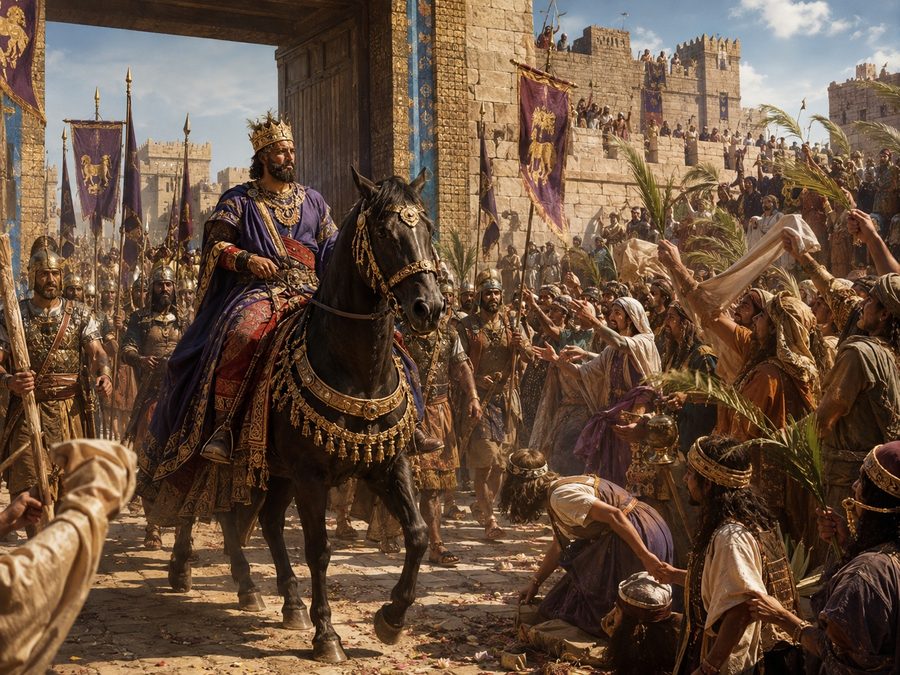
Parousia was not a mystical term when Matthew
wrote it; it was a civic one. In the everyday Greek of
the first century it named the official arrival
of a king or emperor at a city — an event
provinces minted coins for and citizens turned out to
see, the least invisible occasion in ancient public
life. The standard lexicon of New Testament Greek
accordingly glosses the word: “arrival, advent
… the coming of Christ … in messianic
majesty.” A royal presence, yes — the presence that begins with a public arrival. The word genuinely carries both senses, and “presence” is not an impossible English rendering; the fault is not the word the New World Translation chose but the invisible event of 1914 read into it. An invisible parousia is not found in the lexica, the papyri, or the fathers who read this Gospel in its own language — and the question is settled by context, which comes next.1
The Discourse Answers the Rendering
Whatever the disciples meant by their question, what
settles the matter is Jesus’ answer — and His
answer is a sustained warning against exactly the kind of
claim the Watchtower makes. If they say “he is in
the wilderness,” do not go out; if they say
“he is in the inner rooms” — present,
but hidden from view — “do not believe
it” (Matt. 24:26). Why not? “For as the
lightning comes from the east and shines as far as the
west, so will be the parousia of the Son of
man” (Matt. 24:27). Lightning is Jesus’ own
chosen image for the event: instantaneous, unannounced,
and impossible to miss. And He says who will see it:
“all the tribes of the earth … will see the
Son of man coming on the clouds of heaven with power and
great glory” (Matt. 24:30). A parousia that no one
on earth can see, vouched for by an organization announcing a presence no one saw, is not a hard case for
this discourse. It is the case the discourse was built to
forbid.2
As You Saw Him Go
The rest of the New Testament speaks with one voice. The
angels at the Ascension: “This Jesus … will
come in the same way as you saw him go into heaven”
(Acts 1:11) — and the disciples watched Him
go; the “same way” is bodily and visible, not
secret. John: “Behold, he is coming with the
clouds, and every eye will see him, every one who pierced
him” (Rev. 1:7) — every eye, the hostile ones
included, which no invisible presence can satisfy. Paul:
the Lord descends “with a cry of command, with the
archangel’s call, and with the sound of the trumpet
of God” (1 Thess. 4:16) — the loudest
verse in his letters — and the lawless one is
destroyed “by his appearing and his coming”
(2 Thess. 2:8), literally the manifestation
of his parousia: the presence, when it comes, is
manifest by definition. Not one text describes an
unwitnessed return.3
The Authority Already Given
There is also a question the 1914 enthronement cannot
answer. The risen Jesus’ parting words to His
assembled Church are a coronation announcement:
“All authority in heaven and on earth has been
given to me” (Matt. 28:18). All authority —
given, past tense, at the resurrection. If Christ has
held all authority in heaven and on earth since the
first Easter, what remained for Jehovah to give him,
invisibly, in 1914? A king cannot be enthroned twice
over the same dominion. And the sentence that closes the
same Gospel undoes the doctrine from the other side:
“lo, I am with you always, to the close of the
age” (Matt. 28:20). The presence of Christ with
His people did not begin in 1914; He promised it for
every day between the Ascension and the end. The Church
has never lacked her Lord’s presence and has never
needed a date for it. What she awaits is not a presence
but an appearing.4
The Invisible Event That Moved
Watchtower history then supplies the argument’s
last step. For roughly six decades the Society taught
that Christ’s invisible presence began in
1874. As late as 1929 its book Prophecy
stated: “The Scriptural proof is that the second
presence of the Lord Jesus Christ began in 1874
A.D.” Only in the 1930s and 1940s was the presence
relocated to 1914, where it has remained. Ask what kind of event can be redated by forty years, and the answer is: only an event with no
witnesses. A visible parousia could never have been
redated, because someone would have had to see it.
The portability of the presence is not an incidental
embarrassment; it is a demonstration that nothing
observable ever anchored the doctrine — the mark of
a conclusion reached by
human reasoning
rather than by anything that happened.5
The Hope the Church Actually Holds
None of this diminishes the doctrine of the Lord’s
return; it restores it. The Church awaits what the creed
says and the New Testament shouts: He will come
again, in glory, visibly, to judge the living and
the dead — the blessed hope no believer needs an
organization to certify, because when it happens, no one
will need to be told. Until then His kingship is real and
His presence with the Church is real — in His word,
His Spirit, and above all the Eucharist — but the
parousia remains ahead of us, undated, as He insisted it
must remain (Matt. 24:36). What the last days are is
taken up on
the last-days page;
the deadline that kept moving, on
the generation page.6
The Strongest Reply
The Society’s best case rests on two things Jesus said. Asked for
“the sign of your presence” (Matt. 24:3, NWT), He gave one
— and, the argument runs, no one asks for a sign of an event the
whole world will watch; a sign is needed precisely because the presence
is invisible. And He compared His presence to “the days of
Noah,” when people took no note until the flood came (Matt.
24:37–39): a presence covering a period, during which the world
goes about its business unaware and only the faithful discern it.
Insight on the Scriptures builds its entry on exactly this: the
parousia “is not simply a momentary coming followed by a rapid
departure but is, rather, a presence covering a period of time,”
which “allows for an invisible presence that goes undiscerned by
all but the faithful prior to that revelation.”
The disciples’ question answers the first point. They asked
“when will this be” (Matt. 24:3) — a sign of timing,
like the fig tree’s leaves that show “summer is near”
(Matt. 24:32), not a sign for detecting something already present and
hidden. And Jesus answers the sign question by forbidding the hidden
reading outright: if they tell you He is “in the inner rooms, do
not believe it,” for the parousia will be like lightning across
the whole sky (Matt. 24:26–27). The Noah comparison points the
same way once it is read to the end. What people took no note of was not
an invisible presence but the coming flood: “they did not know
until the flood came and swept them all away, so will be the coming of
the Son of man” (Matt. 24:39). The parousia is compared to the
flood — the least invisible event in Genesis — and the
lesson drawn is readiness for a sudden, unmistakable arrival: “for
you do not know on what day your Lord is coming” (Matt. 24:42).
Noah’s neighbors were not missing a presence. They were about to
meet one.
The lexicon the Society itself quotes says the same: parousia
“denotes both an arrival and a consequent presence with.” A
presence that follows an arrival is the Catholic doctrine. What the
Watchtower needs is a presence with no arrival — one that began in
1914 without anyone seeing it, and that its own publications first
placed in 1874. Both dates were fixed by arithmetic. Neither was fixed
by anything that happened.
What remains if this claim fails. If the presence of 1914 was never visible, the coming Christ promised still is. What this page establishes is that the New Testament describes a parousia every eye will see, and that the Society itself moved the invisible one by forty years. What it does not establish is when; nobody knows that, and Jesus said so.
The full essay adds the papyri and coinage evidence
for parousia as a royal arrival, the
Adventist origins of the invisible-presence doctrine,
the 1874–1914 relocation with its sources, and
the Church’s teaching on the Second Coming.
Download it from the summary below — and the
comments are open, without your name if you prefer.
Endnotes
- Bauer–Danker–Arndt–Gingrich (BDAG), 3rd ed., s.v. parousia, pp. 780–781; on the Hellenistic royal usage, Adolf Deissmann, Light from the Ancient East, ch. on parousia. ↩
- Matt. 24:26–27, 30 (RSV). ↩
- Acts 1:11; Rev. 1:7; 1 Thess. 4:16; 2 Thess. 2:8 (RSV) — the last phrase renders tēi epiphaneiai tēs parousias autou, “the appearing of his coming.” ↩
- Matt. 28:18–20 (RSV). ↩
- Prophecy (1929), p. 65. The 1874 presence ran from Russell’s Studies in the Scriptures through the 1920s; the relocation to 1914 was completed in The Truth Shall Make You Free (1943). ↩
- Catechism of the Catholic Church §§668–682, esp. 671–673; Matt. 24:36 (RSV). ↩