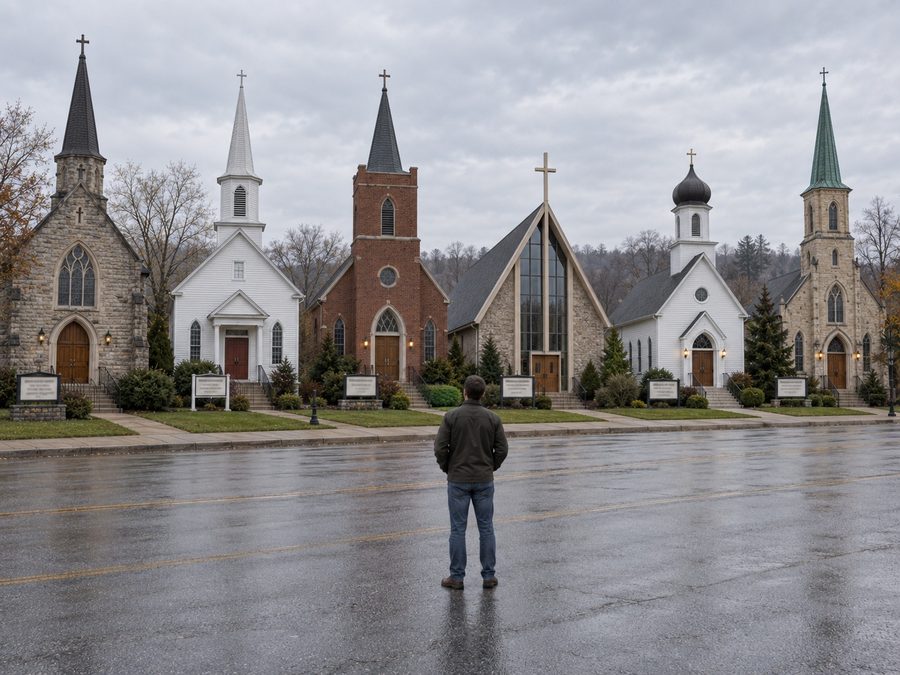
Lutheran
The Reformation’s first family, confessing the
Augsburg Confession (1530). Lutherans baptize infants,
confess Christ’s true body and blood in the Supper,
keep a liturgy Catholics would recognize, and retain more
of the old Church than any other family. The live dispute
with Rome is justification — and it is precisely
here that the 1999 Joint Declaration narrowed the
distance. Start with
Is Sola Fide True?
and Symbols, or Sacraments? —
where a Lutheran will find himself agreeing with half the
Catholic case against the memorialists.
Reformed and Presbyterian
Calvin’s heirs, confessing Westminster (1646) or
the continental Three Forms of Unity. Infant baptism,
covenant theology, a high doctrine of Scripture, and
the strongest predestinarian teaching in
Protestantism. The central disputes are authority and
election: begin with
Is Sola Scriptura Scriptural?,
then Predestination, Election, and Free Will
and Can You Know You Are Saved?
Anglican
The English middle way, with the Thirty-Nine Articles and
the Book of Common Prayer — episcopal in order,
liturgical in worship, and internally divided between
catholic-leaning and evangelical wings. The historic
dispute is the one that created it: papal authority.
Start with Peter and the Papacy
and Apostolic Succession.
Methodist and Wesleyan
Wesley’s revival, warm-hearted and Arminian:
grace resistible, salvation losable, holiness pursued.
A Methodist already agrees with Rome against Calvin on
free will and perseverance — which reframes the
whole conversation. Start with
Can You Know You Are Saved?
and Is Sola Fide True?
Baptist
Believer’s baptism by immersion, congregational
independence, and ordinances rather than sacraments
— the Baptist Faith and Message is the largest
American confession. The disputes are baptism and the
Supper’s nature: start with
Should Babies Be Baptized?
and Literal Body and Blood?
Pentecostal and Charismatic
The twentieth century’s great growth: the
Spirit’s gifts active now, worship expressive,
structure light. A Pentecostal’s instinct that God
still acts — heals, speaks, moves — is a
Catholic instinct too; the Church has never taught that
miracles ceased. The dispute is discernment and
authority: start with
One Church, or Many?
and Rational to Believe in Miracles?
Restorationist
The churches of Christ and their cousins, seeking the
New Testament pattern with no creed but the Bible. The
premise — that the Church fell and must be
restored from the book alone — is the Watchtower’s
premise in a milder key, and the same two pages answer
it: Was There a Great Apostasy?
and Is Sola Scriptura Scriptural?
Non-Denominational Evangelical
The largest and least defined family: Bible church,
worship band, statement of faith on the website —
usually Baptist in practice, Zwinglian at the table, and
unaware of holding a tradition at all. That last is the
place to begin, gently: everyone has a tradition; the
only question is whether it is examined. Start with
Is Sola Scriptura Scriptural?
and Why Do Catholic Bibles Have More Books?
If You Came Here from the Watchtower
Many former Witnesses find their way to an evangelical church
first, and for good reasons: the Bible is open, nobody reports
your hours, and Christ is preached as God. Two things are worth
knowing before you settle. The first is that the churches above
disagree with one another on baptism, the Supper, and how a
person is saved, and every one of them shares with the Catholic
Church the Trinity, the creed, and the canon you were taught to
distrust; the map above is the map of what remains once the
Watchtower’s objections are gone. The second is the fear
that a Magisterium is another Governing Body. It is not, and the
difference is checkable: a public succession any historian can
trace, a defined faith that has not been reissued, penalties that
touch the sacraments and never your family’s table. The
pages that test that claim are, in order,
Is Sola Scriptura Scriptural?,
Is Sola Fide True?,
and Can You Know You Are Saved?,
and the page for a former Witness who wonders whether Rome is
simply Brooklyn with older furniture is
Is This Just Another Governing Body?.
Why the Map Matters
Two honest observations close the page. First, the
families above refute one another: on baptism, the
Supper, election, and order, they cannot all be right,
and each claims the same Bible read the same way. That fact is not a refutation of sola scriptura — a
doctrine is not false because its holders disagree — but it
is the hardest question the doctrine must answer: what the
clarity of Scripture means when serious readers of one text divide
on baptism and the Supper. A Protestant reader feels its force
long before Rome says a word. Second, whatever family you come from, you
already agree with the Catholic Church against some
other family on something important. The conversation
this site offers begins there — from agreement,
with your actual confession on the table, not a
composite nobody holds.