The Trinity: A Guide for the Perplexed
by Richard Whiting
© 2026 Richard Whiting. All rights reserved. May be reproduced in whole, with attribution. See the full notice at the end of this article.
I. Why the Confusion?
The doctrine of the Trinity sits at the center of Christian faith, and for many people it sits there like a logical contradiction. Three is one? One is three? What am I supposed to do with that?
That confusion rests on a single assumption: that the Trinity is arithmetic. It isn’t. The doctrine has never asked anyone to believe three equals one. It does not say God is made of three parts, or that there are three gods in a committee, or that God wears three masks at different moments. None of these is what the Church teaches, and none of them would survive serious examination if it did.
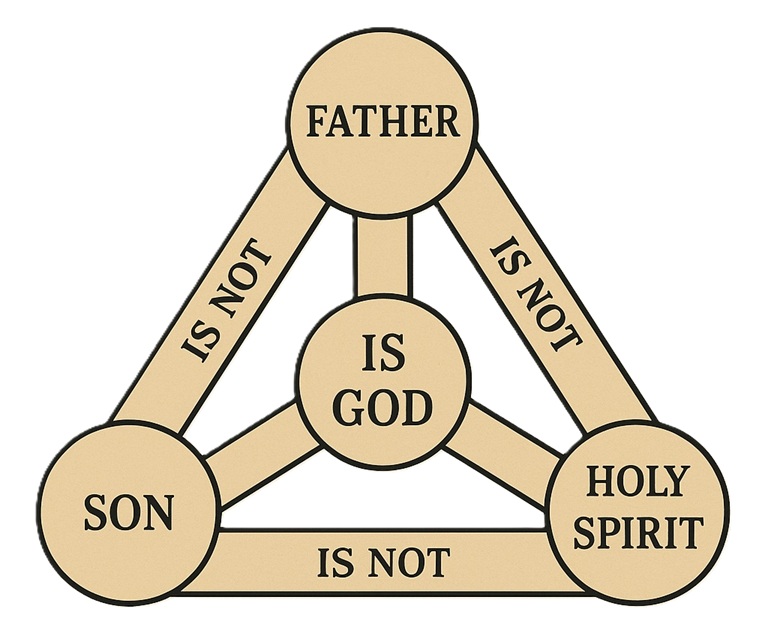
The doctrine of the Trinity is a claim about the inner life of God at the deepest experience of His own being — that the one God we encounter in Scripture is, in His own inner life, not solitary but eternally relational — Father, Son, and Holy Spirit — three real and eternal relationships within one undivided divine being. It is an answer to two questions:
“What is God’s own inner life in His oneness?”
“What can we understand about His inner life, and how?”
These are questions of ontology and epistemology. And because these are questions about what is ultimately real (not just what appears to us), they have to be approached with patience, with humility, and with openness to the possibility that the answer may be larger than the question.
What follows is an attempt to open the door slightly and show what stands on the other side: a picture of God as He has revealed His inner nature, the ultimate reality that is beyond our limited capacity to explain. This is the very definition of religious “mystery”: a truth of God that exceeds the full grasp of human reason, yet is genuinely revealed and partially knowable — an ultimate truth about reality that human imagination could not have originated on its own. The topic is genuinely complex, and the picture emerges in stages — each section building on the ones before it.
II. The Limits of What We Can Know
Any argument about who God is has to begin with an honest assessment of what kind of knowing we are capable of in the first place. The human mind is finite. God, by any serious definition, is infinite. The implication is straightforward: if God exists at all, He is not the kind of reality the human intellect will fully encompass. He will have to disclose Himself, and we will have to receive that disclosure with the appropriate humility. A God we could fully grasp would, by that very fact, be smaller than the mind grasping Him — an idol of our own making, however well-intentioned. Augustine put this in a single sentence: if you understand it, it is not God.1
Some find this answer evasive. “You are appealing to mystery,” the objection runs, “to excuse yourself from defending a claim that does not actually make sense.” But the appeal to the limits of human reason is not an evasion. It is a recognition of something we already know to be true in less controversial settings. We routinely accept realities we cannot fully comprehend, and we do not consider this a defect in the realities.
The point can be made with an example from mathematics. In 1931 the logician Kurt Gödel proved, with mathematical rigor, that any consistent system of reasoning powerful enough to do basic arithmetic must contain true statements it cannot prove. Reason itself, applied to its own foundations, established that reason has a horizon it cannot cross — and the proof is universally accepted. The mind, in other words, can demonstrate its own limits.
This is not an argument proving the Trinity. It is a demonstration that exceeding the limits of our intuition is not, by itself, evidence that something is unreal or incoherent. The doctrine of the Trinity is not under any obligation to fit neatly inside the human mind. The mind’s difficulty with it is not evidence against the doctrine. It is exactly what one should expect when a finite mind turns toward an infinite reality. We would not expect a character in a novel to explain the author who wrote him, and we should not be surprised — in a far greater way — when a creature cannot fully explain his Creator. What we can ask of the doctrine is that it be coherent, that it be consistent with what God has revealed of Himself, and that it survive honest examination of the objections raised against it. To those questions the rest of this defense is addressed.
III. Two Words Worth Learning: Being and Knowing
Two Greek words deserve a brief introduction, because the entire defense of the Trinity hinges on keeping them separate, and almost every confusion about the doctrine traces to muddling them together.
The first is ontology, which means the study of what is — what something really and truly is, in itself, independent of any observer. The second is epistemology, the study of how we come to know — our grasp of that being from within our own limited ability.
The distinction matters more than it sounds. A person blind from birth can become a leading expert on the optics of color — every wavelength, every neural pathway, every measurement we have ever made. He still will not know what red looks like. The reality of color does not depend on his grasp of it; the limit of his grasp does not diminish what color is. What a thing is, and what we can know of it from where we stand, are two different things — and the second does not bend to the limits of the first. Some realities, by their very nature, are accessible only from inside the experience of them.
Now apply this to God. The doctrine of the Trinity is an ontological claim. It is a statement about what God actually is in His own inner life. It is not a theory the Church invented and then defended. It is a disclosure — something God has shown about Himself, first through the long preparation of Israel, then in the person of Jesus Christ, and finally in the outpouring of the Holy Spirit on those who had known Christ. The Church, reflecting on what was received, reached for the language of one divine being and three eternal relations not to explain the mystery but to guard it — to say, faithfully, what must not be denied since it had been revealed by God Himself.
IV. How Scripture Reveals the Triune God: The Old Testament
Because the Trinity is sometimes accused of being a doctrine read into the Bible (eisegesis) rather than out of it (exegesis), the scriptural evidence needs to be laid out directly. There is more of it than people often realize. The word “Trinity” is not in the Bible, but the reality is seeded throughout — hinted at in the Old Testament, openly displayed in the New. Scripture’s revelation of the triune God was gradual.
The unity of God
Christianity, like Judaism, is monotheistic. The bedrock confession of Israel is the Shema: “Hear, O Israel: the Lord our God, the Lord is one” (Deuteronomy 6:4). In Hebrew it reads: “Shema Yisroel Adonoi Eloheinu Adonoi Echad.” The Trinity does not contradict this confession; it deepens it. Christians do not believe in three gods. We believe in one God whose inner life is relational.
The Hebrew word for "one" in this verse, echad, will not by itself decide the question. The word means "one," and that is all it means; it does not, on its own, prove plurality within God. But neither does it foreclose plurality. Echad is the ordinary word for numerical oneness, used freely of simple unities and of complex ones — the "one flesh" of husband and wife in Genesis 2:24 being a familiar example. The point of the Shema is not to define the inner metaphysical structure of God’s being, but to command exclusive worship of Yahweh in the face of the surrounding polytheism. Israel is being told to worship the Lord alone, not many gods alongside Him. Several modern translations bring this out by rendering the verse in terms of exclusivity rather than bare numerical oneness. The NASB has, “Hear, O Israel! The LORD is our God, the LORD alone!” The Jerusalem Bible reads, “Listen, Israel: Yahweh our God is the one, the only Yahweh.” The Lexham, Amplified, and other modern translations render the verse similarly. None of this weakens biblical monotheism; it strengthens it by reading the Shema for what it actually says. The verse forecloses polytheism. It does not foreclose the fuller revelation that the one God whom Israel was commanded to worship has, in His own inner life, an eternal relational structure that the New Testament will openly disclose.
A related concern is sometimes raised by the strongest unitarian-sounding verses in Israel's prophets. Isaiah, in particular, has the Lord declare with great force: "I am the first and I am the last; besides me there is no god" (Isaiah 44:6); "I am the Lord, and there is no other, besides me there is no God" (Isaiah 45:5). Do these verses not exclude any kind of plurality within the divine being? They do not, and the same prophet shows why. They exclude what they were addressing: the worship of other gods alongside Yahweh, the polytheism of the surrounding nations. They do not exclude the fuller revelation of inner divine relationality, because the same Isaiah gives us Isaiah 48:16. Throughout that chapter the speaker is the Lord himself — "I am the first, I also am the last" (v. 12) — and yet in verse 16 that same divine speaker says: "And now the Lord God has sent me, and his Spirit." The one speaking as God; the Lord God who sends him; the Spirit sent with him — three distinct figures, in a single verse, from the very prophet who most uncompromisingly rules out other gods. The two are not in tension once the categories are kept clear. Old Testament monotheism rules out other gods. It does not rule out the Father, the Son, and the Holy Spirit being one God. The New Testament does not abolish the monotheism of Israel; it discloses what was always true within it.
Old Testament foreshadowings
The full revelation of the Trinity awaited Christ, but the Old Testament contains a series of remarkable hints. These should not be overstated. Read on their own terms within ancient Israelite religion, none of these passages strictly teaches a doctrine of the Trinity, and the early Christians did not claim that they did. What the Christian tradition does claim is that, read in light of what came later, these passages are difficult to dismiss as mere accidents of phrasing.
In Genesis 1, "the Spirit of God" hovers over the waters before creation begins, and God creates by speaking — "Let there be light" — a Word that goes forth and accomplishes its purpose. By the third verse of the Bible we already have God, His Word, and His Spirit acting together. Psalm 33:6 makes the pattern explicit: "By the word of the Lord the heavens were made, and by the breath of His mouth all their host." Notice what is being said. The Hebrew word for "word" is dabar; the word for "breath" is ruach — the same ruach that hovers over the waters in Genesis 1.
When the New Testament, written in Greek, takes up these same terms, dabar appears as logos and ruach as pneuma — the same logos that opens John's Gospel ("In the beginning was the Word [logos], and the Word was with God, and the Word was God," John 1:1) and the same pneuma that the New Testament uses of the Holy Spirit. The continuity is unmistakable. The Word by which the heavens were made in Psalm 33 is the Word who, John tells us, was with God in the beginning and was God, and through whom all things were made. The Psalm does not present God's Word and God's Breath as creatures God uses; it presents them as belonging to God's own divine life — going forth from Him to bring the heavens into existence. Creation is brought forth by God's own Word and Spirit — realities the Old Testament describes with the language of dabar and ruach, and which the New Testament later reveals more fully as the Logos and Pneuma: the eternal Son and the Holy Spirit.
In Genesis 18, the Lord appears to Abraham at the oaks of Mamre. The text says plainly, "The Lord appeared to Abraham" — and then says Abraham looked up and saw three men. He addresses them as one ("My lord, if I have found favor in your sight, do not pass by your servant"), and the conversation that follows alternates between the singular and the plural. The text is patient of a reading in which the three speak as one Lord, and in which the one Lord is glimpsed as three. From very early, the Church Fathers read this passage as a prefiguring of the Trinity.
Other passages reinforce the pattern. Genesis 1:26 has God saying, "Let us make man in our image, after our likeness" — a plural that does not sit comfortably with the standard explanations: angels are not creators and do not share the divine image, and the plural of majesty was not standard biblical usage for God. Proverbs 8 has divine Wisdom speaking as a person who was "with God" before creation, "rejoicing before Him always." The seraphim in Isaiah 6:3 cry "Holy, holy, holy" — a triple the Fathers read as one more quiet signal of the same triune reality.
None of this would have been enough, on its own, to establish the doctrine. But once Christ had come and the Spirit had been poured out, these passages stopped looking like coincidences. They looked like preparation.
V. How Scripture Reveals the Triune God: The New Testament
When we open the New Testament, the Trinitarian pattern is everywhere, even before any theologian sets out to formulate it. There is no attempt to prove the Trinitarian formula in the Gospels or in the other books of the New Testament — it is already assumed, because it was the experience of the Church. It was already the sacred tradition handed on from the apostles to their successors and disciples.
Christ’s ministry opens and closes with all three Persons named together. At the Jordan, the Son stands in the water, the Spirit descends as a dove, and the Father’s voice comes from heaven: “This is my beloved Son, with whom I am well pleased” (Matthew 3:16–17). Three distinct subjects: the voice from above is not the dove descending, the dove descending is not the Son being baptized, and yet all three act as one God. At the close of His earthly ministry Christ commissions His Church with the same triadic name: “Go therefore and make disciples of all nations, baptizing them in the name of the Father and of the Son and of the Holy Spirit” (Matthew 28:19). One name, three Persons under it. Christ does not say “names.” Between these two baptismal scenes — the one He receives and the one He commands — His public life is bracketed by the unmistakable presence of the Triune God.
The Gospel of John, more than any other New Testament book, is written to make clear who Jesus is. From the first verse to the last chapter, John builds a case for the divinity of Christ that is calibrated to two audiences at once: monotheistic Jews who would recognize claims to the divine name and divine prerogatives, and philosophically educated Gentiles who would recognize the language of Greek metaphysics. The Gospel is constructed so that neither audience can miss the point.
The Gospel opens with the famous prologue: "In the beginning was the Word, and the Word was with God, and the Word was God" (John 1:1). The grammar is precise. The Word is with God [i.e., the Father, whom Jews recognized as God throughout the Old Testament] — distinct from Him — and yet is God, sharing His very nature.
Throughout that Gospel, Jesus speaks of His unique relationship with the Father in ways that no prophet ever dared. "I and the Father are one" (John 10:30). "Before Abraham was, I AM" (John 8:58) — a direct claim to the divine name from Exodus 3:14, and one His Jewish hearers understood perfectly, since they immediately picked up stones to kill Him for blasphemy. "He who has seen me has seen the Father" (John 14:9). "I am in the Father and the Father in me" (John 14:10-11). "And the Word became flesh and dwelt among us, full of grace and truth; we have beheld his glory, glory as of the only-begotten Son from the Father" (John 1:14).
The structural climax of the Gospel comes at its end. The risen Christ appears to Thomas, who falls before Him and says, "My Lord and my God!" (John 20:28). The phrase is exactly the one a devout Jew would address to Yahweh alone. Thomas could not have used those words of any creature, however exalted, without committing the gravest blasphemy. And Jesus does not correct him. He receives the confession as His due. John then tells us why his Gospel was written: "These are written that you may believe that Jesus is the Christ, the Son of God, and that believing you may have life in His name" (John 20:31).
The book ends as it began — with the unambiguous confession that the man who was crucified is the Lord God Himself. From "the Word was God" in the first verse to "my Lord and my God" in the last chapter, John has made his case, and his stated purpose is now explicit: he wrote the entire Gospel so that we would arrive at exactly the confession Thomas made.
The case John builds in his Gospel does not stand alone. The Synoptic Gospels — Matthew, Mark, and Luke, written independently and often emphasizing different aspects of Christ's ministry — corroborate it at its most decisive moment. At Christ's trial before the Sanhedrin, the high priest Caiaphas asks Him directly, "Are you the Christ, the Son of the Blessed?" Jesus answers, "I am; and you will see the Son of Man seated at the right hand of Power, and coming with the clouds of heaven" (Mark 14:61–62; cf. Matthew 26:63–64; Luke 22:67–70). The high priest tears his clothes and declares, "You have heard his blasphemy." The Sanhedrin condemns Him to death (Mark 14:63–64). The detail matters. Claiming to be the Messiah was not, in itself, blasphemy under Jewish law; many Jews would claim messianic identity in that century without facing this charge.
The verdict turned on the second half of Christ's answer. He invoked Daniel 7:13–14, where "one like a son of man" comes with the clouds of heaven and is given everlasting dominion such that "all peoples, nations, and languages should serve him" — the verb the Septuagint renders as latreuō, the worship due to God alone. He further invoked Psalm 110:1, "The Lord said to my Lord: sit at my right hand," placing Himself on the heavenly throne beside YHWH. To the high priest, formed in the Hebrew Bible, this was not a messianic claim. It was a claim to share in the very prerogatives of YHWH. The hostile witness of His judges is one of the strongest pieces of evidence that His claims to divinity were heard exactly as such. The high priest tore his clothes not because Jesus had claimed messianic identity but because He had claimed something no Messiah ever claimed and no creature could rightly claim: a seat on the heavenly throne at God's right hand, and the universal sovereignty that belongs to God alone. The verdict was blasphemy, and the Synoptics independently preserve it.
Elsewhere Scripture is explicit that the Son is no mere creature — not even the highest of created beings. Hebrews 1:5–6 asks rhetorically, "For to what angel did God ever say, 'You are my Son, today I have begotten you'? Or again: 'I will be to him a father, and he shall be to me a son'? Or again, when he brings the firstborn into the world, he says, 'Let all God's angels worship him.'" The inspired author distinguishes sharply between the only-begotten Son and every created angel: angels worship the Son, and the Son receives that worship as His due. No creature, however exalted, occupies that place.
Paul makes the same case from a different angle in Colossians 1:15–19: "He is the image of the invisible God, the firstborn of all creation; for in him all things were created, in heaven and on earth, visible and invisible, whether thrones or dominions or principalities or authorities — all things were created through him and for him. He is before all things, and in him all things hold together... For in him all the fullness of God was pleased to dwell." Notice what Paul does. He calls Christ "firstborn of all creation," and then, in the very next breath, explains why: not because Christ is the first thing made, but because all things were created through Him and for Him. The Greek word prōtotokos ("firstborn") here means primacy of rank, not chronological priority — a usage attested throughout Hebrew Scripture, where Israel is called God's "firstborn" (Exodus 4:22) without implication that Israel was God's earliest creation. Paul forecloses the misreading explicitly: a creature cannot be the agent through whom all things are created, since that creature would itself be among the things created. The Son stands on the Creator's side of the divide between Creator and creation. He is "before all things." In Him "all the fullness of God was pleased to dwell." This is not the language of an exalted creature. It is the language of God Himself, taking on flesh.
The same pattern shows up across the Pauline correspondence and elsewhere. Paul's benediction to the Corinthians has been used in Christian worship ever since: "The grace of the Lord Jesus Christ and the love of God and the fellowship of the Holy Spirit be with you all" (2 Corinthians 13:14) — three Persons, addressed as the source of distinct gifts, in one prayer. The same triadic structure appears in 1 Peter 1:2 ("according to the foreknowledge of God the Father, in the sanctification of the Spirit, for obedience to Jesus Christ"), in Ephesians 4:4–6 ("one Spirit ... one Lord ... one God and Father of all"), and in dozens of other places. Gordon Fee, in his comprehensive study God's Empowering Presence: The Holy Spirit in the Letters of Paul2, characterizes Paul's view as a "soteriological and functional Trinitarianism" — meaning that the Trinitarian shape of Paul's thought shows up most clearly precisely where he is describing how God saves, not in formal theological exposition. The Trinitarian structure is not a doctrine Paul argues for. It is a reality he assumes.
The personal divinity of the Holy Spirit
Because the Spirit's personhood is more often denied than the Son's in modern objections, it is worth pausing over the evidence. Throughout the New Testament the Spirit does things only a person can do. He teaches (John 14:26). He bears witness (John 15:26). He convicts of sin (John 16:8). He guides into truth (John 16:13). He intercedes for believers "with groanings too deep for words" (Romans 8:26). He speaks (Acts 13:2), forbids (Acts 16:6–7), appoints (Acts 20:28), and can be grieved (Ephesians 4:30) and lied to (Acts 5:3). In the same passage in Acts, Peter equates lying to the Holy Spirit with lying to God: "You have not lied to men but to God" (Acts 5:4). One sentence affirms both the Spirit's personhood and His divinity.
An impersonal force is not lied to, grieved, or blasphemed. A force does not appoint church leaders or distribute spiritual gifts "as He determines" (1 Corinthians 12:11). The Spirit's actions throughout the New Testament are the actions of a personal divine agent, not an impersonal divine influence.
Christ's own testimony confirms what the Spirit's actions show. In John's Gospel Jesus promises to send "another Helper" — the Holy Spirit — "whom the Father will send in my name" (John 14:26). The Greek word translated "another" is allos (ἄλλος), distinct from heteros (ἕτερος), which also can mean "another." Where the New Testament maintains the classical distinction, allos denotes "another of the same kind," while heteros denotes "another of a different kind." W. E. Vine, in his Expository Dictionary of New Testament Words3, comments on this very verse: "When Christ said, 'I will make request of the Father, and He shall give you another Helper (allon Parakleton),' He made a tremendous claim both for Himself and for the Spirit, for allos here implies the personality of the Spirit, and the equality of both Jesus and the Spirit with the Father." Vine's final step — equality with the Father — goes beyond what allos alone can establish; the word compares the second Paraclete to the first, not either to the One who sends them. But the rest of his point holds: allos implies the Spirit's personality and His same-kindedness with the Son. The Spirit Christ promises is not a lesser substitute. He is another of the same kind as Christ Himself — Christ's personal presence by another mode, sharing fully in the same divine nature.
VI. Why a Solitary God Cannot Be Love
Scripture has now shown us that Father, Son, and Holy Spirit are presented as one God — prepared for in the Old Testament and openly displayed in the New. Before turning to the doctrinal formulation that the Church drew from this revelation, one further consideration drawn from the very nature of love itself deserves attention. More than any other consideration, this argument has persuaded thoughtful inquirers of the inner reasonableness of the Trinity. The argument runs through what Scripture says about the very nature of God.
The First Letter of John says simply that God is love (1 John 4:8). That is a very strong sentence. It does not say God is loving, or that God has love, or that God shows love. It says that love is what God is. At the deepest level of the divine being, love is not something God does; it is something God is.
Now consider what love requires at its fullest. Love is not a solitary act. One can love oneself, and one can intend love toward beings one has not yet made — but love in its richest sense is something else: a giving of oneself to another, and the other's free return of that gift. A lover with no beloved has the disposition without the act, the capacity without its exercise.
The implication, applied to God, is difficult to avoid. If God is love in His very being — not just in His behavior toward creatures, but in Himself, eternally — then there must be, within the one God, someone to love, someone loved, and the love between them. Otherwise love in this fullest sense is not what God is. At best it is something God does once He has made creatures to love. At worst it is an event that happened to God; before there was anyone to love, God was not yet loving in this richest sense.
Neither alternative is acceptable, and neither matches what Scripture actually says. Classical theism has always allowed for divine self-love and for love directed toward creatures once they exist, and the doctrine of the Trinity does not deny these. But love in this richest sense is not self-regard, and it is not a posture taken toward what one has made. Love in its fullest sense is interpersonal communion between equals: a Lover who eternally gives Himself to a Beloved, and a Beloved who eternally returns that gift. If God is love in His very being, then love so understood requires more than one within God Himself. Otherwise the strongest sense of "God is love" has to wait until creation supplies a recipient, and what Scripture presents as constitutive of God's eternal being becomes, on closer inspection, a creaturely afterthought.
The twelfth-century theologian Richard of St. Victor pressed this argument with precision.4 A truly loving being, he wrote, must have a beloved — so the divine being must contain at least two. But a perfectly generous loving being would not hoard that love as a closed exchange between two; he would rejoice to share it with a third. The most perfect love is not the love of two who turn inward toward each other, but the love of two who together turn outward to share what they have. Therefore, Richard concluded, the God who is love must be, in His own eternal life, a communion: a Lover, a Beloved, and the Love they share, opening outward.
This is not offered as a strict proof. Philosophy alone could never arrive at the Trinity with certainty; the doctrine had to be revealed. But the convergence is striking: what philosophy inferred, Scripture announced. The God who tells Moses “I AM WHO AM” at the burning bush is the same God who shows Himself at the Jordan as a voice from heaven, a Son standing in the water, and a Spirit descending. One God — but never alone. One God — eternally relational. Love at the very root of all that is.
And this gives us the connecting thread between Scripture and what follows. The biblical witness presents Father, Son, and Holy Spirit as one God; the philosophical reflection on what “God is love” must mean shows that this is not merely consistent with one God but is in fact what one God, if He is love, must be. The doctrine is then no longer a strange addition to monotheism. It is the only form of monotheism in which the central biblical claim about God’s very nature is fully realized as eternal interpersonal communion.
VII. One God, Three Real Relationships
One God, in three Persons: Father, Son, and Holy Spirit. This is the doctrine — what the Church reflected on, defended, and confessed after spending two centuries living within it.
The word “Persons” here is where much of the trouble starts. In modern English, “person” means an individual with his own thoughts, memories, and body, distinct from every other such individual. If there were three persons in that sense in one God, there would plainly be three gods, and the doctrine would be nonsense.
But that is not what the classical language means. The words the Church settled on — Latin persona, Greek hypostasis — carried a different weight. They meant something closer to “a real, subsistent standing” or “a distinct relation of being.” In their Trinitarian use, each Person is what classical theology calls a subsistent relation — not a relation as an abstraction, but a real, conscious "who" within the one divine being, constituted by His relation of origin. When this defense speaks of three Persons, the reader should not picture three minds the way one would picture three friends in a room. The technical term denotes three subsistent relations within one undivided divine being, not three contiguous psychological agents.
Because that older language can still feel foreign, the same idea may be better expressed another way: the doctrine of the Trinity teaches that there is one God in three eternal relationships. Not three gods. Not three parts of God. Not one God wearing three masks at different times. But the one living God, whose inner life is not solitary but entirely relational.
It helps to see what the doctrine denies. It denies three separate gods (the heresy of tritheism). It denies that Father, Son, and Spirit are merely three different ways the same one God shows up at different times (the heresy of modalism, sometimes called Sabellianism). It denies that God is assembled from three parts (which would make God a compound, and so not the simple ultimate reality He must be). It denies that the Son or Spirit are creatures rather than fully God (the heresy of Arianism, which the Council of Nicaea rejected in 325).
What the doctrine affirms is this: within the one, undivided, simple being of God there are three eternal "whos" — real personal subjects within one undivided divine consciousness — each constituted by His distinct relation of origin. The Father is who He is in eternally begetting the Son. The Son is who He is in being eternally begotten of the Father. The Spirit is who He is in eternally proceeding from the Father and the Son. These relations of origin are not attributes the Persons happen to have; they are what makes each Person the Person He is. Each can therefore properly be addressed not as a "what" but as a "who." Each is fully and wholly God. None is a third of God. Each shares wholly in the one divine nature. They are distinguished not by having different amounts of divinity but by how each stands, at origin, to the others.
It is worth saying clearly what the doctrine does not claim to do. It does not claim to explain how three Persons can be one God; it claims only to describe faithfully what God has revealed of Himself, while preserving His transcendent oneness. The Church does not pretend to have penetrated the inner mechanism of the divine life. What the Church says is: this is what has been disclosed, and any account that denies the unity of God or the distinct reality of the three Persons has departed from what was given. The doctrine is faithful description, not exhaustive explanation.
VIII. Origin, Word, and Love: The Three Eternal Relations
Here is the inner grammar of the divine life as the Christian tradition has understood it. Three relationships, each defined by origin.
The Father is the unoriginated origin. He is not begotten by anyone. He does not proceed from anyone. In an old Latin phrase, He is fons divinitatis — the fountain, the spring, the source from which the divine life flows. This is not to make Him “more God” than the Son or the Spirit; in the one divine being there is no “more” or “less.” It is rather to name His particular relational standing. The Father is the One from whom. The starting point. The source without source.
The Son is eternally generated from the Father. The Nicene Creed says He is "begotten, not made," and that distinction is important. To make something is to produce a thing other than yourself. To beget is to bring forth from within yourself something that shares your very nature, the way a human father brings forth a human son who is fully human. To say the Son is eternally begotten is to say that within the one life of God the Father eternally knows Himself, and that perfect self-knowledge is not merely an abstract thought but a real relational pole — the Word, the Son, the Father's own being expressed. This is why Hebrews 1:3 echoes John 1:14 when it describes the Son as "the radiance of the glory of God and the exact representation of His nature" (RSV). There was never a time when the Father was without the Son, because there was never a time when the Father was without His own perfect self-knowledge.
Here is where another common misconception arises: a human son necessarily comes after his father in time, but to apply this temporal necessity to the divine Father-Son relation is a category error. Generation in God is not a temporal event; it is an eternal relation of origin. The Father is the unoriginated source from whom the Son is eternally begotten.
The Holy Spirit proceeds from the Father and the Son. Here the language shifts — not “begotten” but “proceeding.” The Spirit is not a second Son; the relation is something else again. The Holy Spirit is the Love eternally shared between the Father and the Son, so real, so substantial that He too is a relational pole in the one divine life. Just as knowledge unites a mind to what it knows, love unites the one who loves to the one who is loved. In God, that love is not a passing feeling; it is a conscious reality. The Spirit is that Love, eternally breathed forth, proceeding from the Father and the Son — the bond who is Himself a “who.”
Notice what these three relationships have in common. Each is defined by its origin, or, in the Father’s case, by having no origin. The Father is the Father because He eternally begets the Son. The Son is the Son because He is eternally begotten of the Father. The Spirit is the Spirit because He eternally proceeds from the Father and the Son. None of these relations comes from outside the divine life and gets added on. Each one is a way of being God.
The phrase the early Church settled on for this is “relation of origin”5 — and despite its dryness it is doing real work. It denies that the Son and Spirit are less divine than the Father; they are fully and equally God. It denies that there is any gap of time or substance between them; they are co-eternal. What it affirms is structure. The Father is the principle without principle. The Son is eternally from the Father. The Spirit is eternally from the Father and the Son.
IX. How the One God Acts: From the Father, Through the Son, by the Holy Spirit
One of the most beautiful and practical consequences of this inner structure deserves special attention, because it is too rarely taught.
Because God is one, every divine action is one action. The Father does not do some things while the Son does others and the Spirit does a third set. There is no division of labor within God, as though the office had been split into three departments. When God acts, He acts wholly, simply, and as one God.
But every divine action, being the action of a triune God, carries within it a Trinitarian grammar. Every act of God originates with the Father, is enacted through the Son, and is completed by the Holy Spirit. From, through, and by. This is the pattern of everything God does.6
This is not arbitrary. It follows directly from the inner life of God. The Father is the origin, so every action has its source in Him. The Son is the Word, the Father’s perfect expression, so every action is enacted through Him as a thought is enacted through the word that gives it form. The Spirit is the Love who perfects and completes, so every action reaches its fulfillment by Him. The same “from, through, and by” that describes the inner life of God also describes how the one God interacts with the world.
One clarification before turning to examples. Modern readers are inclined to picture this inner life as three minds working in concert — three centers of consciousness coordinating their wills. The Church has consistently resisted this. To picture the Trinity that way is to picture three gods, however cooperative; it fragments the divine being into three of what Scripture insists there is only one of. The classical formulation is exact: one essence, one intellect, one will, one operation in God. The Father, the Son, and the Spirit do not have three minds that happen to agree. They share — and more deeply, they are — the single divine knowing and willing, distinguished only by their relations of origin within the one indivisible life of God.
Look at how this plays out in what God has actually done.
Creation. Genesis tells us that in the beginning God created the heavens and the earth. But look at the next verses. The Father wills; the Word speaks (“Let there be light”); the Spirit hovers over the waters, giving life to what has been spoken. From the Father, through the Word, by the Spirit, the world comes to be. John’s Gospel confirms the pattern: “All things were made through Him, and without Him was not any thing made that was made” (John 1:3).
The Incarnation. The angel says to Mary, “The Holy Spirit will come upon you, and the power of the Most High will overshadow you; therefore the child to be born will be called holy — the Son of God” (Luke 1:35). The Father sends; the Son comes, taking flesh; the Spirit is the One by whom it all comes to pass in Mary’s womb. The pattern holds.
Salvation. “For God so loved the world that He gave His only Son” (John 3:16). The Father plans it. The Son enacts it, living, dying, and rising for our salvation. The Spirit, poured out at Pentecost, applies to each believer what the Son accomplished. Of Jesus Paul writes, “Through Him, we both have access in one Spirit to the Father” (Ephesians 2:18) — the same pattern in reverse.
Christian prayer. Our prayers have had, from the very beginning, a Trinitarian shape. Christ Himself signaled it when He told the Samaritan woman that "the true worshipers will worship the Father in spirit and truth" (John 4:23–24). Read in light of what the same Gospel later reveals — that Christ is the Truth (John 14:6) and that the Holy Spirit is the Spirit of truth (14:17, 15:26, 16:13) — His words trace the Trinitarian shape from the worshiper's side: worship offered to the Father, in the Spirit, through the Son who is the Truth. We pray to the Father, through the Son (our one mediator), in the Holy Spirit (who, as Paul says in Romans 8:26–27, prays within us when we do not know how to pray as we ought). The old Eucharistic prayers close, "Through Him, and with Him, and in Him, O God, almighty Father, in the unity of the Holy Spirit…" That is not pious decoration. It is the exact grammar of how God acts, and of how we, drawn into His action, respond.
Once you begin to see the pattern, you see it everywhere. Every blessing of God flows from the Father’s initiative, passes through the Son who is the expression of the Father’s mind and heart, and arrives by the Holy Spirit who makes it real in our lives. And every movement of our lives toward God travels the same route in reverse: the Spirit draws us, the Son opens the way, and we arrive home in the Father.
X. Imperfect but Useful Analogies
Every analogy for the Trinity is imperfect — and the imperfection is part of the lesson. Anything in creation is itself a creature, and a creature can echo its Creator only partially. Still, partial illustrations can help, so long as we are clear about where they fall short. Two analogies are worth examining — a simpler one that gives a partial visual grasp, and a deeper one that comes closer to the actual structure of the doctrine.
The coin
Consider a coin. A coin has two sides and an edge. The two sides are really distinct — heads is not tails, and tails is not heads — yet there is only one coin. The edge belongs to neither side alone; it proceeds, so to speak, from both, and joins the two together. You cannot have one side of a coin without the other; the very being of “heads” is bound up with the existence of “tails,” and vice versa. And the edge is not a third coin, but a real feature of this one coin, related to and proceeding from both faces at once.
This gets at something true about the Trinity. The Father and the Son are really distinct, yet inseparable; you cannot have a Father without a Son or a Son without a Father, since each is what He is precisely in relation to the other. And the Spirit, like the edge, proceeds from both and binds them in one.
The analogy is admittedly imperfect. A coin is a single thing with two sides; neither side originates from the other. Heads does not generate tails. In the Trinity, by contrast, the Son is eternally generated from the Father — there is a real relation of origin between them. The coin captures the inseparability of the divine Persons and the procession of the Spirit from both Father and Son, but it does not capture the eternal generation of the Son from the Father, which is essential to who they are. So the analogy is useful only as far as it goes.
The mind
St. Augustine offered a different analogy7, which is in some ways more illuminating, because it gets at the relation of origin that the coin misses. The coin analogy is preliminary scaffolding, but the mind analogy comes closer to the inner shape of the doctrine itself.
A human person is plainly one. But within that one person, there is always a knower, a thing known, and a knowing that joins them. Or, put another way: a memory, an understanding, and a will — three distinct operations, never separable. As you read this paragraph, there is you — the self who remembers the last sentence, understands the words now under your eye, and wills to continue or to stop. Memory, understanding, and will are not three separate people inside your head. They are three ways in which your single soul is present to itself and to the world. Take any one of them away, and you stop being you.
Notice that the understanding genuinely arises from the memory — we cannot understand what we do not in some sense already hold — and that the will arises from both, since we love what we know. There is a kind of analog of generation and procession built into the structure of the human mind itself. This is precisely what the coin analogy could not show.
St. Augustine saw in this an echo of the interior life of the Creator. The Father eternally knows Himself; that perfect self-knowledge is a relational pole within the one divine life — the Son, the Word, the eternally generated. The Father and Son eternally love one another; that perfect love is another relational pole — the Spirit, eternally proceeding from both.
This analogy, too, ultimately falls short. A human being’s self-knowledge and self-love come and go; the divine Son and Spirit are eternal. Memory, understanding, and will are operations of one person, not Persons themselves; the Father, Son, and Spirit are really distinct “whos.” But the analogy gets one great thing right: oneness and inner relationality are not strangers to each other. We live that truth every time we think. And it gets a second great thing right that the coin could not — that the second relation arises from the first, and the third arises from both. The structure of generation and procession is something we can recognize, in a small way, from the inside of our own minds.
Why no analogy will be enough
The two analogies are useful here because each catches something the other misses, yet even both together necessarily fall short of the ineffable reality. The coin shows inseparability and procession-from-both, but not generation. The mind shows generation and procession by way of operations, but not three distinct “whos.” Together they suggest the doctrine without containing it. That is what we should expect. If any analogy could fully contain the Trinity, the Trinity would be small enough to be a creature. The wider Christian tradition has long noticed similar partial echoes — what Augustine called vestigia Trinitatis, “traces of the Trinity” in created reality — from the threefold structure of being, knowing, and willing in the human soul to the unity-in-diversity of communities of love.
XI. The Witness of the Earliest Christian Writers
Before turning to the standard objections, one historical observation deserves attention, because it settles a great many of those objections before they are even formulated. The Trinitarian faith of the Church can be traced, in writing, all the way back to the generation that personally knew the apostles. It is not a fourth-century construction. It is the faith of those whom the apostles themselves taught — and of their immediate students after them.
This matters because one of the most common objections to the Trinity treats it as a doctrinal innovation: a clever construction by Constantinian bishops (or Constantine himself!), imposed on a simpler primitive Christianity that had supposedly known nothing of it. The historical record refutes this directly. The men who studied at the feet of the apostles, and the men who studied at the feet of those men, are on record affirming what would later be called the Trinitarian faith — affirming it as something received, not as something newly proposed.
Trace the line.
Ignatius of Antioch (c. 35 – c. 107)
According to early tradition, Ignatius was a disciple of the apostle John. He served as bishop of Antioch — the city where, according to Acts 11:26, the disciples were first called Christians — and was martyred in Rome around the year 107, only a few years after the death of the last apostle. On the way to his execution he wrote seven letters that survive. They are not theological treatises; they are pastoral letters to churches and to individuals, and yet the Trinitarian shape of his thought is unmistakable.
He calls Jesus Christ “our God” repeatedly and without any sense of strain: “Jesus Christ our God,” he writes to the Ephesians, “was conceived by Mary according to the plan of God.”8 He speaks of “the Son of God who is from eternity with the Father.” He greets the Ephesians as those “united and elect through genuine suffering by the will of the Father and of Jesus Christ our God.” He speaks of being built into the temple of God the Father, “hoisted up to the heights by the engine of Jesus Christ, that is, the Cross, using as a rope the Holy Spirit.” The image is striking and the structure is plainly Trinitarian. This is a man writing to churches in roughly A.D. 107 — churches founded by the apostles, in a generation that still remembered them — and he is taking it for granted that the Father, the Son, and the Holy Spirit are all divine and all distinct, with each playing His proper role in the work of salvation.
Clement of Rome (writing c. 96)
Clement was a leader of the Roman church near the end of the first century. Tradition associates him with the apostles Peter and Paul, and Irenaeus places him in the third generation from the apostles. His one surviving letter, written to the Corinthian church around the year 96, contains the rhetorical question: “Have we not one God, and one Christ, and one Spirit of grace poured out upon us?”8 The triadic structure is again unmistakable, and again presupposed rather than argued for. Clement does not stop to defend the Trinitarian shape of his sentence; he assumes his readers will recognize it as the common faith.
Polycarp of Smyrna (c. 69 – c. 155)
Polycarp, on the testimony of his own student Irenaeus, was a disciple of the apostle John.9 He served as bishop of Smyrna for decades and was martyred there in old age around the year 155. The account of his martyrdom records the prayer he offered as he was about to be burned at the stake: “For this cause, and for all things, I praise you, I bless you, I glorify you, through the eternal and heavenly High Priest, Jesus Christ, your beloved Son, through whom be to you with him and the Holy Spirit glory, both now and to the ages to come.”8 It is a Trinitarian doxology spoken at the very moment of death, by a man whom early tradition remembers as having heard the apostle John preach in person. He is not inventing it. He is offering up to God, in his last conscious moments, what the apostles had taught him.
Justin Martyr (c. 100 – 165)
Justin was born around the year 100, converted from pagan philosophy in his thirties, and wrote at length to defend the Christian faith before being martyred at Rome around 165. In his First Apology, written for the Roman emperor, he describes Christian worship plainly: “We worship the Creator of all things, holding him in the second place, and the prophetic Spirit in the third.” The ranking language reflects an order of mention within Christian worship of the one God, an emphasis later sharpened at Nicaea but already plainly Trinitarian rather than Arian in its substance. He goes on to identify Christ as the Word (Logos) of God, calling him “true God,” and to insist that the same Word who appeared to Abraham and Moses became flesh in Jesus of Nazareth.10
Theophilus of Antioch (c. 180)
Theophilus, the seventh bishop of Antioch in succession from the apostles, is the first known writer to use the Greek word Trias — “Triad” or “Trinity” — of God. Writing around the year 180, he says: “The three days which were before the luminaries are types of the Trinity, of God, and his Word, and his Wisdom.”11 Latin would soon catch up: about A.D. 200, Tertullian of Carthage coined Trinitas in Latin, and articulated the formula “one substance, three persons” — a full century before Nicaea.12
Irenaeus of Lyons (c. 130 – c. 202)
Irenaeus is one of the most important figures in this chain, because he stands in a direct line of teaching from the apostles. He was a disciple of Polycarp, who was a disciple of John. In his great work Against Heresies, written around 180, he describes Christian baptism as taking place “into God the Father, and into Jesus Christ the Son of God who became incarnate and died and rose, and into the Holy Spirit of God.” He repeatedly refers to the Son and the Spirit as “the two hands of the Father,” through whom God created and continues to act in the world.13 He insists that this is not a teaching he has invented, but the teaching that the Church everywhere had received “from the apostles and their disciples.” He is explicit on this point: the Church, though scattered throughout the world, holds one and the same faith, handed down through public succession from the apostles — and that faith is the Trinitarian faith he proceeds to summarize.
What this chain of witnesses establishes
Notice what the historical record actually shows. By A.D. 107 a disciple of John is calling Jesus “our God” in pastoral correspondence and assuming the divinity of the Spirit. By A.D. 96 a leader of the Roman church is grouping Father, Son, and Spirit in a single rhetorical question. By A.D. 155 a disciple of John is offering Trinitarian doxology with his last breath. By A.D. 180 a bishop of Antioch is using the word “Triad” of God. By A.D. 200 Tertullian has coined the Latin word “Trinity” and laid out the formula “one substance, three persons.” All of this is generations before the Council of Nicaea was even called.
These men did not all live in the same place. They wrote in different languages — Greek and Latin — in different cities across the Mediterranean world: Antioch, Rome, Smyrna, Lyons, Carthage. They were not in committee. What they share is that they were taught, directly or at one remove, by the apostles. And what they handed on, with complete consistency, is the Trinitarian faith.
The literary evidence above is reinforced by something even older and more universal: the shape of the Church’s worship itself. Long before any council codified the doctrine, the Church baptized, prayed, and sang in Trinitarian forms received from the apostles. The Didache, a Christian instructional text that is dated by most scholars to the late first or very early second century, prescribes baptism “into the name of the Father and of the Son and of the Holy Spirit” — word for word the formula of Matthew 28:19. The earliest extant Eucharistic prayer, preserved in the Apostolic Tradition traditionally attributed to Hippolytus of Rome (early third century), is structurally Trinitarian: addressed to the Father, through the Son, in the unity of the Holy Spirit. The early Christian hymn Phos Hilaron (“Hail Gladdening Light”), still sung in the Eastern liturgy and dating to the late second or early third century, ends with a Trinitarian doxology.
The principle is ancient: lex orandi, lex credendi — the law of prayer is the law of belief. What the Church has always prayed reveals what the Church has always believed. The Trinitarian shape of Christian worship is older than the Trinitarian shape of any single Christian writing, because worship preceded writing. From its earliest practice the Church has addressed God in three breaths: to the Father, through the Son, in the Holy Spirit.14
XII. Arianism a Novelty, Not a Recovery
With this historical witness in view, we can now address head-on the most common modern objection to the Trinity: that it was an innovation imposed by the imperial Church in the fourth century, and that what came before was something simpler and more like what Jehovah’s Witnesses, Mormons, or other dissenting groups today claim — a unitarian Christianity in which the Son is a created being, and the Spirit is simply a force.
This account has the historical record exactly backwards. To see why, three distinct things have to be kept apart. First, there is the inherited worship and confession of Father, Son, and Spirit, which the Church had practiced from the apostles onward. Second, there is the later technical articulation of that faith in the formal vocabulary of substance, person, and procession — vocabulary that did indeed sharpen over time as controversies forced precision. Third, there is Arius’s specific claim that the Son is a creature, brought into existence by the Father and not eternally divine. The first was apostolic. The second was a clarification of the first. The third was a genuine novelty that broke from both. Arianism was the novelty. The Trinitarian faith was the tradition handed down from the apostles.
Arius was a priest of Alexandria who, beginning around A.D. 318, started teaching that the Son was not eternal — that there was, as he put it, ‘a time when the Son was not’. He held that the Son was the highest of created beings, brought into existence by the Father before the world was made, but a creature nonetheless, and not equal to the Father in divinity. This teaching attracted controversy quickly, because it ran directly against what the Church had always taught and prayed.
It is worth underlining how far Arius’s position was from the prior tradition. By the time he began teaching, the Trinitarian shape of Christian faith had been openly attested in writing for more than two hundred years — in Ignatius, in Clement, in Polycarp, in Justin, in Theophilus, in Irenaeus, in Tertullian, in Origen — and had been the unbroken practice of Christian baptism, Christian worship, and Christian doxology in churches founded by the apostles themselves. The Son had been called “our God” in writing within a decade of the death of the last apostle. The word “Trinity” had been used of God for over a century. The formula “one substance, three persons” had already been articulated by Tertullian. None of this was new.
Against that two-hundred-year inheritance, Arius set a teaching that no apostolic writer had taught and that no apostolic Father had handed on. He did not appeal to a tradition; he appealed to philosophical inferences and to a handful of biblical proof-texts that, read in isolation, could be made to support a graded view of divinity. The Council of Nicaea in 325 was convened precisely because the older bishops recognized in Arius’s teaching a departure from what they had received. Of the roughly three hundred bishops present, only two failed to subscribe to the Creed that affirmed the Son’s full divinity — “true God from true God, begotten not made, of one substance with the Father.”15 That ratio is itself revealing. The bishops were not voting on which interpretation to canonize from a contested field. They were preserving, almost unanimously, the tradition they had inherited from their teachers, who had inherited it from theirs, in an unbroken chain reaching back to the apostles.
The Council of Constantinople in 381 did the same for the Holy Spirit, expanding the Creed to confess the Spirit as “the Lord and giver of life, who proceeds from the Father, who with the Father and the Son is adored and glorified.”16 Again, the council was not adding a new doctrine; it was clarifying, against later denials, what had always been the practice and confession of the Church.
When modern “restorationist” groups such as Jehovah’s Witnesses claim to be recovering the simple, original, pre-Nicene Christianity, what they are actually proposing is a much later philosophical reconstruction — one that the original Christians, living in Antioch and Rome and Smyrna in the generation after the apostles, would not have recognized. The pre-Nicene Christianity of the historical record is recognizably Trinitarian. The unitarian alternative is the genuine novelty, and it had to wait until the fourth century to appear in any serious form, and then to wait another fourteen centuries to find anyone willing to revive it.
The point is simply to correct a widely misunderstood historical case. Honest reasoning about the doctrine has to begin with an accurate picture of where it came from. The Trinity is not a fourth-century imposition on first-century faith. It is the apostolic faith itself, written down by those who learned it from the apostles, articulated more precisely as the centuries went on, and defended (when defense became necessary) against innovations that ran against it.
XIII. The Standard Objections, and the Replies
If the case for the Trinity were free of objections, it would not be worth defending. Several objections recur often enough that they deserve a direct response.
“The doctrine is a self-contradiction.”
A common objection is that the doctrine asserts a logical contradiction — that one equals three. It does no such thing. The classical formula is that God is one in essence and three in person. “One” and “three” are predicated of different categories. There is no contradiction in saying that something is one in respect to A and three in respect to B; that is exactly the structure of every coherent statement about a multifaceted reality. A triangle is one shape and three sides. A musical chord is one chord and three notes. Saying “the chord is one” does not contradict “the chord is three” once you specify that one is said of chordhood and three of notes. The Trinity is structured the same way.
“The Bible never uses the word ‘Trinity.’”
True, but irrelevant. The Bible never uses the word “omniscient” or “omnipresent” either, and yet the realities are taught throughout. The Bible never uses the word “monotheism,” but no one denies that monotheism is biblical. Doctrines are taught by what Scripture reveals, not only by which words it happens to use. The realities of one God, the full divinity of the Son, the personal divinity of the Spirit, and the distinction among the three are all clearly taught. The word “Trinity” is simply shorthand for what the Bible already presents.
“The Trinity was invented at Nicaea in 325.”
This was addressed at length in the previous section, so a brief summary will suffice here. The Council of Nicaea (325) did not invent the Trinity; it defended an existing teaching against the novelty of Arianism. Trinitarian baptismal formulas, doxologies, and confessions are present in Christian writings from the late first century onward, two and three generations before Nicaea. By the time Arius began teaching that the Son was a creature, the Church had been confessing the divinity of the Son and the Spirit in unbroken practice for two hundred years. Of the roughly three hundred bishops at Nicaea, only two failed to subscribe to the Creed. The Council did not innovate; it preserved. The novelty was Arius’s. The Council clarified what was already believed and had been for centuries.
"Many passages in the Gospels show Jesus as subordinate to or lesser than the Father. So He is not God."
This is one of the most common objections, and it usually comes with a list. Jesus says the Father is greater than He is (John 14:28). He prays to the Father (Matthew 26:39) — surely God does not pray to God? He says He does not know the day or hour of the end (Mark 13:32). He says He can do nothing of Himself (John 5:19, 30). He calls the Father "my God" (Matthew 27:46; John 20:17). He is hungry, tired, afraid in Gethsemane, and dies. Taken together, the objector says, this is not how God talks or acts.
The objection has real force, and it deserves a real answer. The answer the Church arrived at, by the time of the Council of Chalcedon in 45117, is that Jesus Christ is one Person with two complete natures — fully divine and fully human — neither confused nor separated. He is not partially God and partially man. He is wholly God and wholly man, in one Person. This is not a clever evasion; it is the only formulation that makes sense of the full New Testament witness, which describes Him at one moment as forgiving sins and receiving worship, and at the next as weeping at a friend's tomb. The two-natures doctrine reads both kinds of passages exactly as they stand.
Paul makes the dynamic explicit in Philippians 2:6–8. Christ "was in the form of God," yet "did not consider equality with God a thing to be grasped." Instead, He "emptied Himself, taking the form of a servant, being born in the likeness of men." The Greek word translated "emptied" is kenoō — a deliberate self-limitation. The eternal Son, in becoming man, took on real human limitations as part of taking on a real human nature: the need for sleep and food, ignorance of certain facts not given to His human consciousness, the experience of fear and grief, and finally the experience of death. None of this diminished His divinity. It expressed His divinity in the form of perfect obedience.
Read this way, the apparent objection patterns dissolve. Christ prays to the Father because He is genuinely human and human beings pray. He does not know the day or hour because He has freely accepted a human consciousness that does not know everything. He can do nothing of Himself because as the incarnate Son He acts in perfect filial dependence on the Father, modeling the very life He calls His followers to. He calls the Father "my God" from the cross because He is dying as a man, in solidarity with the human race He came to redeem. He is hungry and tired and afraid because He has taken on a real human body and a real human soul.
The same Jesus who says these things also says, in the same Gospels, "I and the Father are one" (John 10:30); accepts Thomas's confession "My Lord and my God" (John 20:28) without correction; forgives sins on His own authority (Mark 2:5–10); receives worship from disciples (Matthew 28:9, 17) and angels (Hebrews 1:6); and declares, "Before Abraham was, I AM" (John 8:58). The Gospels do not contain two contradictory portraits of Jesus that need to be reconciled. They contain one portrait of one Person who is both fully God and fully man, and who acts and speaks through both natures throughout His earthly life.
“The Holy Spirit is just God’s active force, not a person.”
This is the standard claim of Jehovah’s Witnesses and a few other groups. It cannot survive the actual text of the New Testament. As laid out above, the Spirit teaches, witnesses, convicts, intercedes, speaks, forbids, appoints, distributes gifts “as He determines,” can be grieved and lied to, and is identified with God in Acts 5. None of these is the action of a force. They are the actions of a personal divine agent. To call the Spirit a force is to ignore the verbs Scripture uses about Him.
The Greek text adds another piece of evidence, though it should be handled with care. The Greek noun for spirit, pneuma, is grammatically neuter, but in the passages where Jesus speaks about the Spirit — John 14, 15, and 16 — the masculine personal pronoun ekeinos (“He”) is used. Some grammarians attribute this to agreement with the masculine parakletos (“Advocate”) used in those same chapters; others argue the choice is theologically motivated, since ekeinos is sometimes used of the Spirit even where parakletos is not the nearest antecedent. Either way, the personal pronoun is consistent with what the actions in the verses also show: that the Spirit is a personal “He,” not an impersonal “it.”
A related sub-objection asks: how can the Holy Spirit be “poured out” and people be “filled” with Him if He is a Person (Acts 2:4, 33)? But similar metaphorical language is used of Jesus Himself — He is described as “poured out” in death (Philippians 2:7; Isaiah 53:12) and as dwelling within believers (Ephesians 3:17; Colossians 1:27; Galatians 2:20) — yet no Christian doubts that Jesus is a Person. Three times in the Gospel of John Jesus says that He is “in the Father” and the Father “is in” Him (John 10:38; 14:10-11). The metaphor of pouring or filling does not negate personhood; it describes a particular mode of presence.
Another sub-objection runs like this: the Father has a name (Jehovah/Yahweh) and the Son has a name (Jesus), but the Holy Spirit does not have a name, so He cannot be personal. This objection rests on a category error.
First, "Yahweh" is not the personal name of the Father alone; it is the name of the one God whom Scripture later reveals to be triune. Both the Son and the Spirit are identified with Yahweh in the New Testament. Paul applies to Jesus the Joel prophecy that "everyone who calls on the name of the Lord shall be saved" (Romans 10:13, citing Joel 2:32) — where "the Lord" in Joel is the divine name Yahweh. And in Acts 28:25-27, Paul attributes Isaiah 6:9-10 directly to "the Holy Spirit" — though Isaiah names the speaker of that passage as Yahweh of hosts. The single divine name belongs to all three Persons, because there is one God.
Second, "Jesus" is not, strictly speaking, the eternal name of the divine Son; it is the name given to Him in His humanity ("you shall call His name Jesus, for He shall save His people from their sins," Matthew 1:21). The eternal Son existed and was the Son before the Incarnation; "Jesus" names what He became when He took on human nature for our salvation.
What remains, then, is that "Father," "Son," and "Holy Spirit" are not three proper names of the kind we use to distinguish individuals of the same kind. They are designations of relations of origin within the one Godhead — the Father unoriginated, the Son eternally begotten of the Father, the Spirit eternally proceeding from Father and Son. The objection treats the three Persons as if they should each have a proper name in the way you and I do; but Persons of the Trinity are not three of anything that would require distinguishing proper names. They are the one Yahweh in three eternal relations.
“The Trinity was borrowed from pagan triads.”
This is historically another category error. Pagan triads (Isis-Osiris-Horus, for instance) describe three separate gods, often a divine family. The Christian Trinity teaches one God in three Persons. The two structures are conceptually opposite. The Christian Trinity grew out of strict Jewish monotheism, and its earliest defenders — Tertullian, Athanasius, the Cappadocians — were exquisitely sensitive to the danger of polytheism. They were not borrowing from paganism; they were defending against the misreadings that would have moved them in that direction.
“Trinitarian worship is incompatible with Jewish monotheism.”
A serious Orthodox Jewish objection to the Trinity holds that any inner-divine distinction is incompatible with the strict monotheism of Israel — that Trinitarian worship is, however carefully articulated, a form of avodah zarah, strange worship. This deserves a serious answer rather than a polemical one. Two points form the response. First, the Old Testament itself contains the seeds the New Testament will openly reveal — the plural of Genesis 1:26, the visitor at Mamre, the Word and Spirit of Psalm 33:6, the three speakers of Isaiah 48:16. These are not Christian re-readings of neutral texts; they are features of the Hebrew Scriptures themselves, features that have puzzled rabbinic commentators for two millennia. Second, the apostolic generation that recognized Christ as divine was itself Jewish. Peter, John, Paul, Thomas, and the rest were monotheistic Jews formed in synagogue worship. Their recognition of Christ as God did not come despite their Jewish monotheism but from within it. They did not believe they had abandoned the Shema; they believed they had finally understood what its one God had been preparing them to see. The Christian claim is that the inner relational life of the one God of Israel was disclosed, not invented, in Christ.
“If the doctrine cannot be understood, it cannot be believed.”
Anything fully comprehensible by a finite mind would not, on the standard definition, be God. We accept all sorts of things we cannot exhaustively understand. No physicist exhaustively understands quantum mechanics, yet physicists believe in it. No neuroscientist exhaustively understands consciousness, yet no one therefore denies that consciousness exists. No mathematician exhaustively grasps the higher infinities, yet no one therefore denies their reality. “I cannot fully understand it” is not, in any other domain, a sufficient reason to disbelieve. It would be strange to apply that standard only here, to the one subject — the infinite God — where exhaustive comprehension would actually disprove the very thing one was trying to know.
XIV. Putting It All Together
The human mind is finite; that is the plain fact of being a creature, and we meet it every day, not only in theology. Across every field where we operate — from the structure of consciousness to the behavior of subatomic particles to the reaches of mathematical infinity — we routinely accept realities we cannot fully comprehend, and do not consider this a defect in the realities themselves. We will not arrive at the doctrine of God by unaided faculties; God will have to disclose Himself, and we will have to receive that disclosure with appropriate humility.
The doctrine of the Trinity is a claim about what God actually is in His own being — not a theory the Church assembled, but a disclosure the Church received. The God revealed in Scripture is one God, not three. But He is not a solitary God, and He cannot be, because Scripture says He is love, and love by its very nature requires relationship. The one God is therefore, in Himself, an eternal communion: a Father who is the unoriginated origin, a Son eternally generated from the Father, and a Holy Spirit eternally proceeding from the Father and the Son. These three are not three gods but three real, eternal relationships within the one divine life. Each is fully God. Each is distinguished from the others only by how He stands, at origin, to the others.
And this inner life has an outward grammar. Everything God does flows from the Father, is enacted through the Son, and is completed by the Holy Spirit. Creation, incarnation, salvation, and the life of prayer all follow this pattern, because the God who acts is the God who, eternally, subsists as this pattern.
No one exhaustively understands the Trinity. St. Augustine wrote fifteen books on the subject in his treatise De Trinitate, and would have been the first to admit that he had barely scratched the surface. But the inability to exhaust a subject is not the same as inability to know it truly. We know our own minds, we know other persons, we know the natural world truly without exhausting any of them. The doctrine of the Trinity can likewise be known truly without being comprehended completely. The case for it, taken as a whole, is the most coherent and the most evidentially grounded account ever offered for the inner life of God — and the alternatives, when examined, fall short of what the Scriptural and historical evidence support.
One God. Three eternal relationships. Father, Son, and Holy Spirit — the Lover, the Beloved, and the Love they share. And this inner life of the Divine Trinity is the love into which Christians are invited. St. Peter describes it this way at 2 Peter 1:3–4: "His divine power has granted to us all things that pertain to life and godliness through the knowledge of him who called us to his own glory and excellence, by which he has granted to us his precious and very great promises, that through these you may escape from the corruption that is in the world because of passion, and become partakers of the divine nature." That invitation has been received and lived in the experience of the Church across twenty centuries — in the prayer of every saint — in the worship of every generation, in the sacraments through which Trinitarian life is poured into the soul. God's grace continues to invite us to participate in the very Trinitarian love that is the inner life of the One God.
Glory be to the Father, and to the Son, and to the Holy Spirit,
as it was in the beginning, is now, and ever shall be,
world without end. Amen.
Copyright and Distribution
© 2026 Richard Whiting. All rights reserved.
This essay may be reproduced and distributed freely, in printed or electronic form, provided that it is reproduced in whole and without alteration, and that the author’s name is retained. Excerpts may be quoted in reviews, scholarly works, or other writings consistent with fair use, with attribution. For any other use, including translation, adaptation, or partial republication beyond fair use, please contact the author.
A Note on Authority
This essay represents the author’s articulation of the Catholic doctrine of the Trinity, drawing on Scripture, the Catechism of the Catholic Church, the Church Fathers, and the major theological tradition. It is offered as a personal defense, not as an official statement of the Church’s teaching. Where this defense is fortunate enough to align with the magisterial teaching of the Church, the credit belongs to the tradition that formed it. Where it falls short, the responsibility is the author’s alone.
Endnotes
- Augustine, Sermon 117, 3.5: Si comprehendis, non est Deus. ↩
- Gordon D. Fee, God's Empowering Presence: The Holy Spirit in the Letters of Paul (Peabody, MA: Hendrickson Publishers, 1994), 839. ↩
- W. E. Vine, An Expository Dictionary of New Testament Words, s.v. “Another” (London: Oliphants, 1940; numerous subsequent editions). The fullest modern edition is Vine's Complete Expository Dictionary of Old and New Testament Words, ed. Merrill F. Unger and William White Jr. (Nashville: Thomas Nelson, 1985). ↩
- Richard of St. Victor, De Trinitate, Book III, esp. chs. 11–19; written c. 1162–1173. English translation: Richard of Saint Victor: The Twelve Patriarchs, The Mystical Ark, Book Three of The Trinity, trans. Grover A. Zinn (New York: Paulist Press, 1979). ↩
- Catechism of the Catholic Church, 2nd ed. (Vatican City: Libreria Editrice Vaticana, 1997), §254. ↩
- The Holy Spirit, Lord and Giver of Life: Catechetical Reflections in Preparation for the Great Jubilee of the Year 2000, Pontifical Committee for the Great Jubilee of the Year 2000 (New York: Crossroad, 1997), 19. ↩
- Augustine of Hippo, On the Trinity (De Trinitate), especially Books IX–XV, where the psychological analogies of memory, understanding, and will are developed. The complete treatise comprises fifteen books, written between approximately A.D. 400 and 417. English translation: Augustine, The Trinity, trans. Edmund Hill, in The Works of Saint Augustine: A Translation for the 21st Century, vol. I/5 (Hyde Park, NY: New City Press, 1991). ↩
- Citations of Ignatius are from his Letter to the Ephesians 18:2 and 9:1, and his Letter to the Magnesians 6:1; the Clement citation is from 1 Clement 46:6; the Polycarp doxology is from the Martyrdom of Polycarp 14. All follow the standard text and numbering of The Apostolic Fathers, ed. and trans. Bart D. Ehrman, 2 vols., Loeb Classical Library (Cambridge, MA: Harvard University Press, 2003). ↩
- Irenaeus, Against Heresies (Adversus Haereses) 3.3.4; and Irenaeus’s Letter to Florinus, preserved in Eusebius, Ecclesiastical History 5.20.4–8. ↩
- Justin Martyr, First Apology (ch. 13); and Dialogue with Trypho (chs. 56–62). English translations in The Ante-Nicene Fathers, ed. Alexander Roberts and James Donaldson, vol. 1 (Edinburgh: T&T Clark, 1867; reprinted Grand Rapids: Eerdmans, 1953). ↩
- Theophilus of Antioch, To Autolycus, 2.15, in The Ante-Nicene Fathers, vol. 2. ↩
- Tertullian, Adversus Praxean (Against Praxeas), composed c. A.D. 213. The Latin word Trinitas and the formula una substantia, tres personae (“one substance, three persons”) appear especially in chs. 2 and 12. English translation in The Ante-Nicene Fathers, vol. 3. ↩
- Irenaeus of Lyons, Against Heresies (Adversus Haereses) 1.10.1 and 4.20.1, in The Ante-Nicene Fathers, vol. 1. ↩
- On the Didache: The Didache, ed. and trans. Aaron Milavec (Collegeville, MN: Liturgical Press, 2003); also in Ehrman, The Apostolic Fathers (Loeb), vol. 1. Most contemporary scholars place its core in the late first or very early second century. On the so-called Eucharistic prayer of Hippolytus: Apostolic Tradition, critical edition by Paul F. Bradshaw, Maxwell E. Johnson, and L. Edward Phillips (Minneapolis: Fortress, 2002). On the Phos Hilaron, see Henry Chadwick, The Early Church, rev. ed. (London: Penguin, 1993), 274–275; the hymn is preserved in the Apostolic Constitutions and is still sung at Vespers in the Byzantine rite. The principle lex orandi, lex credendi is traditionally derived from Prosper of Aquitaine (c. 435), Indiculus, ch. 8: ut legem credendi lex statuat supplicandi. ↩
- The Creed of the Council of Nicaea (A.D. 325). The figure of approximately three hundred bishops in attendance, with only two refusing to subscribe (the Libyan bishops Theonas of Marmarica and Secundus of Ptolemais), is drawn from primary accounts including Eusebius, Life of Constantine 3.6–14, and Athanasius, De Decretis Nicaenae Synodi. The standard English text of the Creed is in Decrees of the Ecumenical Councils, ed. Norman P. Tanner, S.J., 2 vols. (Washington, D.C.: Georgetown University Press, 1990), 1:5. ↩
- The Niceno-Constantinopolitan Creed, promulgated at the First Council of Constantinople (A.D. 381). In Tanner, Decrees of the Ecumenical Councils, 1:24. ↩
- The Definition of the Faith of the Council of Chalcedon (A.D. 451). In Tanner, Decrees of the Ecumenical Councils, 1:86. The two natures are united in the one Person of the Son “without confusion, without change, without division, without separation” (asynchytos, atreptos, adiairetos, achoristos). ↩