The Catholic answer begins with an agreement worth naming: the
Watchtower is right that the risen Christ is no resuscitated
corpse, and right that the resurrection body is radically new.
Lazarus came back to mortal life and died again; Christ rose beyond
death’s reach. The dispute is not between a crude physicalism
and a refined spiritualism. It is between transformation and
disposal — between a God who redeems the body and a God who
discards it.
The Lord’s Own Words
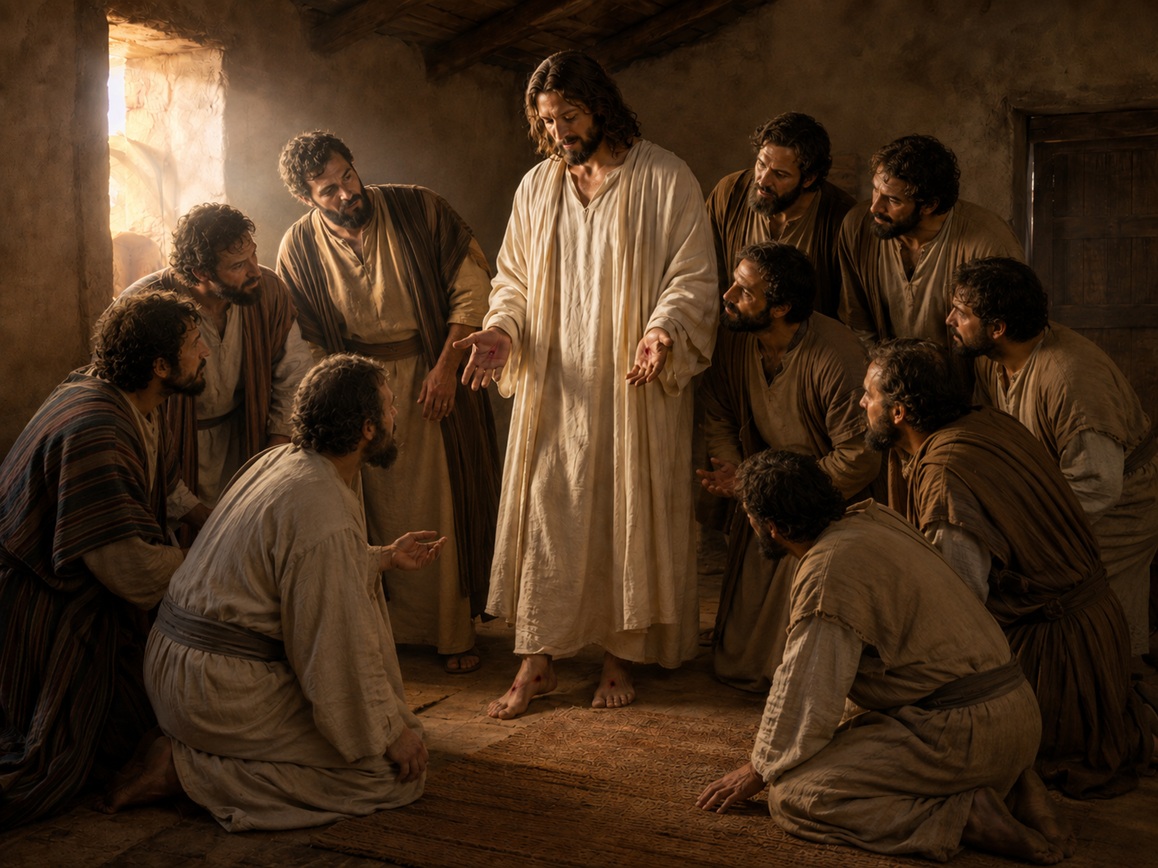
On the evening of the first Easter the disciples made, almost word for word, the Watchtower’s proposal: they “supposed that they saw a spirit.” Jesus corrects them. “See my hands and my feet, that it is I myself; handle me, and see; for a spirit has not flesh and bones as you see that I have” (Luke 24:37–39) — and He asked for food, “and he took it and ate before them.” The hands and feet are offered as proof of identity: the one they see is the one who was crucified. He had also said in advance what would rise. “Destroy this temple, and in three days I will raise it up” — and John adds, “he spoke of the temple of his body” (John 2:19–21). The thing destroyed is the thing raised. On the Watchtower reading, the sign Jesus gave Israel never came to pass.1
The Flesh That Did Not See Corruption
Peter’s Pentecost sermon rests on a contrast. David “died and was buried, and his tomb is with us to this day”; but the Christ “was not abandoned to Hades, nor did his flesh see corruption” (Acts 2:29–31, quoting Psalm 16:10). What distinguishes Jesus from David is what happened to His flesh. A body dissolved or disposed of by God has not been preserved from corruption, and a resurrection in which the flesh plays no part could have been preached over an occupied tomb. On the apostolic teaching the empty tomb is evidence; on the Watchtower’s it is scenery — emptied by God to suggest an event that, on their own account, did not happen to the body that lay there.2
What “a Spiritual Body” Means
Paul’s “spiritual body” (1 Cor. 15:44) is the Watchtower’s strongest ground, and the answer turns on Paul’s own usage. Two chapters earlier he contrasts the “unspiritual” man with the “spiritual” man (1 Cor. 2:14–15), and no reader supposes the spiritual man is made of spirit. The words describe orientation, not composition: the natural body is animated by ordinary human life, the spiritual body is the same body animated and governed by the Spirit of God. The philological case is set out at length by William Lane Craig: the contrast “is not between physical body / non-physical body, but between naturally oriented body / spiritually oriented body.” Augustine drew the same line: “when the flesh serves the spirit, it will justly be called spiritual” — not, he adds, because flesh turns into spirit.3
As for “flesh and blood cannot inherit God’s Kingdom” (1 Cor. 15:50), the phrase is a Semitic idiom for frail, mortal human nature — Paul uses it elsewhere to mean simply “any human being” (Gal. 1:16) — and the verse’s second half restates its first: “nor does the perishable inherit the imperishable.” What is excluded from the Kingdom is not the body but mortality. Paul’s remedy is not the shedding of the body but its change: “this perishable nature must put on the imperishable” (1 Cor. 15:53). A man who puts on a coat has not been replaced by the coat.
A Life-Giving Spirit
“The last Adam became a life-giving spirit” (1 Cor. 15:45) deserves a careful answer, because read alone it sounds like the whole doctrine. Paul is quoting Genesis 2:7, where Adam became a living soul. If “became a life-giving spirit” means Christ was turned into spirit as His substance, then by the same reading Adam was turned into soul as his substance, and Adam had no body — which is absurd, and defeats the parallel Paul is building. Both halves of the verse say what each Adam became for others: the first transmits natural life to his race, the last transmits resurrection life to His. The verse is about what Christ gives, not what He is made of. The same holds for “made alive in the spirit” (1 Pet. 3:18): Paul promises that God “will give life to your mortal bodies also through his Spirit” (Rom. 8:11). If “made alive in the spirit” meant “became a spirit,” the believer’s body would be promised a resurrection its Lord’s body never had.4
The remaining proof-text turns on the same mistake. “Even though we once regarded Christ according to the flesh, we regard him thus no longer” (2 Cor. 5:16) is read as though according to the flesh described what Christ is now made of. But the phrase modifies the knowing, not the Christ — and Paul applies it in the same sentence to everyone: “we regard no one according to the flesh.” If the verse turned Christ into a spirit, it would turn all Corinth into spirits with him. To know someone according to the flesh is to appraise him by worldly standards, as Paul once appraised a crucified pretender and, after Damascus, never did again.
What the Materialized-Body Theory Costs
The appearances are explained by the Watchtower as temporary bodies, materialized as the angels of old materialized. Consider what the theory does to the evidence Jesus offered. The body shown to Thomas bore the wounds of the nails and the spear, and the demonstration was offered as proof of identity. On the Watchtower reading, that body was a construct of the moment, its wounds manufactured marks in flesh that was never crucified, worn to persuade Thomas of a continuity that did not exist. “It is I myself” becomes a stage direction, and “a spirit has not flesh and bones” becomes the strangest sentence in Scripture: a spirit assuring His friends, by means of a temporary body, that He is not a spirit. The theory does not explain the evidence; it converts it into a performance.5
The recognition failures have the explanation Luke states: “their eyes were kept from recognizing him,” and at the breaking of the bread “their eyes were opened” (Luke 24:16, 31). The withholding was in the seeing, not in a rotation of bodies. And the locked doors show that the risen body is not subject to the limits of the present one — which is what glorification means, and what Paul’s contrasts promise. New properties argue against a body only if a real body must behave exactly like an unglorified one, which is the assumption Paul spends a chapter denying.
The Ransom Argument
The deepest Watchtower argument is that reclaiming the body would cancel the ransom. It assumes a sacrifice is annulled unless its victim stays dead, and Scripture’s own treatment of sacrifice runs the other way: the offering is accepted, and acceptance is shown by what God does with it. Hebrews presents the risen Christ as high priest who “entered once for all into the Holy Place” and “always lives to make intercession” (Heb. 9:12; 7:25) — a living priest, presenting a completed sacrifice. Paul joins death and resurrection without embarrassment: Jesus “was put to death for our trespasses and raised for our justification” (Rom. 4:25). The resurrection is not the taking back of the offering but the Father’s acceptance of it — the Lamb of Revelation stands “as though it had been slain” (Rev. 5:6), slain, standing, and bearing the marks. That is why the wounds remain in the glorified body: the sacrifice is not undone by the resurrection but displayed in it.6
A Man in Heaven
The New Testament’s account of Christ now is consistent, and on Watchtower premises startling. God “will judge the world in righteousness by a man whom he has appointed” (Acts 17:31). “There is one mediator between God and men, the man Christ Jesus” (1 Tim. 2:5) — present tense, long after the Ascension. “In him the whole fulness of deity dwells bodily” (Col. 2:9) — dwells, not dwelt. The Incarnation was not an episode from which the Son has withdrawn. One of us, body and soul, is at the right hand of the Father, and He has not laid our nature down.
What the Church Teaches
The Church’s teaching is graded with unusual precision. That Christ “rose gloriously from the dead” on the third day is de fide. That the dead will rise “with the same bodies as they had on earth” is likewise de fide — the Fourth Lateran Council declared that all “will arise with their bodies which they have now.” That the bodies of the just will be transfigured to the pattern of the risen Christ is the certain teaching of theologians, resting on Philippians 3:21: He “will change our lowly body to be like his glorious body.” Decades after the Ascension, Christ has a body, called glorious, to which ours will be conformed. And the tradition has always noted what the Gospels record: the risen Christ retained His wounds in a transfigured body, as tokens of triumph rather than relics of defeat.7
This is the concise case. The full essay adds the treatment of “equal to angels” and marriage in the resurrection, the two-Adams argument in detail, the Watchtower’s two-class reading of the resurrection hope, and complete documentation for everything asserted here. It is available as a Word document at the end of this page.
Endnotes
- Luke 24:36–43; John 20:26–27; John 2:19–21, RSV. The disciples’ mistaken inference in Luke 24:37 — “supposed that they saw a spirit” — is the proposal Jesus answers in v. 39. ↩
- Acts 2:25–31, quoting Psalm 16:10. Ludwig Ott notes that Peter and Paul (Acts 13:35–37) both rest the resurrection on this psalm. ↩
- William Lane Craig, “The Bodily Resurrection of Jesus,” in Gospel Perspectives I, ed. R. T. France and D. Wenham (Sheffield: JSOT Press, 1980), 47–74, drawing on Robert Gundry, Sōma in Biblical Theology (Cambridge, 1976). Augustine, City of God XIII, 20, trans. Marcus Dods. ↩
- The two-Adams argument is developed in full in the essay, section V. ↩
- The materialization theory is stated in the Watchtower’s own words in the left panel, with citations. ↩
- Hebrews 7:25; 9:11–12; Romans 4:25; Revelation 5:6, RSV. ↩
- Ludwig Ott, Fundamentals of Catholic Dogma, trans. Patrick Lynch (1955; TAN reprint, 1974): Christ’s resurrection de fide; the dead rise “with the same bodies as they had on earth” de fide, quoting Fourth Lateran (D 429); transfiguration to the pattern of the risen Christ sent. certa; “The Risen Christ retained the wounds in His transfigured body as tokens of His triumph over death.” Cf. Catechism of the Catholic Church 645–646. ↩