This page does not solve the problem of evil, and no page does. What
can be shown is narrower: that the strict version of the argument
fails, that the surviving version proves less than it is taken to
prove, and that Christianity says something about suffering which is
not a theory and which no other account offers.
What Is Granted
The suffering is real, and it is not a shadow that makes the light
visible. Children die of bone cancer. An earthquake kills tens of
thousands in a night, none of them chosen. The quantity is a
difficulty on its own, since a reply that accounts for some suffering
has not accounted for this much of it. And a great deal of it
accomplishes nothing observable, which is precisely the point of
Rowe’s examples.
Christians have also made the difficulty worse. Telling a bereaved
parent that God needed another angel, or that everything happens for
a reason, has driven more people out of the faith than any argument
ever has. Job’s comforters are preserved in Scripture as a
warning, and they are still among us.
The Strict Argument Has Been Answered
Mackie’s claim was that God and evil are logically
incompatible. The claim requires a hidden premise, that a good and
omnipotent God could have no morally sufficient reason for permitting
any evil whatever, and no one has been able to establish it. Alvin
Plantinga’s free will defense showed that if such a reason is
so much as possible, the alleged contradiction
dissolves.1
The result should not be overstated, and believers regularly
overstate it. Plantinga did not identify God’s reasons and did
not offer a theodicy. He showed consistency, which is why Mackie
himself later granted the point. Nobody who has watched a child die
was ever troubled by a question about consistency.
How Far the Evidence Reaches
The serious argument is Rowe’s, and its weight rests on one
step: from finding no good that would justify a particular horror, to
concluding that there is none. Stephen Wykstra observed that such an
inference works only where we could expect to detect the thing if it
were present. A man with a heavy head cold who smells nothing has not
established that the milk is
fresh.2
This line of reply is called skeptical theism, and it is stronger
than it first appears; its limits are admitted below.
So the question is whether human beings are the kind of creatures who
would see the reasons of an omniscient God if there were any. Put
that way, the confident answer looks odd. People routinely fail to
see the point of what their own parents did until twenty years later.
This reply has a limit, and it must be stated rather than hidden.
Pushed to its full extent it corrodes moral judgment generally: if we
cannot tell whether a horror serves an unseen good, neither can we
tell whether relieving it prevents one. A defense that rescues
God’s goodness by making goodness unknowable has paid too much
for the rescue. The honest position is that our failure to see a
reason is real evidence and weaker evidence than it feels, which
lowers the confidence Rowe’s argument carries without disposing
of it.
The Fit Argument Cuts Its Own Sample
The skeptic’s third form is different from Mackie’s
and Rowe’s and deserves its own answer: not that suffering
disproves God, but that its pattern — tracking
geology and microbiology rather than desert — fits
indifference better than providence. Two replies. First, the
pattern is the one Christianity itself predicts. It is the
skeptic’s hypothesis, not the Christian one, that expects a
world where rain checks the character of the fields it falls on:
Christ said plainly that the Father makes His sun rise on the
evil and the good (Matt. 5:45), and that the tower of Siloam did
not fall on the worst eighteen men in Jerusalem (Luke
13:4–5). A creation of stable natural law, in which desert
is settled at a judgment rather than by earthquakes, is what the
doctrine describes; finding law-like suffering confirms both
hypotheses equally, and evidence that fits both moves neither.
Second, the fit argument weighs only the suffering. On
indifference, the anomaly is everything else — that the
byproducts of geology and microbiology include creatures who
grieve over geology and microbiology, measure the world against
a justice nothing in it taught them, and cannot stop asking this
very question. Suffering distributed without desert fits both
stories; mourners who mind that it is so fit only one.
Freedom Accounts for What We Do to Each Other
Most of the evil anyone actually meets is inflicted by other people.
A world containing creatures who genuinely choose is a world in which
they can choose wrongly, and the alternative is not a world of free
creatures who always choose well but a world of creatures who cannot
choose at all. Love that cannot be withheld is not love, and a God
who wanted love had to make beings capable of refusing it.
The limit here is real too. The victim’s freedom was not
enlarged by her attacker’s. What the argument establishes is
that a world with genuine agency in it is worth the risk of agency
misused, not that any particular abuse was worth what it cost. And it
says nothing whatever about the fawn.
Law Accounts for a World Where Harm Is Possible
Natural evil is the harder half, and the place where defenses
commonly overreach. A world of stable law is the precondition of
nearly everything worth having, because agents can act only where
things behave predictably. A world in which God suspended the
regularities whenever they were about to hurt someone is a world in
which no one could act at all, since nobody could know what anything
would do.
The same tectonics that levels a city recycles carbon and keeps the
planet habitable; the same cellular replication that permits growth
permits cancer. These are one system seen at different moments. But
the argument explains why a law-governed world contains hazards, not
why this many, and the child in the collapsed building is not
consoled by the carbon cycle. On natural evil the Christian answer is
thinner than the Christian would like.
Suffering Makes Some People and Destroys Others
There is a long tradition of treating the world as a place where
souls are made rather than kept comfortable, and it has genuine
force. Courage and compassion are real goods, and neither can exist
where nothing is ever
wrong.3
The limit is plain and is where honest treatments stop. A great deal
of suffering makes nobody better and leaves the survivors diminished,
and it kills its victims before any growth is possible. That residue
is exactly the suffering Rowe selected, and a theodicy claiming to
have covered the whole field with this argument has stopped looking
at the field.
The Objection to Theodicy Itself
A charge worth recording comes as often from believers as from
atheists: that explaining from a desk what a murdered child’s
suffering accomplished treats her as an instrument, and that there is
something corrupt in the exercise however carefully it is conducted.
The charge lands. Every general justification of suffering is offered
by someone who is not the one paying, which is what Ivan Karamazov
saw and why his refusal outweighs any calculation.
What Christianity Adds
Everything above could be said by any theist, and most of it has been
said by philosophers with no religion at all. What Christianity adds
is not a further argument but a claim about what God did.
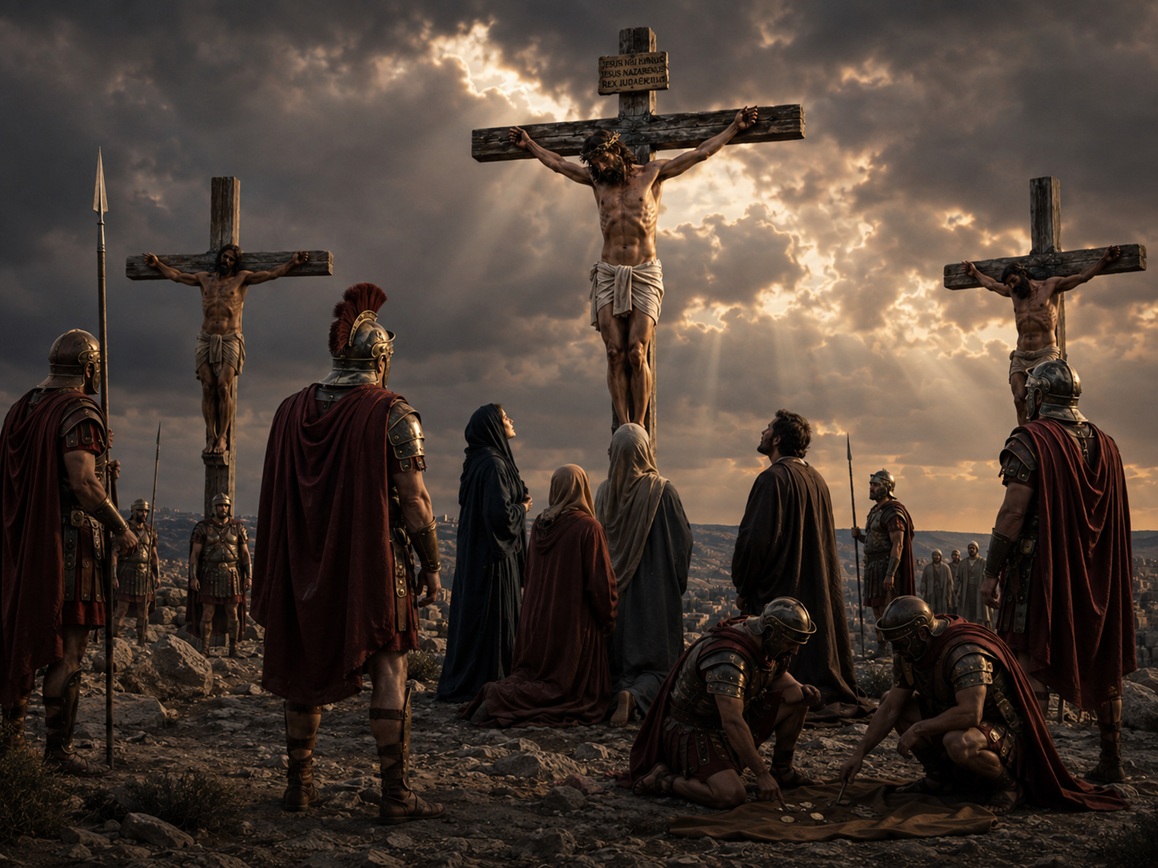
He did not remain outside the suffering He permits. He entered it as
a participant, was betrayed by a friend, tried by a court that knew
better, tortured by professionals and executed in public, as one of us
and not as a visitor. That explains nothing. Nothing in the Passion
says why the fawn burned or why the child in Flint died.
What it does is answer one particular charge with great force: that
God, if He exists, is a spectator of an agony He does not share,
disposing of other people’s pain from a position of perfect
safety. Whatever else is true, the sufferer who prays to the God of
the Christians is not addressing someone who has never been where she
is.
Dostoevsky understood this, and gave Ivan no philosophical reply.
Alyosha answers him by kissing him, and the book answers him with the
Passion. The tears are not explained away; they are said to have been
atoned for, which is the one thing Ivan demanded and thought
impossible. And the Christian hope is not that the suffering will be
shown acceptable but that it will be undone, which is why the promise
at the end of Scripture is not a ledger balanced but tears wiped from
faces (Rev. 21:4).
Job, and an Answer That Explains Nothing
Scripture treats this question at length once, and does not do what
either side expects. Job’s friends offer the standard theodicy
of their day, that suffering is punishment and Job must have earned
it. God condemns them for it, and vindicates Job, who had accused Him
to His face.
What Job receives is not an explanation. He is never told about the
wager in the prologue. He is given a tour of creation and, at the end
of it, God Himself — and, as Chesterton saw, that is the answer:
“The refusal of God to explain His design is itself a burning
hint of His design. The riddles of God are more satisfying than the
solutions of man.” Two things follow: that Scripture treats the tidy
answer as an offense, and that the biblical response to suffering is
overwhelmingly protest rather than resignation. A third of the Psalms
are complaints, and Christ died quoting
one.4
A word to the reader who came here from the Watchtower pages. You
were taught that suffering settles a court case: that God permits
it to answer Satan’s challenge to His sovereignty, and that
the verdict will be read at Armageddon. Nothing on this page
depends on that account, and the difference is worth noticing.
The Christian answer is not that God lets the trial run to its end
for the sake of a legal point; it is that He entered the suffering
Himself. Revelation 21:4, the verse you know as the promise of a
paradise earth, is here a promise about a Person who wipes the
tears away, and it is kept by the same hands that were pierced.
And if an organization that promised you the verdict by a date has
failed you, that is a fact about the organization, not about God.
The Reply in Brief
What remains is a question still open and a claim of a different
kind: that the God accused of indifference submitted to the worst
that the accusation describes, and that the tears Ivan refused to
leave unatoned for were atoned for on a Friday afternoon outside a
city wall.
This is the short answer. The full essay states Rowe’s argument
in his own words, works through Wykstra and Alston on what we are in
a position to see, sets out the Augustinian and Irenaean traditions
against each other, takes up Job and the literature of lament, and
documents everything asserted here. It is available as a Word
document at the end of this page. The companion page on
arguments for and against God
weighs this objection against the case on the other side.
Endnotes
- Alvin Plantinga, God, Freedom, and Evil (1974), with the technical version in The Nature of Necessity (1974), ch. 9. Plantinga offers a defense rather than a theodicy: the aim is to show consistency, not to identify God’s actual reasons. Mackie’s concession is in The Miracle of Theism (1982), 154. ↩
- Stephen J. Wykstra, “The Humean Obstacle to Evidential Arguments from Suffering,” International Journal for Philosophy of Religion 16 (1984), 73–93; and William P. Alston, “The Inductive Argument from Evil and the Human Cognitive Condition,” Philosophical Perspectives 5 (1991), 29–67. ↩
- The soul-making tradition is traced to Irenaeus and developed by John Hick, Evil and the God of Love (1966). C. S. Lewis puts the harder version in The Problem of Pain (1940), ch. 6; his A Grief Observed (1961), written after his wife’s death, is the necessary companion and much less confident. ↩
- Job 38–42, with the friends condemned at 42:7. On lament, see Psalms 6, 13, 22, 44 and 88, and the book of Lamentations; Christ quotes Psalm 22:1 from the cross (Matt. 27:46). On the Catholic teaching, Catechism of the Catholic Church §§309–314 and 324, with §385 on evil as the privation of a good. Chesterton’s sentences are from his “Introduction to the Book of Job” (1907), quoted exactly. ↩