Who Can Forgive Sins?

Placeholder image

“If you forgive the sins of any, they are forgiven; if you retain the sins of any, they are retained.”

“Why confess to a priest? I go straight to God.” No Catholic practice draws the objection faster, and the objection has real texts behind it: one mediator (1 Tim. 2:5), a promise that God forgives those who confess to Him (1 John 1:9), and the plain fact that only God can forgive sins — a truth the scribes of Capernaum stated and Jesus did not deny.

But the same Jesus, risen, breathed on His apostles and gave them exactly this authority in so many words — and Matthew records the crowd glorifying God, “who had given such authority to men” (Matt. 9:8). This page asks what those words established, whether the early Church understood them sacramentally, and what confession actually is from the inside: not a barrier between the sinner and God, but the one place on earth where a human voice is authorized to say, out loud and to you, your sins are forgiven. It belongs beside the sacraments page and, for readers from the Watchtower, the page comparing confession with the judicial committee.

You may leave comments below — anonymously, if you wish — but please read our policy on commenting before doing so.

Protestant View

Jump to the Catholic View ↓

The Protestant objection to auricular confession is stated here at full strength, from its own texts.

Only God Forgives Sins

When Jesus told the paralytic his sins were forgiven, the scribes reasoned: “Who can forgive sins but God alone?” (Mark 2:7) — and Jesus answered not by correcting the principle but by proving His divine authority. Sin is against God; God alone absolves it. “If we confess our sins, he is faithful and just, and will forgive our sins” (1 John 1:9) — confession is made to Him, and no verse commands a Christian to enumerate sins to another man to obtain forgiveness.1

One Mediator, and a Priesthood of All

“There is one God, and there is one mediator between God and men, the man Christ Jesus” (1 Tim. 2:5). The New Testament calls no Christian minister a priest (hiereus); it calls the whole Church “a royal priesthood” (1 Pet. 2:9). James does say “confess your sins to one another” (Jas. 5:16) — but that is mutual, brother to brother, not penitent to priest; a command for the confessional would read “confess to the elders,” and it does not.2

A Practice with a Date

Private auricular confession, the objection concludes, has a documented history: public penance in the early centuries for grave public sins, private confession spreading from the Irish monasteries, and the obligation of annual confession to one’s own priest imposed only in 1215, at the Fourth Lateran Council. A requirement twelve centuries in the making, on this reading, is church law, not the Gospel — and John 20:23 concerns the Church’s preaching of forgiveness and her admission and exclusion of members, not a judicial tribunal in a box.3

Endnotes
  1. Mark 2:7; 1 John 1:9 (RSV).
  2. 1 Tim. 2:5; 1 Pet. 2:9; Jas. 5:16 (RSV).
  3. Fourth Lateran Council (1215), canon 21, Omnis utriusque sexus, on annual confession.

Catholic View

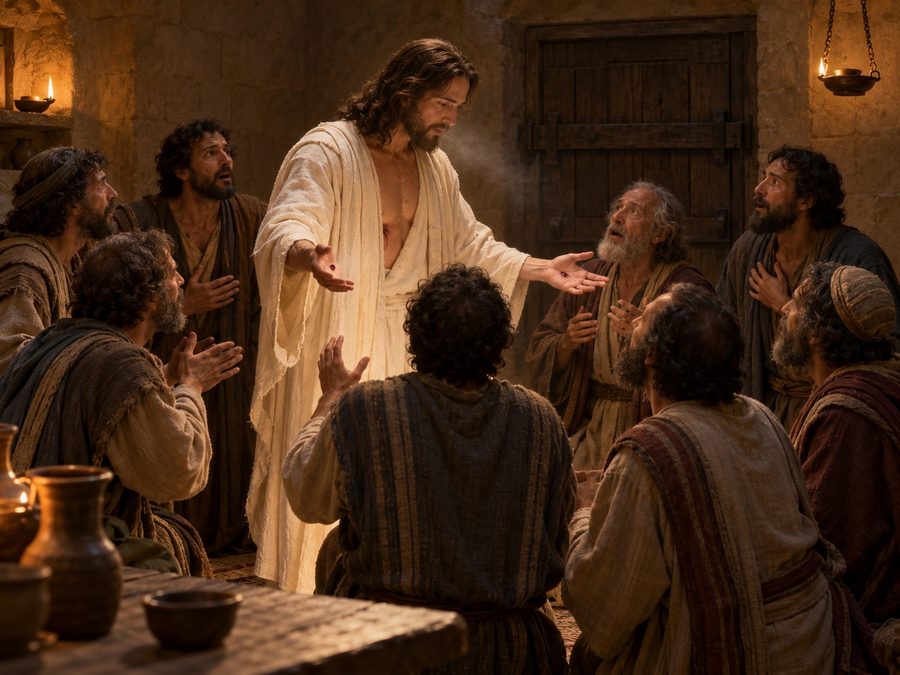
Grant the principle at once: only God forgives sins, sin is against Him, and no priest has a milligram of power that is his own. The question is not whether God alone forgives but whether God, who alone forgives, has chosen to forgive through men — and that question the risen Christ answered in a locked room.

The Words in the Upper Room

“As the Father has sent me, even so I send you.” And when he had said this, he breathed on them, and said to them, “Receive the Holy Spirit. If you forgive the sins of any, they are forgiven; if you retain the sins of any, they are retained” (John 20:21–23). Every clause resists the reduced reading. The commission is modeled on Christ’s own sending — and Christ did not merely announce forgiveness; He conferred it. The breath recalls creation: something new is being made. And the two-sided grant — forgive or retain — is unintelligible as generic preaching, because preaching retains nobody’s sins; retention requires knowing the case. A power to bind and loose that turns on the state of the sinner requires hearing the sinner — which is all confession is.1

Authority Given “to Men”

Matthew had already prepared the reader. When Jesus forgave the paralytic and healed him to prove the forgiveness real, the crowds “glorified God, who had given such authority to men” (Matt. 9:8) — a plural the evangelist chose, writing for a Church in which that authority was being exercised. Paul describes his own ministry the same way: God “gave us the ministry of reconciliation” and made the apostles “ambassadors for Christ,” through whom God Himself appeals (2 Cor. 5:18–20) — and Paul forgives a penitent Corinthian “in the presence of Christ” (2 Cor. 2:10). One mediator, yes (1 Tim. 2:5) — and the one Mediator has ministers, or Paul’s sentences are meaningless. The ambassador does not rival the sovereign; he is how the sovereign’s pardon reaches the province.2

James, and the Elders

The “one another” of James 5:16 has a context the objection omits: two verses earlier, the sick man is told to “call for the elders of the church,” who pray over him and anoint him, “and if he has committed sins, he will be forgiven” (Jas. 5:14–15). The confession of verse 16 follows directly — in a scene where the Church’s ordained elders are already at the bedside exercising a ministry tied to the forgiveness of sins. Mutual confession and ministerial absolution are not rivals; James has both in one paragraph, and so does the Catholic Church.3

What Developed, and What Did Not

The history is conceded — and read rightly, it testifies for the power, not against it. The early Church’s penance was harder than the confessional, not absent: grave sinners confessed and were reconciled by the bishop after public penance, sometimes of years — a discipline nobody invents for a power nobody claims. What changed across the centuries was the form — public to private, once in a lifetime to often, bishop to priest; the Church’s conviction that her ministers reconcile sinners by Christ’s authority runs unbroken from John 20 through Tertullian and Cyprian to Lateran IV, which regulated frequency precisely because the sacrament already existed. Form develops; the gift was given in the upper room.4

The Reply in Brief

Only God forgives sins — and God incarnate, possessing that authority, breathed it on His apostles with a two-sided grant that requires hearing the case. Matthew says the authority was given “to men”; Paul calls his ministry reconciliation and forgives in Christ’s presence; James puts the elders at the penitent’s side. The practical difference is the one a former Witness will feel most: what the sinner meets in the confessional is not a committee weighing his membership but a tribunal of mercy where the verdict, for every penitent, is already purchased — and spoken aloud, which is exactly what a guilty conscience needs and 1 John’s silent assurance, true as it is, does not supply.5

The full essay adds the patristic record from the Didache through Cyprian, the development of the rite, what a confession actually sounds like from the inside, the seal of confession, and the answers to the remaining objections. Download it from the summary below — and the comments are open, anonymously if you prefer.

Endnotes
  1. John 20:21–23 (RSV); Catechism of the Catholic Church §§1441–1445, 1461.
  2. Matt. 9:8; 2 Cor. 5:18–20; 2:10; 1 Tim. 2:5 (RSV).
  3. Jas. 5:14–16 (RSV).
  4. On the ancient discipline of exomologesis and episcopal reconciliation, Tertullian, On Repentance, and Cyprian, On the Lapsed; Fourth Lateran Council (1215), canon 21.
  5. The comparison with the Watchtower’s judicial arrangement is drawn in full on the discipline page.

Summary

Only God forgives sins — and God chose to forgive through men. The risen Christ breathed on the apostles: “If you forgive the sins of any, they are forgiven; if you retain the sins of any, they are retained” (John 20:22–23). The two-sided grant cannot be generic preaching — preaching retains nobody’s sins, and retention requires hearing the case. A power that turns on the sinner’s state requires hearing the sinner: that is all confession is.

Scripture says the authority was given “to men.” Matthew’s crowd glorifies God “who had given such authority to men” (Matt. 9:8) — a plural written for a Church already exercising it. Paul holds “the ministry of reconciliation,” appeals as Christ’s ambassador, and forgives a penitent “in the presence of Christ” (2 Cor. 2:10; 5:18–20). The one Mediator has ministers, or those sentences mean nothing.

James puts the elders at the penitent’s side. Before “confess your sins to one another” comes “call for the elders of the church” — who pray, anoint, and “if he has committed sins, he will be forgiven” (Jas. 5:14–16). Mutual confession and ministerial absolution stand in one paragraph, there and in the Catholic Church.

The history testifies for the power. The early Church’s penance was harder than the confessional, not absent: public penance, episcopal reconciliation — a discipline nobody builds around a power nobody claims. The form developed; the gift was given in the upper room, and Lateran IV regulated a sacrament that already existed.

And the sinner needs the verdict spoken. What the penitent meets is not a committee weighing membership but a tribunal of mercy whose verdict is already purchased — and said aloud, to you, which is what a guilty conscience needs and silent assurance does not supply.