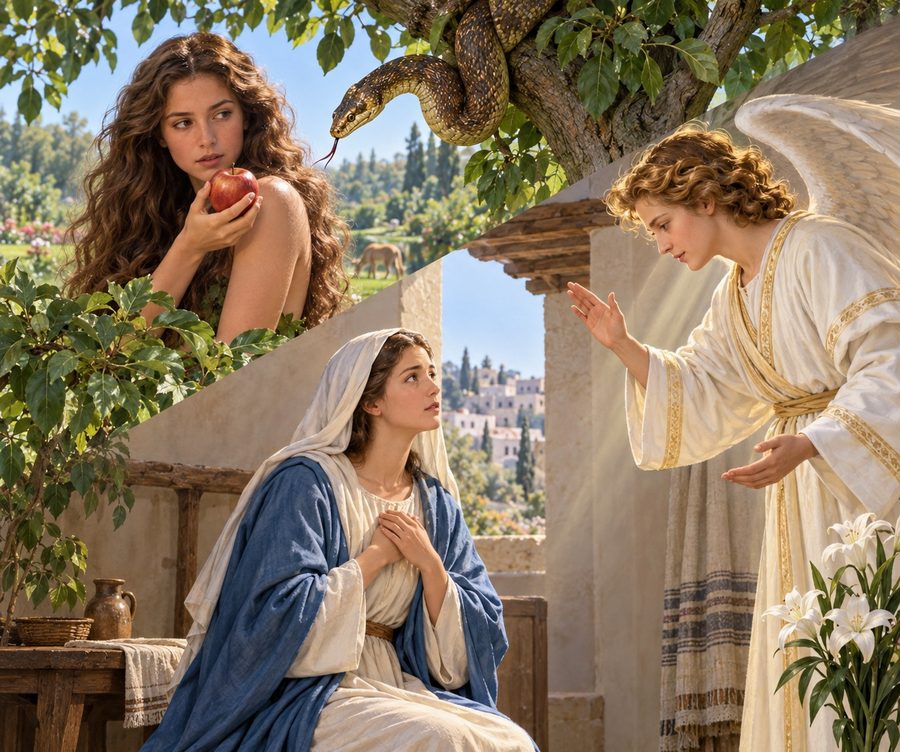
The Orthodox case just stated rests on two pillars: that
Rome teaches inherited personal guilt, and that 1854
exempted Mary from redemption. Neither pillar holds —
and once they fall, the dispute shrinks to something the
two communions could discuss over one table.
What Was Actually Defined
Read the definition. Mary, “in the first instance of
her conception, by a singular grace and privilege granted
by Almighty God, in view of the merits of Jesus
Christ, the Savior of the human race, was preserved
free from all stain of original sin.” Every clause
answers an Orthodox fear. Not exempted from redemption but
redeemed more radically: preserved, by Christ’s
merits, as a man is saved from a pit either by being
pulled out or by being caught before he falls in —
and the second rescue is the greater. Not detached from
humanity: she needed the Savior as absolutely as any
child of Adam, which is why she herself sings,
“my spirit rejoices in God my Savior”
(Luke 1:47). The dogma does not lift Mary out of the
human race; it declares what grace did, first and most
perfectly, in one of us.1
The Guilt That Rome Does Not Teach
The premise-attack collapses on the Catechism’s
own sentence: original sin “does not have the
character of a personal fault in any of Adam’s
descendants.” It is, the same paragraph teaches, a
deprivation of original holiness and justice; human
nature is wounded, mortal, inclined to sin — and
the previous paragraph says the word “sin”
applies here only analogically: contracted, not
committed; a state, not an act. Set that beside the
Orthodox description — inherited mortality,
corruption, and inclination, without personal culpability
— and the two accounts are describing substantially
the same wound, in two conceptual vocabularies. The differences
that remain are real — the East does not share
Augustine’s account of how the wound is transmitted, nor the
Latin habit of stating grace as a nature deprived of a gift
— and they are not flattened here; but they are differences
of framework, not the inherited crime the objection attacks. Whatever Augustine said at his harshest, and
whatever the old Latin of Romans 5:12 suggested, the
defined Catholic doctrine is not inherited crime. The
East’s strongest argument is aimed at a position
its intended target does not hold.2
The East’s Own Witness
Now let the Orthodox liturgy testify. The East calls Mary
Panagia and achrantos — All-Holy,
immaculate — in every service; its piety holds her
free of personal sin; and it has kept a feast of her
conception since before the schism. The angel’s own
greeting points the same direction: kecharitōmenē
(Luke 1:28), a perfect participle — not
“favored” for the occasion but already
having-been-graced, named by her grace as if it were
her title. If Mary is all-holy, spotless, and graced from
the beginning — and the East’s prayers say
all three — then the disagreement with 1854 is not about Mary.
Calling her Panagia is not the same as accepting 1854,
and the East is right to insist on the difference: the titles say
what grace did in her; the definition says when, and in what
framework. The disagreement is about the metaphysics of one
instant,
described in the vocabulary of a doctrine of original
sin that, examined above, the two communions no longer
hold apart.3
What Actually Remains
Strip away the two fallen pillars and what remains is
honest and familiar. The East asks: even if true, may a
pope define it alone? That is not a Marian question; it
is the question of this whole cluster of pages —
authority, examined on
the first-millennium page
and the councils page
— and it deserves its own answer, not a Marian
proxy war. On the substance, the calibrated conclusion
runs: the Orthodox liturgy’s witness, the
angel’s greeting, and the shared doctrine of the
inherited wound are all consistent with what 1854
defined, and none of them requires its denial. A church
that sings achrantos to Mary every evening is
nearer to the Immaculate Conception than its polemics
allow — which is why the modern dialogue treats
this, like grace on
the theosis page,
as a dispute about idiom and authority more than about
the Mother of God herself.4
The full essay adds the patristic material on the
new Eve, the history of the December feast in East
and West, Aquinas’s hesitation and
Scotus’s resolution, the text of
Ineffabilis Deus, and the Orthodox
theologians on both sides of the question. Download
it from the summary below — and the comments
are open, without your name if you prefer.
Endnotes
- Ineffabilis Deus (8 December 1854), the defining formula; Luke 1:47 (RSV); Catechism of the Catholic Church §§490–493 on Mary as redeemed “in a more exalted fashion.” ↩
- Catechism of the Catholic Church §§404–405. ↩
- Luke 1:28; the RSV renders “O favored one,” the Greek participle being kecharitōmenē. On the December feast’s antiquity in the East, the Byzantine calendar for December 9. ↩
- On the modern discussion, the Joint Commission’s dialogue documents treat authority, not Mariology, as the dividing question; see the Great Schism page. ↩