Why So Many Religions?

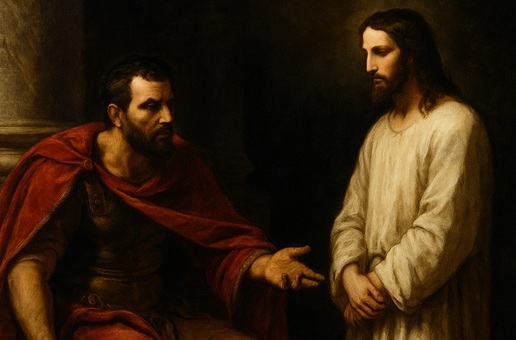
Pilate asking Jesus, What is truth?

“Every one who is of the truth hears my voice.” Pilate said to him, “What is truth?”

Ten thousand religions, and every one of them sure. The Muslim in Riyadh, the Hindu in Varanasi, the Baptist in Tulsa, and the Catholic in Kraków each holds his faith with the same inward certainty — and each, mostly, holds the faith of his parents. To many honest minds this single observation outweighs every argument on this site: if revelation were real, would it not have produced agreement? Does the map of the world’s religions not look exactly like what human culture, rather than divine action, would draw?

The objection deserves a page of its own because it is not really an argument about God; it is an argument about knowledge — that where sincere, intelligent people disagree this deeply, no one is entitled to confidence. That principle sounds humble. But it proves far more than the skeptic wants: philosophy, ethics, politics, and history are riven by exactly such disagreement, and nobody concludes that there is no truth about justice or that no one may hold a view of it. And the principle has a reflexive problem — secular unbelief also tracks time and place of birth, which by the argument’s own logic would discredit the argument.

What a Catholic owes the question is not a shrug but an account: why a God who wants to be known would be sought in ten thousand ways, what the Church actually says about the religions (“rejects nothing that is true and holy” is her own sentence), and how, among many claimants, one claim submits itself to a kind of test the others do not. That account is the business of the panels below.

You may leave comments below — anonymously, if you wish — but please read our policy on commenting before doing so.

Atheist/Skeptic View

Jump to the Catholic View ↓

The skeptic’s argument from religious diversity is not that every religion is false because religions disagree. It is subtler: that the pattern of belief looks exactly like culture and nothing like revelation, and that no believer can claim a confidence his rivals cannot claim with equal right.

Faith Follows the Map

Religious identity is the most heritable of convictions. The child of Riyadh becomes a Muslim, of Varanasi a Hindu, of Tulsa a Baptist — with probabilities no other “discovery of truth” exhibits. If belief were a response to evidence, it should distribute the way scientific conclusions do, converging across cultures; instead it distributes the way languages do, transmitted by birthplace. The most economical explanation of a belief that tracks geography is that geography, not God, produces it.1

The Symmetry of Certainty

Nor can inward experience break the tie, because the experiences are symmetrical. The Pentecostal’s warmed heart, the Muslim’s awe before the Qur’an, the Mormon’s burning in the bosom, and the Catholic’s peace before the sacrament feel, from inside, exactly alike in authority. Each community discounts the others’ experiences by criteria it exempts its own from. An honest believer, the skeptic argues, should apply to his own faith the tests he applies to everyone else’s — the “outsider test” — and no faith, examined as an outsider examines it, retains its self-evidence.2

Contradictory Revelations Cancel

The claims, moreover, are not complementary glimpses of one summit; they contradict. God is triune and God is strictly one; Christ died on the cross and Christ was not crucified; the self is immortal and the self is an illusion. At most one of these can be true, and each is held on grounds — scripture, miracle, experience, tradition — formally identical to the others’. A juror facing ten confident, mutually contradictory witnesses does not pick his favorite; he concludes that confidence, in this courtroom, is not evidence.3

What a Real Revelation Would Have Done

Finally, the state of things is evidence in itself. A God who wanted mankind to know one truth had the means to make it plain, and what exists instead is ten thousand earnest guesses distributed by longitude. Diversity is what human religion-making looks like from above. Revelation, if it ever happened, is indistinguishable on the map from its absence — and a hypothesis indistinguishable from its absence has, the skeptic concludes, been weighed.4

Endnotes
  1. The demographic argument is a staple of the contemporary literature on religious disagreement; its hiddenness-flavored form is treated on this site’s hiddenness page.
  2. The “outsider test for faith” is John W. Loftus’s formulation; the underlying symmetry point is older and widely pressed.
  3. On the mutual exclusivity of core doctrinal claims, e.g. the Trinity against tawhid, and the crucifixion against Surah 4:157.
  4. The argument in this form descends from Enlightenment critiques of particular revelation; its contemporary statements appear throughout the philosophy-of-religion literature on divine hiddenness and religious diversity.

Catholic View

Grant the data before disputing the verdict. The map is real: faith is largely inherited, the experiences of certainty are symmetrical, and the core claims of the great religions genuinely contradict one another. None of this is denied here. The question is what follows — and the skeptic’s principle, examined, proves both too much and too little.

Disagreement Does Not Dissolve Truth

Take the principle at face value: where sincere, intelligent people disagree deeply and durably, no one may hold a confident view. Philosophy has disagreed about free will for twenty-five centuries; ethics about justice; historians about causes; and the skeptic himself holds firm views in all three — including the view that God does not exist, which is itself a minority position held against a vast, sincere, intelligent majority. If deep disagreement discredits confidence, atheism goes first. If it does not, the map of religions proves what the map of philosophies proves: that the question is hard and that humans approach truth from where they stand — which no one ever doubted. And the birthplace argument recoils the same way: secular unbelief tracks time and place of birth as tightly as any creed — the child of 1950s Moscow or modern Stockholm inherits his unbelief exactly as the child of Tulsa inherits his Baptism. An argument that discredits every position that has a demography discredits every position there is. Where a belief comes from is a fact about the believer; whether it is true is a fact about the world, and only evidence — not geography — can touch it.1

What the Diversity Actually Shows

Look at what the ten thousand religions disagree about — and at what they do not. Beneath the contradictions lies a startling unanimity: that the visible world is not the whole story; that something is owed to the divine; that the self is answerable; that gratitude, sacrifice, and purity mean something. Ask what the word divine means anywhere on earth and the answer converges — the reality on which all else depends — as the divinity page documents. This is precisely what Paul said the nations had: a real but clouded knowledge of God from the things that are made, and a law written on the heart (Rom. 1:19–20; 2:14–15). Mankind’s religions look less like ten thousand inventions than like ten thousand attempts at the same door — which is evidence of the door, not against it. Universal seeking is a strange fossil for a world in which there was never anything to find.2

What the Church Actually Says About the Others

The objection usually imagines Christianity claiming that every other faith is darkness and its adherents damned. That is not the Catholic teaching, and the Church’s own sentence should be on the table: “The Catholic Church rejects nothing that is true and holy in these religions,” whose precepts “often reflect a ray of that Truth which enlightens all men.” The Fathers said it earlier still: Justin Martyr taught that the seeds of the Word were scattered among the nations, so that whatever has been said well anywhere belongs to Christians. On this account the map is exactly what one would expect if one God made all men for Himself, left His witness in creation and conscience, and then revealed Himself fully at one time, in one place, through one people — as anything genuinely historical must happen somewhere. The scandal of particularity is the price of God acting in history at all; a revelation given everywhere at once would be indistinguishable from philosophy.3

The Tie-Breaker the Courtroom Allows

The juror with ten confident witnesses does not go home; he looks for the witness whose testimony can be checked. And here the symmetry the left panel relies on breaks, because the grounds of the great religions are not formally identical. Most rest on a private disclosure — a recitation received alone in a cave, golden plates shown to few, an enlightenment attained in solitude — which can be believed but not examined. Christianity’s central claim is a public event in datable history: a man known to thousands, executed by a named official, and proclaimed risen by witnesses who could be — and were — cross-examined, imprisoned, and killed without recanting. That claim can be false, but it is checkable in a way its rivals are not, and this site spends two pages checking it. The outsider test, honestly applied, does not flatten the field. It selects for the one faith that volunteers for it.4

The Question Behind Pilate’s

The page’s hero scene is the argument in miniature. A sophisticated Roman, surrounded by the gods of every province, asks “What is truth?” — the diversity of religions standing behind the shrug — while the Truth stands in front of him, checkable, scarred, and about to be publicly tested in the only way that settles anything. The sincere seeker in any land, the Church teaches, is already responding to grace and is not outside God’s mercy; the map assigns no one’s eternity. But for the reader who can read this page, the question is no longer geographic. The claims differ; the evidence differs; and one claimant has left a tomb to inspect. Begin there — this site does.5

The full essay works through the disagreement argument formally, the common core of the religions, the Church’s actual teaching from Justin to Nostra Aetate, the scandal of particularity, and the asymmetry that makes one claim testable. Download it from the summary below — and the comments are open, anonymously if you prefer.

Endnotes
  1. On disagreement in philosophy as the parallel case, see the contemporary epistemology-of-disagreement literature; the reflexive application to unbelief’s own demography is pressed by several Christian philosophers.
  2. Romans 1:19–20; 2:14–15, RSV. On the convergent meaning of “the divine,” Roy Clouser’s survey is presented on the divinity page.
  3. Nostra Aetate (1965), §2, quoted from the Vatican translation; Justin Martyr, Second Apology 8, 13, on the seeds of the Word, paraphrased.
  4. The historical case is made on Did Jesus Rise from the Dead? and Why Christianity?
  5. John 18:37–38, RSV; on the sincere seeker, Lumen Gentium §16 and Catechism of the Catholic Church §§847–848.

Summary

Grant the map; dispute the verdict. Faith is largely inherited, the certainties feel symmetrical from inside, and the great religions genuinely contradict one another. But the principle drawn from this — deep disagreement forbids confidence — proves too much: philosophy and ethics disagree as deeply, forever, and no one concludes there is no truth about justice. And it recoils: unbelief tracks birthplace as tightly as belief — Stockholm and 1950s Moscow inherit their atheism as Tulsa inherits its Baptism. Where a belief comes from is a fact about the believer; whether it is true is a fact about the world.

Ten thousand religions are ten thousand attempts at the same door. Beneath the contradictions lies a strange unanimity — a dependence, a debt, an answerable self — and one meaning of “the divine” the world over. That is what Paul said the nations had: knowledge of God from the things made, a law written on the heart. Universal seeking is an odd fossil for a world with nothing to find.

The Church’s own sentence about the religions is not the one the objection imagines. “The Catholic Church rejects nothing that is true and holy in these religions,” which reflect “a ray of that Truth which enlightens all men” — Justin said it of the seeds of the Word seventeen centuries before Nostra Aetate. A God acting in history must act somewhere; the scandal of particularity is the price of revelation being an event rather than a philosophy.

The courtroom has a tie-breaker: check the checkable witness. Most foundational claims are private — a cave, golden plates, a solitary enlightenment. One is a public event in datable history, proclaimed by witnesses who were cross-examined and killed without recanting. It could be false — but it volunteers for the outsider test the others cannot take. The map assigns no one’s eternity; the sincere seeker anywhere is within God’s mercy. But for the reader of this page, the question is no longer geography. One claimant left a tomb to inspect.