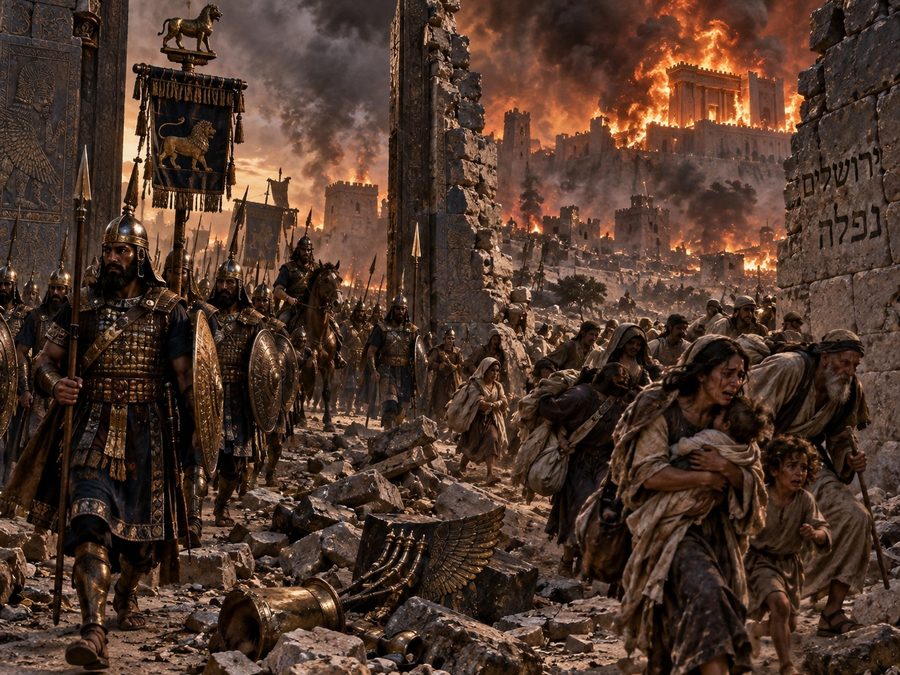
Begin with what is not in dispute, because it is nearly
everything. Jerusalem fell in Nebuchadnezzar’s
eighteenth regnal year (2 Kings 25:8, counting by
accession years); Jeremiah prophesied seventy years for
Babylon; the exiles returned under Cyrus. The Bible’s
facts are agreed on both sides of this page. What the Bible
does not contain is a single B.C.E. date — the numbered
timeline itself is a modern construction, built from ancient
records outside Scripture. The question is not whether to use
secular chronology. It is whether to use it consistently.
One convention should be cleared away first. Historians write
587 or 586 for the same event; the one-year difference turns on
whether Judah counted regnal years from Nisan or from Tishri,
and on how the eighteenth and nineteenth years of 2 Kings
25:8 and Jeremiah 52:29 are reconciled — it is not a doubt
in the Babylonian record, which is fixed to the year. A Witness
should not mistake a one-year convention for a twenty-year gap.
One Chronology, Not Two
Every date the Watchtower prints comes from the sources it
asks its readers to distrust. Its whole system hangs on 539
B.C.E. for the fall of Babylon — and 539 is not in the
Bible. Insight on the Scriptures derives it from
Ptolemy’s canon, the classical historians, and
cuneiform tablets: “The date of 539 B.C.E. for the fall
of Babylon can be arrived at not only by Ptolemy’s
canon but by other sources as well.”1
The same canon, the same historians, and the same tablet
record that give 539 for Babylon’s fall give 587 for
Jerusalem’s — they are one chronology, not two.
The Society accepts the rung it needs and rejects the rung it
cannot afford, and its own stated principle — secular
dates count “only when” they harmonize with its
reading of the Bible — concedes that the selection is
doctrinal, not historical.
Not One Witness but Many, All Agreeing
And the record being set aside is not a lone king list with
room for error. The Neo-Babylonian period is among the best
documented stretches of ancient history, and its witnesses
are independent of one another. The Babylonian Chronicle and
the Uruk king list; Berossus; Ptolemy’s canon; the
funerary stele of Adad-guppi, mother of King Nabonidus, who
counts out her hundred and four years reign by reign with no
gap to spare; and above all the commercial archive —
tens of thousands of dated business tablets, running month by
month through every year of every reign. A hidden twenty
years would require every one of these independent records to
be wrong, in the same direction, by the same amount —
and would require the scribes of Babylon to have dated no
loan, sale, or marriage contract in two whole decades. The
standard reconstruction is Parker and Dubberstein’s
Babylonian Chronology 626 B.C.–A.D. 75, built from
the tablets themselves and used by every Assyriologist; the
chronicles are edited in Grayson’s Assyrian and
Babylonian Chronicles. Jonsson’s book, cited below, is
a guide to that evidence, not its source.2
The Sky Does Not Move
The decisive witness is astronomy, because the sky can be
recomputed by anyone. VAT 4956 records, for
Nebuchadnezzar’s thirty-seventh year, some thirty
positions of the moon and of the planets among the
stars — a configuration that repeats, as a whole, only
at intervals of many centuries. The full set fits 568/567
B.C.E., which fixes the eighteenth year at 587. The 2011
re-analysis reached 588 only by setting the planetary
observations aside as ambiguous and re-reading the lunar data
alone — discarding, in an astronomical diary, precisely
the observations that make its date unmistakable.3
And the method proves too much: the Society’s own
anchor dates rest on tablets of exactly this class. An astronomical text cannot be decisive when it yields 539 and ambiguous when it yields 587; a chronology has to take the tablets as they come.
Seventy Years for Babylon, Not at Babylon
Nor does Scripture itself support the reading that requires
607. Jeremiah’s prophecy assigns the seventy years to
Babylon’s supremacy over the nations, not to
Judah’s empty land: “these nations shall serve
the king of Babylon seventy years,” and when the years
are completed, it is the king of Babylon who is
punished (Jer. 25:11–12) — which happened in 539.
The seventy years therefore end at Babylon’s fall, not
at the exiles’ return two years later, and they began
with Babylon’s rise to mastery some seventy years
before, when Assyria fell — not with Jerusalem’s
destruction, which came midway through the period. Jeremiah
29:10 says it in four words the New World Translation
declines to render: the seventy years are “for
Babylon” — Hebrew le-Babel — which
the NWT gives as “at Babylon,” converting
Babylon’s allotted span into the exiles’
residence and building the 607 arithmetic into the verse
itself.4
What Daniel 4 Actually Says
The 2,520-year calculation requires Daniel’s tree dream
to be a timeline of the centuries. Read the chapter. Daniel
interprets the dream himself, and his interpretation names
its subject: “it is you, O king” (Dan. 4:22). The
seven times pass over Nebuchadnezzar — “seven
times shall pass over you” (Dan. 4:25) — and the
chapter closes with the king restored, praising heaven. The
text says nothing of Jerusalem’s fall, nothing of a
second fulfillment, nothing of days standing for years here,
and nothing of the nineteenth or twentieth century. To reach
1914 one must convert times to years, years to 360 prophetic
days, days back to years by a rule borrowed from other books,
start the count at an event the chapter never mentions, and
end it at an enthronement no one could see. Every step is
supplied by the interpreter; not one is in the text.5
The Date That Moved to Save the Conclusion
The system’s own history is the clearest test. Russell,
following Nelson Barbour, counted 2,520 years from 606 B.C.E.
— arithmetic which, since there is no year zero,
actually ends in 1915. For decades the Society published 606.
When the problem was finally addressed, in The Truth
Shall Make You Free (1943), it was not the conclusion
that moved: the starting date slid back to 607, and 1914
stayed exactly where it was.6
A date derived from evidence moves when the evidence does. A
date that holds still while its foundation is relocated
beneath it was never a conclusion at all — it was the
premise. And on it rests 1914, and on 1914 rests 1919, and on
1919 rests the authority examined on
By What Authority?
— a tower of dates balanced on a year the sky, the
tablets, and the text of Jeremiah all decline to supply.
The Two Chronologies Side by Side
Everything on this page can be laid out in one table. The middle
column is the Society’s, the next is everyone else’s,
and the sources are named so that nothing has to be taken on
trust.
| Event | Watchtower | Standard chronology | Where it comes from |
|---|
| Fall of Babylon to Cyrus | 539 B.C.E. | 539 B.C. | The Nabonidus Chronicle, Ptolemy’s canon, the astronomical diaries; the Society accepts them here |
| Nebuchadnezzar’s reign | 624–582 | 605–562 | The Babylonian Chronicle, the king lists, thousands of dated business tablets, VAT 4956 |
| Jerusalem destroyed (his eighteenth or nineteenth regnal year, Jer. 52:12, 29) | 607 | 587, or 586 by another reckoning of the year | The same tablets that fix his reign |
| Jeremiah’s seventy years | 607–537, a desolation of Judah | 609–539, Babylon’s dominion over the nations | Jer. 25:11–12; 29:10; Zech. 7:5, spoken in 518, fits the second |
| 2,520 years from the fall | 1914 | 1934, a year of no significance | Daniel 4 read as the Society reads it, counted from the corrected date |
The Strongest Reply
The Society’s best case is that Scripture, not the tablets, is the
measuring rod, and that Scripture itself counts the seventy years as
Jerusalem’s. Daniel, in Babylon, “perceived in the books the
number of years which, according to the word of the LORD to Jeremiah the
prophet, must pass before the end of the desolations of Jerusalem,
namely, seventy years” (Dan. 9:2). The Chronicler says that the
desolate land “kept sabbath, to fulfil seventy years”
(2 Chron. 36:21); Zechariah’s angel asks how long the Lord
will withhold mercy from Jerusalem, “against which thou hast had
indignation these seventy years” (Zech. 1:12). If the seventy
years are Jerusalem’s, and the exiles came home in 537, the city
fell in 607 and no tablet can say otherwise. The 2011 articles put it
candidly: the majority of historians hold 587, and “those who
trust the Bible have good reason to do so.”
The Bible’s own numbers refuse the arithmetic. Daniel read
Jeremiah “in the first year of Darius” (Dan. 9:1) —
the year Babylon fell — and understood the seventy years to be
ending then, not two years later; that is why he prayed. Count back
seventy from 539 and the period opens about 609, with Babylon’s
supremacy after Assyria’s fall, exactly as Jeremiah says: the
nations serve the king of Babylon seventy years, and “after
seventy years are completed, I will punish the king of Babylon”
(Jer. 25:11–12). The punishment came in 539; the years were
Babylon’s. Zechariah supplies the sharpest test of all. In the
fourth year of Darius the Persian — 518 — the people ask
whether to keep the fasts they have kept “these seventy
years” (Zech. 7:3–5): the fasts of the fifth month, when the
temple burned, and the seventh, when Gedaliah was murdered. Seventy
years before 518 is 588/587. Counted from 607, those fasts would have
been ninety years old. The prophet the Society cites for the seventy
years dates the fall of Jerusalem to 587.
The Chronicler fixes the same end, not a different length: the land kept
sabbath “until” its sabbaths were paid, “to fulfil
seventy years” — Jeremiah’s seventy, which were
“for Babylon” — and the desolation ended when they ran
out. And the measuring rod is applied only once. The date 539, on which
the Society hangs everything, is not in the Bible. It comes from the
same tablets and the same canon of kings that give 587. A rod that
measures 539 true and 587 false is not Scripture. It is a doctrine,
holding the rod.
What remains if this claim fails. If 1914 falls, Christian hope does not. What this page establishes is that 607 is not the year Jerusalem fell, so nothing counted from it can be right. What it does not establish is anything about when Christ will return, which no chronology has ever known. The New Testament grounds hope in the risen Christ, not in a date.
The full essay lays out the whole case: the seventy years
in Jeremiah, Daniel 4 in its own context, the Babylonian
evidence witness by witness, VAT 4956 and the 2011
re-analysis, and the history of 606, 607, and 1914 in the
Society’s own publications. Download it from the
summary below — and check every date against the
sources cited, which is exactly what this page hopes you
will do.
Endnotes
- Insight on the Scriptures (1988), vol. 1, “Chronology,” which also states the governing principle quoted in the left panel: secular dating merits confidence “only when” it harmonizes with the Biblical record. ↩
- The evidence is assembled, source by source, in Carl Olof Jonsson, The Gentile Times Reconsidered (4th ed.), chs. 3–4: the Babylonian Chronicle, the Uruk king list, Berossus, Ptolemy’s canon, the Adad-guppi stele from Harran, and the continuous dated business archive. ↩
- VAT 4956 is published in A. Sachs and H. Hunger, Astronomical Diaries and Related Texts from Babylonia, vol. 1 (Vienna, 1988). The 2011 article itself states that it set the planetary observations aside as ambiguous and analyzed the lunar positions; the planetary configuration of the tablet fits 568/567 and cannot be accommodated in 588. ↩
- Jeremiah 25:11–12; 29:10 (RSV: “seventy years… for Babylon”; NWT: “70 years at Babylon”). Babylon’s supremacy ran from Assyria’s fall late in the seventh century to 539. Zechariah 1:12 and 7:5, spoken decades after the return, still look back on the seventy years as a completed period of indignation. On the NWT’s handling of texts to fit doctrine, see the page on that translation. ↩
- Daniel 4:20–33, RSV. The day-for-a-year rule appears at Numbers 14:34 and Ezekiel 4:6, in each case stated explicitly by the text for that occasion; Daniel 4 states no such rule. ↩
- The Truth Shall Make You Free (Watch Tower Bible and Tract Society, 1943), ch. 11, where the count to 1914 is re-anchored; Russell’s 606 runs through The Time Is at Hand (1889) and the Society’s literature for five decades. The documentary history is traced in Jonsson, The Gentile Times Reconsidered, ch. 1. ↩