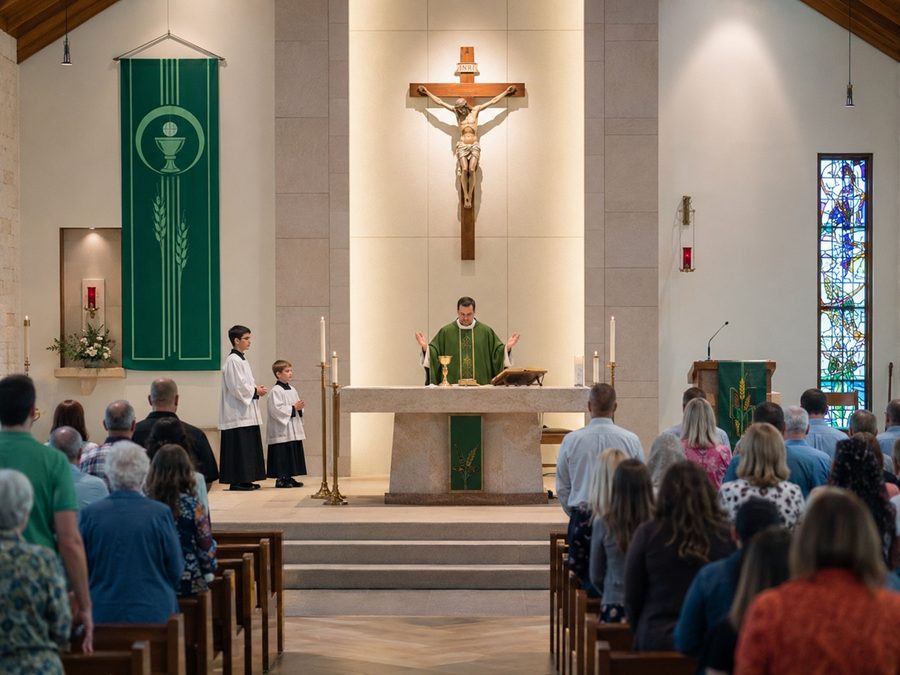
What It Will Feel Like
Some of it may feel familiar. There are songs, prayers, Bible
readings, and a short talk by the priest — called the
homily
which usually runs about ten minutes. Scripture is read aloud at
length: an Old Testament reading, a Psalm, a New Testament
reading, and a Gospel reading, at every Sunday Mass. Some of it will be unfamiliar:
people kneel at certain moments, there are stretches of real
silence, and the center of the room is not a stage with a
speaker but an altar. The whole Mass takes about an hour.
Nobody Is Watching You
Sit anywhere; the back is fine and plenty of regulars prefer it.
There is no attendance record and no monthly report of any kind.
A collection basket will pass — visitors are expected to
let it go by, and nobody notices. When most of the congregation
goes forward to receive Communion, you simply remain seated; in
any parish, some people do, and no one looks twice. When Mass
ends you can slip out with everyone else. If you would rather
try something simpler first, most parishes have a short weekday
Mass — half an hour, a handful of people — which is
the gentlest possible first visit. Not even a collection basket
is passed at the daily Mass.
Familiar Concepts, Different Names
-
Kingdom Hall → the parish
church — the local congregation and its building.
-
Meeting → the Mass — but built around the
Eucharist rather than instruction; the pages on
the Memorial and
the Eucharist
explain why.
-
Elder → the priest — though ordained by the
laying on of hands in a line the site examines under
apostolic succession.
-
Governing Body → the pope and the bishops —
a claim this site examines rather than assumes, on
By What Authority?
-
Field service → nothing. No preaching quota, no
monthly report, not even a box to check.
What Is OCIA?
If curiosity outlasts the first visit, parishes offer something
called OCIA
— the Order of Christian Initiation of Adults. It is a
class for people who want to ask questions, and it is nothing
like a Bible study aimed at your baptism date. It runs
unhurried, usually most of a year; questions are welcomed rather
than managed; many people attend simply to learn; and you can
stop at any point. Nobody is baptized or received into the
Church until they ask to be.
Will They Shun Me If I Change My Mind?
No. Walk away after one visit, or after a year of OCIA, or ten
years after joining, and there is no committee, no announcement,
and no one instructed to avoid you. The Church does have penalties
for a Catholic who formally renounces the faith, and they concern
the sacraments and church office; they say nothing to your family,
your friends, or your parish about whether to speak to you. The contrast
with what it costs you merely to read this site is
worth sitting with for a moment. A church confident of its
claims can afford unlocked doors in both directions.
How to Find a Parish
Every Catholic parish on earth is open to you, and
masstimes.org
will find the nearest one with its Mass schedule. Sunday morning
is the full experience; a weekday morning is the quiet one.
Either way, you can simply go — and simply leave. He was
known to them in the breaking of the bread; the two on the
Emmaus road did not recognize who had been walking beside them
until they sat down at the table (Luke 24:30–35). There is
only one way to find out whether the same thing is waiting for
you.