The Catechism defines the disputed term in one sentence:
“The sacraments are efficacious signs of grace, instituted
by Christ and entrusted to the Church, by which divine life is
dispensed to us.” Signs — the memorialist is right
that they signify. Efficacious — they effect what they
signify, which is where the dispute lives. The opponent on this
page is the memorialist — the Baptist, Zwinglian, and
non-denominational view. Lutherans confess baptismal regeneration
and the real presence, the Reformed call the sacraments means of
grace, Anglicans and Methodists keep sacramental theologies of
their own; on most of what follows they stand nearer Rome than to
the memorialist. The question beneath
the vocabulary is whether God uses matter to give grace, and the
whole shape of biblical religion answers it: a good creation, a
covenant cut in flesh, healing through Jordan water and clay and
spittle, and at last salvation through a body. A religion too
spiritual for matter is not purified Christianity; it is the old
Gnostic instinct in newer clothes.1
What the New Testament Says Baptism Does
Ask not what baptism might symbolize but what the text says it effects. “Baptism… now saves you” — Peter’s own words, immediately guarded from magic: “not as a removal of dirt from the body but as an appeal to God for a clear conscience, through the resurrection of Jesus Christ” (1 Pet. 3:21). “Be baptized every one of you… for the forgiveness of your sins” (Acts 2:38). “Rise and be baptized, and wash away your sins” (Acts 22:16). Saved “by the washing of regeneration” (Titus 3:5). “Born of water and the Spirit” (John 3:5). The memorialist must read four strong verbs as four figures of speech for something happening elsewhere. The sacramental reading takes them as descriptions. Nothing in that competes with faith: the sacrament is faith’s object in action — God doing, visibly and at a nameable moment, what faith trusts Him to do.2
Are Catholics Born Again?
The question deserves a direct answer, because it is usually asked as though it were a trap: yes. Every baptized Catholic has been born again, in the only sense the phrase carries in Scripture. When Jesus tells Nicodemus that “unless one is born anew, he cannot see the kingdom of God” (John 3:3), Nicodemus asks how a man can be born a second time, and Jesus answers by specifying the birth He means: “unless one is born of water and the Spirit, he cannot enter the kingdom of God” (John 3:5) — one birth of water-and-Spirit together, not a physical birth followed by a spiritual one. The context is baptism on every side. Jesus has just come from His own baptism, where the water and the descending Spirit met (Matt. 3:16); and the evangelist’s very next scene has Jesus baptizing — “After this Jesus and his disciples went into the land of Judea; there he remained with them and baptized” (John 3:22). Paul closes the circle by calling baptism “the washing of regeneration and renewal in the Holy Spirit” (Titus 3:5): rebirth, water, and Spirit in a single verse.
The early Church knew no other reading — Justin within living memory of the apostles describing converts regenerated in water, Irenaeus, Cyprian and Augustine citing the verse as a matter of course, and Luther’s Small Catechism still teaching that baptism “works the forgiveness of sins” (the testimony is set out in the essay). The born-again-at-the-altar-call theology that asks the question is the newcomer in the room. So the question may be returned with charity: are you born again the way the Bible describes the new birth — of water and the Spirit?3
The Baptism of Infants
The concession first: every baptism the New Testament narrates is a convert’s, as it is on any mission field, Catholic ones included. The question is what happened to the converts’ children, and there the evidence runs the other way. Baptism was administered by household (Acts 16:33; Lydia; Stephanas) — the way the covenant had always run. Paul calls baptism “the circumcision of Christ” (Col. 2:11–12), and circumcision was given to infants on the eighth day by God’s command; if the new sign fulfills the old, those who would narrow it to adults must explain why the new covenant is at this one point meaner than the old. Peter speaks the covenant idiom at Pentecost: “the promise is to you and to your children” (Acts 2:39). And the early record treats the practice as received, not invented — Origen calls it a tradition from the apostles; Cyprian’s council debated not whether infants should be baptized but whether they must wait eight days. Ott’s grading is flat: valid and licit, de fide. For infants who die unbaptized, the Catechism draws the boundary in a sentence worth memorizing: “God has bound salvation to the sacrament of Baptism, but he himself is not bound by his sacraments” (CCC 1257).4
Confession: David Answers His Own Psalm
“Against thee, thee only, have I sinned” is quoted against the confessional — but David spoke those words after Nathan confronted him face to face, and it was Nathan who pronounced God’s pardon: “The Lord also has put away your sin.” Sin against God only; absolution through a man sent by God. The New Testament makes the pattern an office. “As the Father has sent me, even so I send you… If you forgive the sins of any, they are forgiven; if you retain the sins of any, they are retained” (John 20:21–23). Forgiving or retaining requires hearing; a commission to do what God was already doing without them would be a commission to do nothing. Paul calls it “the ministry of reconciliation” entrusted to ambassadors (2 Cor. 5:18–20); James sends the sick man to the elders and says “confess your sins” (Jas. 5:14–16). The priest is not a second mediator; he is the ambassador the one Mediator sent. And the Catholic who hears “I absolve you” spoken aloud walks out knowing he is forgiven, rather than hoping he has felt sorry enough.5
A Kingdom of Priests — With Priests
“A royal priesthood” (1 Pet. 2:9) is a quotation, and the quotation decides the argument. The words are God’s to Israel at Sinai: “you shall be to me a kingdom of priests” (Ex. 19:6) — said of a nation that had a ministerial priesthood, established by the same God in the same covenant. The universal and the ordained priesthood coexisted for fifteen centuries in the very text Peter cites; his words cannot abolish in the new covenant what they described alongside priests in the old. The left panel’s observation about vocabulary is correct and welcome: the New Testament applies “priesthood” to all the baptized and calls its ministers presbyteroi, elders — the word that became “priest” in English. Both priesthoods are Catholic teaching (CCC 784–786, quoting Lumen Gentium); the dispute is only whether Christ also set some apart, and the case that He did — the Twelve, the elders appointed city by city, the laying on of hands — is made on the apostolic succession page.6
Ex Opere Operato Is Not Magic
The phrase means that the sacrament’s validity does not depend on the holiness of the minister — that Christ, not the priest, is the true actor. It was forged in the Donatist crisis, against the claim that baptisms conferred by failed clergy were void: when Peter baptizes, Christ baptizes; when Judas baptizes, Christ baptizes. The alternative is pastoral terror — no Christian could trust his baptism without first auditing the soul of the man who performed it. What the recipient brings still matters, and the Church says so as plainly as any Reformer: the sacraments “bear fruit in those who receive them with the required dispositions” (CCC 1131). The memorialist’s instinct against mechanical religion guards something true — the Church condemns superstition too. But the line between sacrament and magic is the line between receiving from God on His terms and obligating a power on ours, and it is the sacramental view that keeps God the actor from first to last.7
That answers the magic charge; the works charge deserves its own
answer, because it is really the sola fide dispute in
sacramental dress. “A sacrament that works is a work”
assumes the sacrament is something the believer performs to earn
standing. It is the reverse: a sacrament received is something
done to the believer, not by him. The infant at the font
contributes nothing; the penitent in the confessional brings only
his sins; the communicant opens his mouth. If salvation by works
means man achieving his own rescue, nothing could be further from
it than an act whose whole grammar is receiving. The objection
lands on the wrong end of the transaction — and the
underlying question, whether the faith that saves can remain
alone, is argued at
Is Sola Fide
True?
Worship in Spirit and Truth
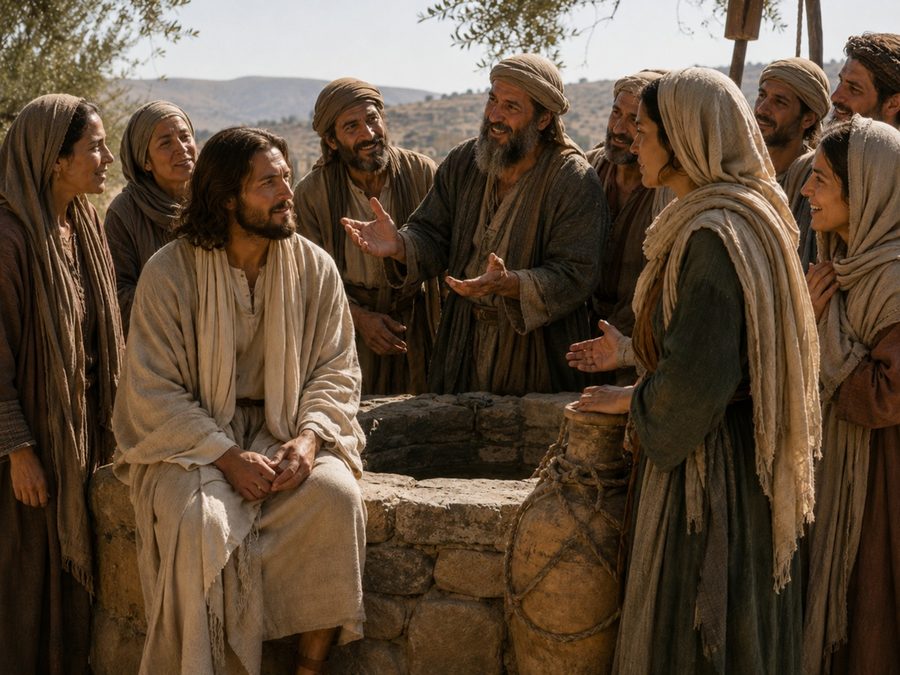
The verse most often set against everything above is John 4:24: “God is spirit, and those who worship him must worship in spirit and truth” — read as Christ’s own verdict against ritual, ceremony, and sacrament. The reading collapses on its context. The Samaritan woman had asked a question of geography — this mountain or Jerusalem (John 4:20) — and Christ’s answer abolishes the where, not the how: “the hour is coming, and now is” when true worship will be tied to no mountain, because the true temple is His own body (John 2:19–21). Nor is “spirit” in John’s Gospel a synonym for the merely interior. In the same conversation Christ offers the woman living water (John 4:10), and when the image returns at the feast, John glosses it himself: “this he said about the Spirit, which those who believed in him were to receive” (John 7:39). Worship in spirit is worship in the Holy Spirit; worship in truth is worship in Him who is “the way, and the truth, and the life” (John 14:6). And the speaker is the same Christ who, on the night before He died, took bread and said “Do this” (Luke 22:19) — instituting the most concrete act of worship the Church possesses. A verse cannot be a verdict against ritual when the Lord who spoke it instituted one.
Indulgences: the Abuse Was Real
Tetzel’s trade was a genuine scandal, and the Council of Trent said so — abolishing the indulgence-sellers and condemning “all base gain for securing indulgences.” A Catholic who pretends otherwise forfeits the argument. But an abuse defines nothing. An indulgence is the remission of the temporal consequences of sins already forgiven; it presupposes forgiveness, has never been forgiveness, and has never legitimately been for sale. Its doctrine stands with purgatory and the communion of saints, argued on their own pages.8
What Is at Stake
Where may a Christian look for assurance? The memorialist locates grace in an interior transaction and leaves the signs outside it; the believer is thrown back on the quality of his own sincerity for confidence it occurred. The sacramental Christian is given something outside himself — a date on which he was baptized, absolution spoken aloud, bread placed in his hands. Grace located where Christ located it can be found again in the dark. That is not superstition but the mercy of a God who knows what we are made of — who has always stooped to matter, because matter is what He made us from, and what His Son became.
This is the concise case. The full essay adds the survey of Reformation positions in their own words, the patristic record on infant baptism, the treatment of scrupulosity and the confessional, why there are seven sacraments and not two, and complete documentation. It is available as a Word document at the end of this page.
Endnotes
- Catechism of the Catholic Church 1131, quoted exactly from the Vatican’s text. ↩
- 1 Peter 3:21; Acts 2:38; 22:16; Titus 3:5; John 3:5, RSV. ↩
- John 3:1–22; Titus 3:5; Matthew 3:16, RSV. Justin Martyr, First Apology 61, quoted in the Ante-Nicene Fathers translation and checked against the library’s copies; Irenaeus, Fragment 34; Cyprian, Letter 71(72):1; Augustine, Letter 98:2, summarized. Luther, Small Catechism, Part IV, on baptism. The Catholic Answers tract “Are Catholics Born Again?” (imprimatur 2004), which assembles this evidence, is held in the site’s reference library. ↩
- Acts 16:33; Colossians 2:11–12; Acts 2:39, RSV. Origen, Commentary on Romans 5.9; Cyprian, Letter 64 (the council of 253). Ludwig Ott, Fundamentals of Catholic Dogma: “The Baptism of young children is valid and licit. (De fide.)” CCC 1257; cf. the International Theological Commission, The Hope of Salvation for Infants Who Die Without Being Baptised (2007). ↩
- Psalm 51:4 with 2 Samuel 12:13; John 20:21–23; 2 Corinthians 5:18–20; James 5:14–16, RSV. ↩
- 1 Peter 2:9, quoting Exodus 19:6. CCC 784–786 and 1546–1547, quoting Lumen Gentium 10: the two priesthoods “differ essentially and not only in degree” while ordered to one another. ↩
- Ott: “The Sacraments work ex opere operato. (De fide.)” Augustine’s principle summarizes In Iohannis Evangelium Tractatus 6.7. CCC 1127–1128, 1131. ↩
- Council of Trent, Decree Concerning Indulgences (Session XXV, 1563); CCC 1471–1479. ↩