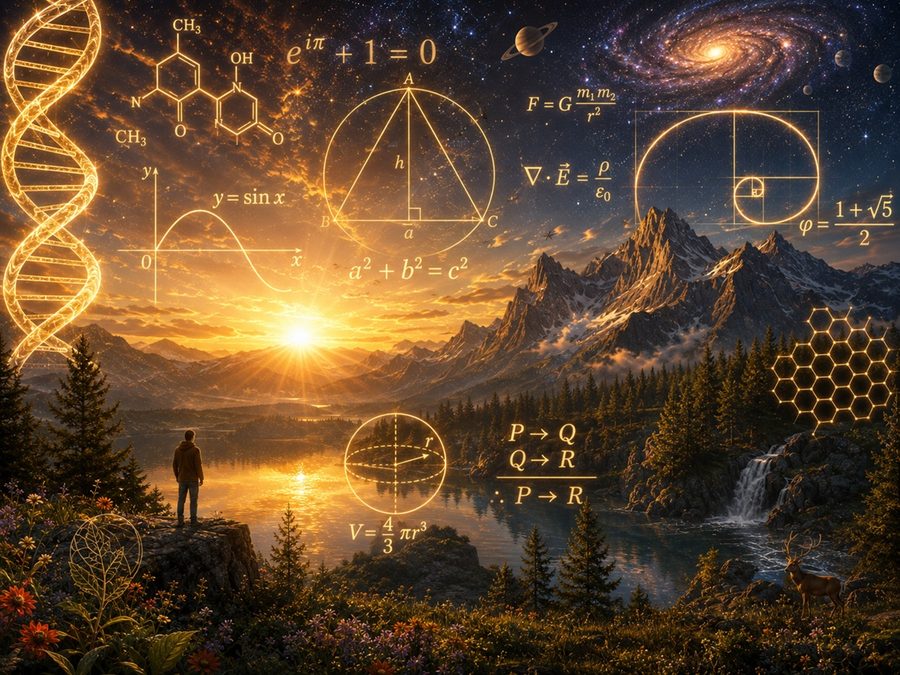
No single argument here is meant to compel. What follows is a
convergence: several independent lines pointing the same way,
none decisive on its own, and together harder to set aside than any
one of them. Saint Paul claims this is how it has always been: that
God’s “eternal power and deity” are “clearly
perceived in the things that have been made” (Rom. 1:20). Not
proved by a syllogism. Perceived, in what is already there.
Why There Is Anything at All
The oldest of these is the cosmological argument — the argument from contingency. The universe did not have to exist. Nothing about it explains why it
is here rather than absent; it is the sort of thing that could have
failed to be. Whatever is like that needs something outside itself
to account for it.
The objection is that this exempts God from the rule it just laid
down. It does not, because the rule was never “everything has
a cause.” It was that whatever could have failed to
exist needs a cause. God is not one more item of that kind;
that is the entire content of the word, as the companion
page on
what we mean by “God”
sets out. To ask who made God is to ask who made the thing that by
definition was not made.
The careful skeptic presses two sharper points, and both deserve
answers. That the Principle of Sufficient Reason is unproven:
true, but rejecting it costs more than theism — all inquiry,
science first of all, runs on the expectation that things have
explanations, and a skeptic who abandons that expectation at
exactly one door has stopped reasoning at the moment reasoning
became inconvenient. And the argument needs only the modest form:
not that everything must have an explanation, but that a thing
which could have one and exists anyway invites the
question. That inferring the whole’s contingency from the
parts is a composition fallacy: some inferences of that shape
fail, but this one does not, because contingency is the kind of
property that survives assembly. A chain in which every link
hangs from another does not hold itself up however long it grows;
a stack of IOUs, however tall, never adds up to cash. If every
member of the collection borrows its existence, the collection
has nowhere to borrow from — and “it is just
there” is not an answer to the question; it is the decision
to stop asking it.
Could the universe itself be that thing? It could, if it showed the
marks of it: not changing, not assembled from parts, not one
item among others. It shows none of them. It changes constantly, it
is made of parts, and every part of it depends on the rest. Graham Oppy, among the ablest living atheist philosophers, takes the other road
and calls the universe’s initial state necessary. The reply
is not to deny that the move is available but to notice its price:
the initial state is still a particular physical arrangement that
could, so far as anyone can tell, have been otherwise, and calling
it necessary asserts what the argument asks to have shown.
This is the argument from contingency, and it should be told apart
from its better-known cousin, the kalam argument, which
turns on the universe having a beginning. The contingency argument
would stand if the universe were eternal; it asks not what started
things but what keeps anything in existence at all. The kalam
argument has its own strengths and its own hostages to cosmology,
and the full essay treats it on its own.
A World That Can Be Understood
This is the teleological argument — the argument from design — in its modern form. Darwin explained the appearance of design in living things, and
explained it well. He did not explain, and never claimed to, why
there is a universe whose laws hold steady enough for evolution to
work in.
That is what fine-tuning presses. The constants governing physics
could have taken almost any values, and nearly all of them give a
universe with no chemistry, no stars, nothing that lasts long
enough to matter. A subtler objection deserves stating: that with
no way to assign probabilities over an infinite range of possible
constants, “improbable” has no defined meaning. The
comparative form of the argument survives it: whatever the measure,
a life-permitting universe is far likelier on theism than on a
single chance universe, and that comparison is all the argument
needs. The multiverse answers by multiplying universes
until ours is unremarkable: a very large purchase — an
infinity of unobserved worlds plus a generator whose own laws
invite the fine-tuning question over again — and whatever
indirect motivations some models claim, the explanatory cost is
paid up front to avoid one conclusion. And the reply that we could only find ourselves in a
life-permitting universe is true but idle: that I could only notice
the firing squad missed if it had missed does not make the missing
unremarkable.
A second argument sits inside the first, the argument from intelligibility. Stranger still is that the universe can be understood at all.
Mathematics worked out for its own sake, with no eye on the world,
keeps turning out to describe the world exactly. That is not what
you would expect of brute matter with no mind behind it. And the
selection effect does not reach this one: survival required minds
that track middle-sized objects — fruit, predators, faces
— not minds whose idle abstractions anticipate the tensor
calculus a century before physics needs it. An orderly world
explains why evolved creatures find some order; it does
not explain why the deepest order keeps answering to the
games mathematicians played for beauty’s sake.
The Fit Between Feeling and Flesh
A newer argument, the psychophysical harmony argument, presses a fact so familiar it is easy to miss: the
states of the body and the states of the mind are matched, and
matched helpfully. Injury feels bad, and the badness is what pulls
the hand from the flame; food and rest feel good, and the goodness
is what draws us toward them. Our experiences make our reports about
them true, and reasoning — run on this strange stuff called
consciousness
— arrives at truths. None of that had to be so.
The physical facts leave the pairing open. The same nerve signal and
the same withdrawal of the hand could have been wired to pleasure,
or to nothing felt at all; a creature whose burns delighted it would
snatch its hand back all the same and live to breed. Across the range
of ways feeling could be laid over function, almost all are useless
or perverse, and the world runs on the sliver that fits. That
harmony, as Brian Cutter and Dustin Crummett have recently argued,
is what a good Mind arranging things would produce, and what blind
law gives no reason to expect.
Selection will not close the gap, because selection grades behavior,
not feeling: it can shape which inner state makes an animal flee, but
it is blind to whether that state feels like agony or bliss, and the
disharmoniously wired creature passes every test survival sets. Nor
does it help to call feeling simply identical to function, since the
naturalist’s own hard problem is the admission that it is not.
The argument proves no Designer; it says the fit between mind and
world is one more thing better explained by a Mind than by matter
left to itself.
The Weight of Right and Wrong
This is the moral argument, and it turns on a distinction the objection blurs. Evolution can explain why we feel obligation. It cannot
explain why some things are wrong. Those are two different
claims, and the objection slides from one to the other without
noticing.
If the moral sense is only inherited instinct, then torturing a
child is not wrong; it is merely something we are built to dislike,
as we are built to dislike bitter flavors. Yet the man who calls
morality an evolved instinct still means it about the
world, not about his own wiring, when he says cruelty
is wrong — the conviction outruns the theory that explains
it away.
Where the Objection Is Strongest
The problem of evil is the hardest thing said against belief in
God, and a believer who pretends otherwise forfeits his
credibility. Three things can be said in reply, and the first is a
concession.
Freedom is worth its price. Love that could not be refused would
not be love, and a world of creatures able to love is worth more
than a world of well-behaved machinery. But the objection is right
that this covers the torturer and not the tumor. It answers the
evil we do. It does not answer the evil that simply happens.
Second, what looks purposeless from inside time may not be. We see
a fragment and pronounce on the whole. This is a real answer, and a
limited one; offered by itself to someone in grief it is cold
comfort, and should not be offered by itself.
The third is not an argument, and it is where Christianity actually
differs from every other answer on offer. The claim is not that God
explains suffering from a safe distance, but that He entered it
(was betrayed, tortured, and executed) and turned it,
in the Resurrection, toward redemption. That does not make evil
good or grief lighter. It means the sufferer is not addressing
someone who has never been where he is.
Why God Does Not Simply Appear
The argument from divine hiddenness asks why a God who wants to be known stays so quiet. The tempting reply — that unmistakable evidence would force
belief and so destroy freedom — is one this site’s own
evidence forbids. God has sometimes appeared unmistakably: to
Paul on the Damascus road, to Thomas with the wounds held out
— and neither man’s love was thereby forced, as Judas,
who watched three years of miracles and left, proves from the
other side. What evidence compels is at most belief that;
and belief-that was never the object — “even the
demons believe, and shudder” (Jas. 2:19). What God seeks is
trust, which no theophany can force, and He measures His
self-disclosure to persons as He wills, judging each by the light
he was given (Luke 12:48). The believer’s claim is not that
God hides, but that He courts rather than conquers — and
that those who sought Him with the seriousness the question
deserves have not, on the record of the ages, found silence.
As for the many religions: that they conflict shows most are wrong
somewhere, not that all are wrong everywhere. Physicians disagree,
and medicine is not thereby false. What is striking, once you look,
is not how much the traditions differ about who is divine but how
completely they agree about what ‘divine’ means.
The pattern of gaps closing is real, and worth conceding. But every
explanation science supplies is an explanation of how something
within the universe works. None of them touches the question of why
there is a universe with anything in it to explain.
The Reply in Brief
No line here forces assent, and none is offered as forcing it. The
claim is only that a universe which did not have to exist, which
runs on constants that did not have to permit us, which yields to
mathematics it had no reason to obey, in which feeling is fitted to
flesh as though on purpose, and in which cruelty is actually wrong,
is better accounted for by a Creator than by nothing at all.
The problem of evil remains the strongest objection, and it is not
dissolved here but weighed. Set against it is a world containing
creatures who can genuinely love, and a God who did not stay out of
the wreckage but was nailed to it.
The full essays take each strand further than a panel allows: the
argument from contingency in the form Aquinas actually gave it, the
fine-tuning figures and what the multiverse would have to cost, why
selection can grade behavior but never the feeling laid over it, why
the moral argument survives every evolutionary account of moral
feeling, and the long Christian literature on suffering:
Augustine, Aquinas, and the modern replies to Hume.