Two questions decide this page, and they must be kept
separate. First: what has the Watchtower actually taught
about “this generation,” in its own words and
in order? Second: what did Jesus mean? The first question
has a documented answer. The second has an old and simple
one — and it is the one answer the Watchtower’s chronology cannot accommodate.
A Deadline That Kept Moving
Set the definitions in a row, each from the Society’s
own publications. In 1927, “this generation”
was the anointed. By mid-century it had become the people
who saw 1914: in 1968 Awake! was calculating that
the youngest of that generation were “nearly 70 years
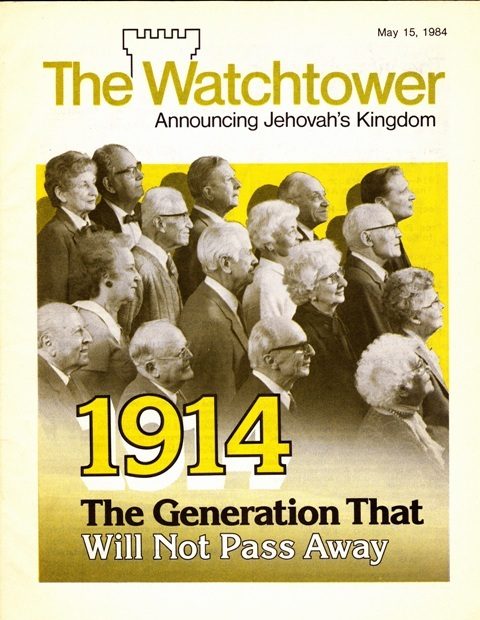
old”; in 1984 The Watchtower put elderly
faces on its cover under the title “1914—The
Generation That Will Not Pass Away.” In 1995, as that
generation reached its actuarial end, the definition
changed: the generation was now “the peoples of earth
who see the sign of Christ’s presence but fail to
mend their ways” — no time limit at all. In
2008 it changed again: the anointed, “as a
class” — the 1927 answer, returned after eighty
years. And in 2010 came the current form: two
overlapping groups of anointed, so that a
“generation” now spans people who never met the
events it is a generation of. The dates speak for themselves: the 1995 change came as the
1914 cohort reached its actuarial end, and the 2010 form removes
any calendar limit. Whether each change was driven by the previous
one’s running out of time is an inference; the reader can
draw it from the chronology, which is why the phases are given
below in the Society’s own words rather than paraphrased.1
The major phases, dated, with the wording of each:
- 1927 — the anointed (The Watch Tower, February 15, 1927, p. 62).
- 1968–1984 — the people who saw 1914: the youngest “nearly 70 years old” (Awake!, October 8, 1968, p. 13); “1914—The Generation That Will Not Pass Away” (The Watchtower, May 15, 1984, cover).
- 1995 — “the peoples of earth who see the sign of Christ’s presence but fail to mend their ways” (The Watchtower, November 1, 1995, p. 19).
- 2008 — the anointed “as a class” (The Watchtower, February 15, 2008, p. 24).
- 2010 — two overlapping groups of anointed (The Watchtower, April 15, 2010, p. 10).
Refinements within a phase are not counted as new definitions.
The Masthead That Changed
The change of 1995 was not an obscure adjustment. For
years, nearly every issue of Awake! told its
readers on the masthead that the magazine
“builds confidence in the Creator’s promise of
a peaceful and secure new world before the generation that
saw the events of 1914 passes away.” That is not a
speculation; it is presented as the Creator’s
promise. With the November 8, 1995 issue the
words “before the generation that saw the events of
1914 passes away” disappeared, and the same month the
generation was redefined. No retraction was published; no
apology to the readers who had deferred education,
children, and careers on the strength of the promise. A
promise attributed to God was withdrawn by editing.2
What Jesus Actually Said
Now read the verse where it lives. In Matthew 24 Jesus has
just left the temple, and His disciples point out its
buildings; He answers that “there will not be left
here one stone upon another” (Matt. 24:2). The
discourse that follows answers the disciples’
question about that — and when Jesus says
“this generation will not pass away till all these
things take place” (Matt. 24:34), the phrase means in
chapter 24 what it means everywhere else in Matthew.
“This generation” asked for a sign
(Matt. 12:41–42); “this generation” is
like children in the marketplace (Matt. 11:16); upon
“this generation” will come the blood of the
prophets — “all this will come upon this
generation” (Matt. 23:36). Every time, without
exception, it means the people standing in front of Him.
No reader of Matthew would take the same phrase, one
chapter later, to mean a class of anointed persons twenty
centuries away whose lives overlap.3
A Prophecy Kept, Not Broken
And on that reading, the prophecy came true —
spectacularly. Within forty years of the words, one
lifetime almost to the year, Roman armies surrounded
Jerusalem and the temple went down stone from stone, exactly
as Jesus had said, while the generation that heard Him was
still alive to see it. Luke’s version even names the
event: “when you see Jerusalem surrounded by armies,
then know that its desolation has come near”
(Luke 21:20). The discourse also looks past A.D. 70 to the
Lord’s final coming — of which Jesus says in
the very next breath that “of that day and hour no
one knows” (Matt. 24:36) — the double horizon
the Church has read here from the beginning. Verse 34 is
not an embarrassment Christians must explain away. It is a
fulfilled prophecy: Jesus attached a deadline to the
temple’s fall, and He kept it. Only a religion that
moved the prophecy to 1914 has to keep moving the
generation.4
The Test the Watchtower Chose
Scripture supplies a test for exactly this situation:
“when a prophet speaks in the name of the LORD, if
the word does not come to pass or come true, that is a word
which the LORD has not spoken” (Deut. 18:22). The
Watchtower accepted that test when it printed the
Creator’s name over the 1914-generation promise. The
generation passed; the promise did not come to pass; the generation was redefined five times; the question Deuteronomy poses was not put in print. Set beside it the sentence Jesus
spoke: one generation named, one deadline given, one temple
down on schedule. The contrast is this site’s theme
in miniature — the difference between a word that
stood and human reasoning that must keep revising itself,
which is the mark of
a man-made religion.
The dates behind the system are examined on
the chronology page;
what the last days actually are, on
the last-days page.5
The Strongest Reply
The Society’s best argument is lexical. A generation, it says,
“usually refers to people of varying ages whose lives overlap
during a particular time period; it is not excessively long; and it has
an end,” and it cites Exodus 1:6, where “Joseph died, and
all his brothers, and all that generation” — a generation
made up of people of different ages whose lives overlapped. Jesus, on
this reading, spoke to disciples who would be anointed, and
“evidently meant that the lives of the anointed who were on hand
when the sign began to become evident in 1914 would overlap with the
lives of other anointed ones who would see the start of the great
tribulation” (The Watchtower, April 15, 2010, p. 10). The
sign was given to the anointed; the anointed are the generation; and the
generation is still here.
Exodus 1:6 says the reverse of what it is cited for. Joseph, his
brothers, and “all that generation” were contemporaries
— people alive together who died together — which is what
the word means everywhere: those born about the same time, living out
one span. It never means a group formed by adding a second cohort whose
lives merely touch the first, and no standard lexicon gives it that
sense; on that definition a generation could be extended indefinitely by
overlap, which is exactly the use being made of it. Nor does anything in
Matthew 24 say the generation is the anointed. “This
generation” in Matthew is always the people in front of Jesus
(11:16; 12:41–42; 23:36), and in the discourse itself it is the
people who “see all these things” (Matt. 24:33) — the
reading the Society itself gave for sixty years, of the people who saw
1914, until they died.
The test is the one the doctrine sets for itself: does it have an end?
An anointed Witness born in 1990 whose life overlapped a 1914 anointed
one who died in 1995 belongs, by the definition, to “this
generation,” and may live to 2080. A generation of a hundred and
seventy years is not “not excessively long.” It is a term
with no expiry, adopted at the moment the previous term expired —
which is the whole of what needed explaining.
What remains if this claim fails. A failed timetable does not mean Jesus failed. What this page establishes is that the Society’s definition of the generation has moved five times, and that Jesus’ own words fit the generation He was speaking to. What it does not establish is that the Olivet discourse has no further horizon; Matthew 24 can be read without a date-setting system, and the Church reads it so.
The full essay documents every redefinition with its
source, walks Matthew 24 whole — both horizons
— and takes up the honest questions: whether
“generation” can mean “race,”
what verse 36 does to every dating scheme, and what
the first Christians expected. Download it from the
summary below — and the comments are open,
without your name if you prefer.
Endnotes
- The Watch Tower, February 15, 1927, p. 62 (the generation identified with the anointed); Awake!, October 8, 1968, p. 13 (“the youngest of ‘this generation’ nearly 70 years old”); The Watchtower, May 15, 1984, cover and p. 5; The Watchtower, November 1, 1995, p. 19; The Watchtower, February 15, 2008, p. 24; The Watchtower, June 15, 2010, pp. 3–5, with April 15, 2010, p. 10. ↩
- The masthead wording ran through the October 22, 1995 Awake!; the November 8, 1995 issue replaced it with “a peaceful and secure new world that is about to replace the present wicked, lawless system of things.” ↩
- Matt. 11:16; 12:41–42; 23:36; 24:2, 34 (RSV). The same usage runs through Mark (8:12, 38; 13:30) and Luke (7:31; 11:29–32, 50–51; 17:25; 21:32). ↩
- Luke 21:20; Matt. 24:36 (RSV); Josephus, The Jewish War, Books 5–6, for the siege and destruction of A.D. 70. On the discourse’s two horizons, Catechism of the Catholic Church §§585–586, 668–679. ↩
- Deut. 18:22 (RSV). ↩