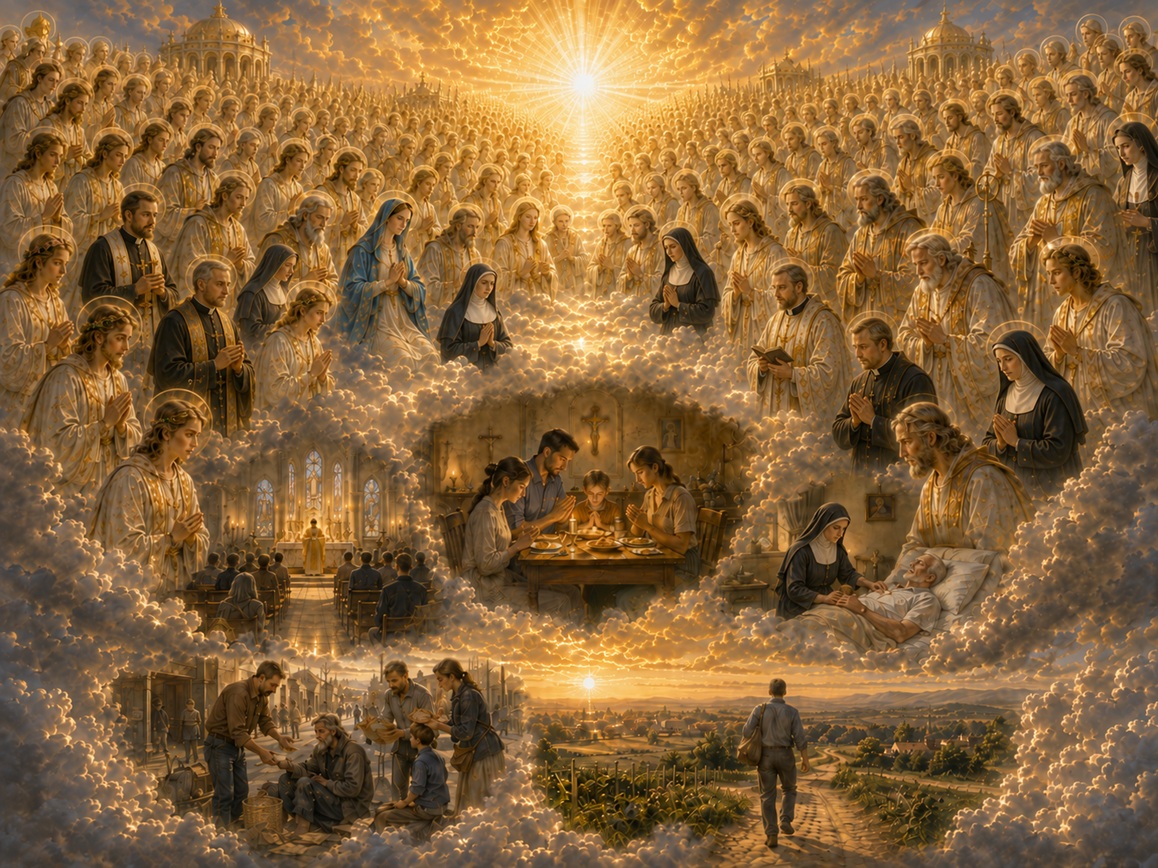
The Communion of Saints

Communion of Saints

“Therefore, since we are surrounded by so great a cloud of witnesses, let us also lay aside every weight, and sin which clings so closely, and let us run with perseverance the race that is set before us, …”

The writer of Hebrews has just finished a long roll-call of the faithful dead — Abel, Noah, Abraham, Moses, Rahab, the prophets — and then turns to the living and says something striking. We are surrounded by them. They are a cloud of witnesses about us, and we are to run our race knowing they are there.

That sentence raises the question this page is about. What exactly is the relationship between Christians still living and Christians who have died? Are they simply gone, remembered but absent, awaiting a resurrection that will one day restore them? Or are they alive now, aware, and still part of the same body we belong to — so that the Church is not two groups but one, some of it here and some of it home?

The Catholic Church calls the second answer the communion of saints, and draws a practical conclusion from it: if they are alive in Christ and love us, we may ask them to pray for us, exactly as we ask a friend on earth. Jehovah’s Witnesses reject that firmly. On their teaching the dead are unconscious and no longer exist, prayer is an act of worship owed to God alone, and any attempt to address the dead is the spiritism Scripture forbids. Protestants reject the practice for quite different reasons: they grant that the saints in heaven are alive and aware, and object instead that Scripture records no such prayer, that there is one Mediator who needs no help, and that the honor paid the saints in practice looks like the worship the Church says it is not. Both cases, in their own words, are set out in the Protestant & Watchtower View panel.

Much of the disagreement turns on a prior question — whether anyone survives death at all — which is argued on the companion page What Is the Soul? Grant that they live, and the remaining questions are these: can they hear us, does asking their prayers take anything from Christ, and is honoring them the idolatry it is charged with being? The Catholic View panel takes each in turn.

I invite your engagement with me on these questions. You may leave comments below, but please be sure to read our policy on commenting before doing so.

Protestant & Watchtower View

Protestants and Jehovah’s Witnesses both refuse to ask the saints for their prayers, and the shared conclusion hides two quite different arguments. The Protestant grants that the saints in heaven are alive and conscious, and objects that asking them is unnecessary and intrudes on the one Mediator. The Witness denies the premise itself: the dead are unconscious and cannot hear, so the practice is not improper but empty.

The Protestant Objection

There is one Mediator, and He needs no help. This is the objection that carries the weight. “There is one God, and there is one mediator between God and men, the man Christ Jesus” (1 Tim. 2:5). If a Christian may come to the Father through the Son at any hour and without leave, then routing a petition through a canonized saint adds a step Scripture never asks for — and suggests, however unintentionally, that the Son is less approachable than His friends.1

Scripture gives no instance of it. Not one prayer in the Bible is addressed to a departed saint. The apostles ask living Christians to pray for them constantly — the very practice the Catholic appeals to — but never once ask a dead one. A devotion this central ought to have left some trace in the New Testament, and it has left none.

In practice it becomes what it denies in theory. Protestants grant that the Church distinguishes dulia from latria on paper, and observe that the distinction is hard to see in the pew: rosaries told before a statue, novenas addressed to a particular saint for a particular favor, shrines where the petitions are plainly directed to the saint rather than through him. A safeguard that needs a theological education to perceive is not much of a safeguard.2

And it assumes something like omniscience in a creature. For a saint to hear thousands of prayers at once, in every language, he would need knowledge Scripture attributes to God alone. The reply that the saints see such things in God is not itself found in Scripture; it is a theological construction built to make the practice possible.

The Watchtower Objection

Jehovah’s Witnesses reject the veneration of saints entirely. There is no class of canonized holy ones, no patron saints, no relics, no images, and above all no prayer addressed to anyone but God. The rejection is not a matter of emphasis but of first principles: prayer is worship, worship belongs to Jehovah alone, and the dead are in any case unconscious and unable to hear anything. Their teaching is set out in Insight on the Scriptures under “Saint,” in Reasoning From the Scriptures under “Images” and “Prayer,” and in the Bible-questions articles on jw.org.3

What They Affirm

Prayer is worship, and worship belongs to God alone. Scripture calls Jehovah the “Hearer of prayer” (Ps. 65:2) and Christ told Satan that it is God alone one must worship and to whom alone sacred service is rendered (Matt. 4:10). Witnesses conclude that to direct prayer to any creature — however holy, however close to God — is to give away what belongs to the Creator. The practice is therefore not a lesser devotion but a species of idolatry.4

The dead cannot hear, because the dead do not exist. This is the argument Witnesses regard as decisive, and it follows from their teaching on the soul. “The dead know nothing at all” (Eccl. 9:5); a man’s thoughts perish on the day he dies (Ps. 146:4); there is no work or thought or knowledge in the grave (Eccl. 9:10). On this view there is nobody there to hear a prayer, and the saints in glory to whom Catholics speak are simply not conscious anywhere.5

Addressing the dead is spiritism, which God forbids. Witnesses point to the Law’s repeated prohibition of consulting the dead: no one is to be found among you who “inquires of the dead” (Deut. 18:10–12), or turns to mediums (Lev. 19:31). Isaiah puts the question sharply: should a people not inquire of their God? “Should they inquire of the dead on behalf of the living?” (Isa. 8:19). To speak to a departed human being, they argue, is to do the very thing these texts prohibit, whatever it is called.6

How They Argue It

There is one mediator, and one only. “There is one God, and one mediator between God and men, a man, Christ Jesus” (1 Tim. 2:5). Witnesses hold that inserting saints as intercessors between the believer and God contradicts that verse directly, and implies that Christ is either too remote or too severe to be approached — when Scripture says believers may come to the throne of God with freeness of speech through him alone (Heb. 4:16).7

Images and relics violate the commandment. The second of the Ten Commandments forbids making a carved image and bowing down to it (Ex. 20:4–5), and John closes his letter with “guard yourselves from idols” (1 John 5:21). Statues of saints, kissed or crowned or carried in procession, and the veneration of bones and cloth, are on this account plain breaches of the commandment, whatever explanation is offered for them.8

In Scripture, “saints” means all believers. Witnesses observe, correctly, that the New Testament calls the whole body of Christians “holy ones” — Paul writes to the saints at Rome, at Corinth, at Ephesus (Rom. 1:7; 1 Cor. 1:2; Eph. 1:1). Nowhere does it single out a canonized elite. They understand the term of the anointed 144,000 who will rule with Christ, and regard the later machinery of canonization, feast days, and patronage as a human invention with no apostolic warrant.9

The practice came from paganism. Consistent with their account of Church history, Witnesses hold that the cult of the saints entered Christendom after the apostles died, as converts brought the habits of polytheism with them and local gods were replaced by local patrons. The companion page Was There a Great Apostasy? sets out that larger claim.10


Endnotes
  1. On the sole mediation of Christ as excluding invocation of the saints, see the Westminster Confession of Faith (1646), XXI.2 — religious worship is to be given to God alone, “and that not to angels, saints, or any other creature” — and the Thirty-Nine Articles, XXII, which calls the Romish doctrine concerning invocation of saints “a fond thing vainly invented.”
  2. That the dulia/latria distinction fails in practice is standard in Reformed polemic from Calvin onward; see John Calvin, Institutes of the Christian Religion III.20.21–27, on invocation and on what he took to be the transfer to creatures of honor due to God alone.
  3. The standard reference treatments are Insight on the Scriptures (Watch Tower Bible and Tract Society of Pennsylvania, 1988), Vol. 2, entry “Saint,” and Reasoning From the Scriptures (1985; rev. 1989), entries “Images,” “Prayer,” and “Spiritism”; see also the Bible-questions articles on jw.org treating prayer to saints. [Page numbers to be supplied from the printed editions.]
  4. Psalm 65:2 and Matthew 4:10, quoted from the New World Translation. On prayer as an act of worship reserved to God, see Reasoning From the Scriptures, entry “Prayer.”
  5. Ecclesiastes 9:5, 10; Psalm 146:4. This argument depends entirely on the Watchtower’s doctrine of the soul; the prior question is treated on the companion page What Is the Soul?, and the two stand or fall together.
  6. Deuteronomy 18:10–12; Leviticus 19:31; Isaiah 8:19. The identification of Christian intercession with the necromancy these texts forbid is the Society’s inference; whether the two are the same act is taken up in the Catholic View panel.
  7. 1 Timothy 2:5 with Hebrews 4:16. The same argument is applied to the intercession of Mary; see the companion page What About Marian Dogmas?
  8. Exodus 20:4–5 and 1 John 5:21. The Watchtower numbers the commandments differently from the Catholic enumeration, which is why the image prohibition is cited as the second rather than as part of the first; the difference is one of division, not of content.
  9. Romans 1:7; 1 Corinthians 1:2; Ephesians 1:1. On “holy ones” understood of the anointed class, see Insight on the Scriptures, Vol. 2, “Saint,” and the companion page Heavens Above! for the 144,000.
  10. The claim that the veneration of saints is a pagan survival belongs to the wider apostasy narrative in Jehovah’s Witnesses—Proclaimers of God’s Kingdom (1993) and Mankind’s Search for God (1990).

Catholic View

The Catholic Church holds that death does not expel anyone from the Church. Those who have died in Christ are alive in Him, aware, and still members of the same body as the living — which is what the communion of saints means. From that one claim everything else follows: if they are alive and love us, asking their prayers is not necromancy but the ordinary courtesy Christians extend to one another, and honoring them is not idolatry but the honor Scripture pays the faithful throughout.

The Dead in Christ Are Not Dead

The objection rests on a premise, and the premise is the weak point. If the faithful departed are unconscious and nonexistent, no more need be said. But Christ Himself denied it, in an argument He chose to make against the Sadducees: God “is not God of the dead, but of the living,” since He calls Himself the God of Abraham, Isaac, and Jacob centuries after they died (Matt. 22:32). Luke’s version adds the reason: “for all live to him” (Luke 20:38).1

The rest of the New Testament assumes the same. Paul wants “to depart and be with Christ,” which he calls far better (Phil. 1:23) — a preference that means nothing if departing is unconsciousness. John sees the martyrs under the altar, conscious, crying out and answered (Rev. 6:9–11). Moses and Elijah, dead for centuries, appear alive and in conversation at the Transfiguration (Matt. 17:3). The full case is on the companion page What Is the Soul?, and it decides this one.

They Know What Happens Here

Grant that they live; can they hear? Scripture indicates that they can, and in a specific way. Christ says there is “joy before the angels of God over one sinner who repents” (Luke 15:10) — heaven follows individual conversions on earth as they happen. Hebrews, having listed the faithful dead by name, tells the living they are “surrounded by so great a cloud of witnesses” (Heb. 12:1). A witness is not an absentee.2

More directly, Revelation twice shows the prayers of Christians on earth being presented in heaven by others. The twenty-four elders fall before the Lamb holding “golden bowls full of incense, which are the prayers of the saints” (Rev. 5:8), and an angel offers much incense “with the prayers of all the saints upon the golden altar” (Rev. 8:3–4). Whatever else those scenes describe, they show heaven aware of, and occupied with, what the Church on earth is asking.3

Asking a Prayer Is Not Consulting a Medium

The charge of spiritism deserves a careful answer, because the texts are real and the prohibition is serious. What Deuteronomy, Leviticus, and Isaiah forbid is necromancy: summoning the dead by ritual to obtain hidden knowledge, bypassing God to consult a power He has not authorized. The whole point of Isaiah’s rebuke is that Israel was going to the dead instead of to God — “should not a people inquire of their God?” (Isa. 8:19).

Asking a saint to pray is the opposite act in every respect. Nothing is summoned; no ritual compels anyone; no hidden knowledge is sought; and nothing is asked except that they do what Christians already do for one another — carry a request to God. The medium seeks information the dead are supposed to supply. The Christian asks intercession that God alone will answer. If the two were the same act, the Transfiguration would convict Christ of it, since Moses and Elijah were long dead and He spoke with them.4

The One Mediator

Paul’s statement that there is “one mediator between God and men” (1 Tim. 2:5) is the strongest verse in the objector’s hand, and it proves less than it seems, for a reason available in the same paragraph. Three verses earlier Paul urges “that supplications, prayers, intercessions, and thanksgivings be made for all men” (1 Tim. 2:1). If asking or offering intercession encroached on Christ’s mediation, Paul contradicted himself within four verses.

He did not, because the two are different things. Christ’s mediation is unique and unrepeatable: He alone is God and man, and He alone reconciled us by His blood. No creature adds anything to it, and the Church has never claimed otherwise. Intercessory prayer is not a rival channel of redemption but a participation in His — which is why Scripture asks for it constantly. Paul begs the Romans to “strive together with me in your prayers” (Rom. 15:30) and tells the Thessalonians to pray for him (1 Thess. 5:25). If asking a fellow Christian to pray usurps Christ, the apostle usurped Him in every letter he wrote.5

No Prayer in Scripture Is Addressed to a Saint

This is quite true, and it is worth conceding plainly rather than disputing. No New Testament prayer asks a departed believer to intercede. But notice what kind of argument that is: an argument from silence, and one that proves a great deal more than the objector wants. There is no New Testament instance of a Christian praying alone in a church building, of a Sunday service outside a home, of the word “Trinity,” or of anyone drawing up a list of which books belong in the Bible. Silence establishes that a practice is not recorded, not that it is forbidden.

And the silence is not surprising. Every book of the New Testament was written while the first Christian generation was still alive; the martyrs whose prayers the Church would later ask were, at the time of writing, either living or newly dead, and the Church’s attention was elsewhere. What matters is how soon the practice appears once the record resumes. It is on the walls of the Roman catacombs by about the year 200 — scratched requests to Peter and Paul to pray, written by people who had grown up under persecution — and it appears without controversy or defense, as something nobody thought needed either.9

Death Does Not End Membership

Here the objection meets its deepest difficulty. Christians on earth may certainly ask each other for prayer; nobody disputes that. So the claim must be that death severs the connection — that a believer who prayed for you last week cannot be asked this week, because he has died.

But Paul says the opposite in as many words. He is persuaded that neither death nor life, nor angels nor principalities, nor anything in all creation “will be able to separate us from the love of God in Christ Jesus our Lord” (Rom. 8:38–39). And the body is one: “if one member suffers, all suffer together; if one member is honored, all rejoice together” (1 Cor. 12:26). A body whose members are cut off at death is not the body Paul describes. The communion of saints is simply the refusal to draw a line through the middle of the Church that Christ did not draw.6

Honor, Images, and the Commandment

That the New Testament calls all believers “saints” is quite true, and it is the Catholic premise rather than an objection to it: the communion of saints is the whole body, not an elite within it. Canonization does not manufacture saints. It recognizes, and holds up for imitation, particular members whose lives the Church judges to have shown Christ plainly — which is what Paul asks for when he tells the Corinthians, “be imitators of me, as I am of Christ” (1 Cor. 11:1), and what Hebrews asks when it says to consider the outcome of your leaders’ lives and imitate their faith (Heb. 13:7).7

As for images, the commandment forbids idols — images made to be gods and worshipped as such. It cannot forbid religious imagery outright, because the same God who gave it commanded the golden cherubim over the ark (Ex. 25:18–20), the woven cherubim on the veil (Ex. 26:1), and the bronze serpent Israel was to look upon and live (Num. 21:8–9). What Scripture condemns is not the carving but the worship — and when the bronze serpent did become an object of worship, Hezekiah rightly destroyed it (2 Kings 18:4). A statue is honored the way a photograph of a father is honored: the regard passes through it to the person, and stops nowhere in the bronze.8

There remains the observation that the distinction is easier to state than to see — that in the pew the novena and the shrine can look like petition addressed to the saint rather than through him. The complaint deserves to be taken seriously rather than waved off, and the Church has taken it seriously: the Council of Trent, which met with the Reformers’ charges in front of it, ordered the bishops to root out superstition and abuse in the veneration of the saints by name, and the Second Vatican Council repeated the instruction. But an abuse is an argument against the abuse. Prayer to God is misused constantly — treated as leverage, as a formula, as a transaction — and nobody proposes stopping it. What the objection shows is that the practice needs catechesis, which is true, and which is not the same as showing that it is idolatry.10

The Reply in Brief

Every part of the objection depends on the first part. If the faithful dead are unconscious, the rest follows and the practice is empty. But Christ told the Sadducees that God is God of the living, and that for Him all live; Paul thought departing to be with Christ was better than remaining; John saw the martyrs awake and heard them speak. Once that is granted, the other charges lose their grip.

Asking a saint to pray is not necromancy, because nothing is summoned and no hidden knowledge is sought. It does not rival the one mediator, or Paul rivalled Him every time he asked for prayer. It does not invent a class of super-Christians, because the saints are the whole Church and canonization only points at some of them. And it does not break the commandment, because the God who forbade idols commanded cherubim. What remains is a family that death has not divided — and the plain instinct, when you are in trouble, to ask the people who love you to pray.

This is the short answer. The full treatment adds the epigraphic and liturgical evidence from the catacombs, where Christians were asking the martyrs’ prayers within living memory of the persecutions; the Fathers on the intercession of the saints; the distinction between latria, dulia, and hyperdulia and where it comes from; what the Second Council of Nicaea actually defined about images and against whom; the development of canonization and what the Church claims for it; and full documentation for everything asserted here. It is available as a Word document at the end of this page.


Endnotes
  1. Matthew 22:31–32, with Mark 12:26–27 and Luke 20:37–38. Christ selected this argument against the Sadducees precisely because they denied the resurrection, and it turns on the patriarchs being alive to God at the moment He speaks.
  2. Luke 15:7, 10; Hebrews 11:1–12:1, where the “cloud of witnesses” is the company just enumerated by name. The Greek martys carries the sense of one who testifies, not merely one who watches.
  3. Revelation 5:8 and 8:3–4. In both scenes the prayers of the saints on earth are held and presented in heaven by someone other than the one praying.
  4. Deuteronomy 18:10–12; Leviticus 19:31; Isaiah 8:19, whose complaint is that Israel consulted the dead instead of God. On the Transfiguration, Matthew 17:1–3 with Mark 9:2–4 and Luke 9:28–31; Luke adds that Moses and Elijah spoke with Christ of His coming exodus at Jerusalem.
  5. 1 Timothy 2:1–5 read as a unit. On requests for intercession, Romans 15:30; 2 Corinthians 1:11; Ephesians 6:18–19; Colossians 4:3; 1 Thessalonians 5:25; James 5:16.
  6. Romans 8:38–39; 1 Corinthians 12:12–27. See also Catechism of the Catholic Church §§946–962 on the communion of saints as the union of the Church on earth, the Church being purified, and the Church in glory.
  7. Romans 1:7; 1 Corinthians 1:2; Ephesians 1:1 for the wide use of “saints,” which the Catholic position affirms rather than disputes. On imitation of particular Christians, 1 Corinthians 4:16; 11:1; Philippians 3:17; Hebrews 6:12; 13:7.
  8. Exodus 20:4–5 with Exodus 25:18–20; 26:1; Numbers 21:8–9; 1 Kings 6:23–29; and 2 Kings 18:4, where the same bronze serpent is destroyed once it is worshipped — which is exactly the distinction the commandment draws. The Second Council of Nicaea (787) defined that the honor given an image passes to the one it represents.
  9. On the catacomb evidence, the graffiti at the shrine beneath San Sebastiano on the Appian Way include invocations of Peter and Paul dated to the third century; comparable inscriptions appear in the catacombs of Callixtus and Priscilla. See also the Martyrdom of Polycarp 17–18 (c. A.D. 156) on the honor paid to a martyr’s remains, and its careful distinction between the worship given to Christ and the love given to the martyrs.
  10. Council of Trent, Session XXV (1563), On the Invocation, Veneration, and Relics of Saints, and on Sacred Images, which directs bishops to remove “all superstition” and “all filthy lucre” from the practice; Second Vatican Council, Lumen Gentium §51, which asks that abuses and excesses be corrected and the practice restored to its proper measure.

Summary

Jehovah’s Witnesses hold that the dead are unconscious, that prayer is worship owed to God alone, and that addressing the departed is the spiritism Scripture forbids. Protestants grant that the saints are alive and aware, and object instead that Scripture records no such prayer and that there is one Mediator who needs no help. The Catholic Church holds that death does not expel anyone from the Church, and that asking a saint to pray is what Christians have always asked of one another.

Everything depends on whether they are alive. Christ settled it against the Sadducees: God “is not God of the dead, but of the living,” since He calls Himself the God of Abraham, Isaac, and Jacob centuries after their deaths (Matt. 22:32), and Luke adds the reason — “for all live to him” (Luke 20:38). Paul thought departing to be with Christ was “far better” than remaining (Phil. 1:23), which means nothing if departing is unconsciousness.

Heaven follows what happens here. There is “joy before the angels of God over one sinner who repents” (Luke 15:10) — individual conversions, known as they happen. Hebrews, just after naming the faithful dead one by one, tells the living they are “surrounded by so great a cloud of witnesses” (Heb. 12:1). A witness is not an absentee.

Revelation shows prayers being carried by others. The elders fall before the Lamb holding “golden bowls full of incense, which are the prayers of the saints” (Rev. 5:8), and an angel offers incense “with the prayers of all the saints” (Rev. 8:3–4). Whatever else those scenes are, heaven in them is aware of what the Church on earth is asking.

Asking a prayer is not consulting a medium. What the Law forbids is necromancy — summoning the dead by ritual to obtain hidden knowledge, going to them instead of to God, which is precisely Isaiah’s complaint (Isa. 8:19). Nothing is summoned when a Christian asks a saint to pray, no knowledge is sought, and nothing is requested but intercession God alone will answer. Were the two acts the same, the Transfiguration would convict Christ, who spoke with Moses and Elijah long after they died.

The one mediator is not in question. Paul says there is one mediator (1 Tim. 2:5) three verses after urging that “supplications, prayers, intercessions” be made for all men (1 Tim. 2:1). He did not contradict himself in four verses. Christ’s mediation is unique because He alone reconciled us by His blood; intercession participates in it rather than rivalling it — which is why Paul begged the Romans to strive with him in their prayers (Rom. 15:30).

Death does not end membership. Nobody disputes that Christians on earth may ask each other to pray, so the objection must be that dying severs the tie. Paul says the reverse: neither death nor life can separate us from the love of God in Christ (Rom. 8:38–39), and in one body “if one member suffers, all suffer together” (1 Cor. 12:26). The communion of saints is the refusal to draw a line through the Church that Christ never drew.

No prayer in Scripture is addressed to a saint — and the silence proves less than it seems. That is granted. But the same argument would rule out the word “Trinity,” the list of which books belong in the Bible, and a Sunday service held anywhere but a house. Every book of the New Testament was written while the first generation was still alive. The moment the record resumes, the practice is there: scratched on the catacomb walls by about the year 200, and written without a word of defense.

All believers are saints — and that is the Catholic claim. The New Testament does call the whole body holy ones (Rom. 1:7; 1 Cor. 1:2). Canonization does not manufacture saints; it recognizes particular ones and holds them up for imitation, which is what Paul asks when he says “be imitators of me, as I am of Christ” (1 Cor. 11:1).

The commandment forbids idols, not images. The same God who gave it commanded the golden cherubim over the ark (Ex. 25:18–20) and the bronze serpent Israel was to look on and live (Num. 21:8–9) — and when that serpent later became an object of worship, Hezekiah destroyed it (2 Kings 18:4). The line falls where Scripture puts it: not at the carving, but at the worship.

In short: the charges stand or fall with the first one. If the faithful dead live in Christ, then the Church has not been divided by death, and asking those who love us to pray is the most natural thing a Christian can do.