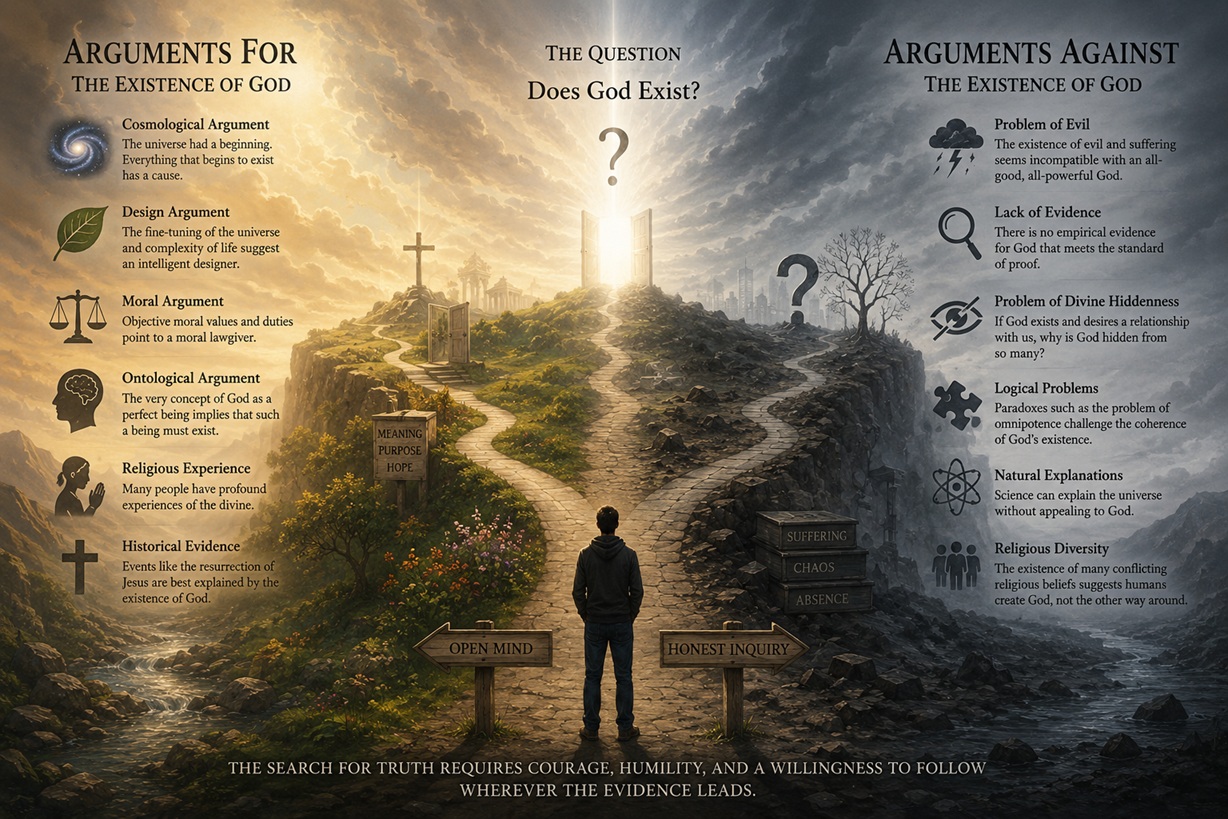
Arguments Pro and Con

Arguments Pro and Con

“For what can be known about God is plain to them, because God has shown it to them. Ever since the creation of the world his invisible nature, namely, his eternal power and deity, has been clearly perceived in the things that have been made. So they are without excuse…”

Saint Paul insists that God’s existence is not hidden knowledge but something “clearly perceived in the things that have been made.” The pages in this section take up that claim and test it. Is belief in God a blind leap, or a reasonable conclusion from the world we actually inhabit? I set out the classical case — from the sheer existence of a contingent universe, from its order and intelligibility, from the reality of moral truth, and from the testimony of conscience and religious experience — not as a single proof that compels, but as a convergence of evidence that makes theism the more reasonable position.

I invite your engagement with me on these questions. You may leave comments below, but please be sure to read our policy on commenting before doing so.

Atheist View

Honesty requires that the strongest objections to belief in God be stated at their full force, not knocked down as strawmen. Chief among them is the problem of evil: if God is all-good, all-knowing, and all-powerful, why does he permit suffering — especially the suffering of the innocent? I will not pretend this question is easy, nor that every answer satisfies.
Alongside the problem of evil stand other serious objections: the hiddenness of God, the apparent sufficiency of natural explanation, and the diversity of religions. I take these seriously and return to them throughout this section. A faith that has never faced its hardest questions is not worth much; a faith that has faced them and still stands is another matter.

Catholic View

Here I set out, in plain terms, the positive case for God — not a single knock-down proof, but a convergence of reasons that together make belief in God more reasonable than unbelief. I begin where Saint Paul begins in Romans 1: that the created order itself testifies to a Creator, so that his “eternal power and deity” are “clearly perceived in the things that have been made.”
The classical arguments — from the contingency of the world, from its order and intelligibility, from the reality of moral truth, and from the testimony of conscience and religious experience — are treated more fully in the references and in the pages that follow. My aim is not to compel assent by logic alone, but to show that the believer has solid ground to stand on, and that faith is not the enemy of reason but its friend.

Summary

Taken one at a time, no single argument may seem decisive. Taken together, they point in one direction: that the world we actually inhabit — contingent, ordered, morally weighted, and shot through with beauty and meaning — is better explained by a Creator than by blind matter. This is a first sketch; I will develop each strand more fully as these pages grow.