The Blessed Sacrament

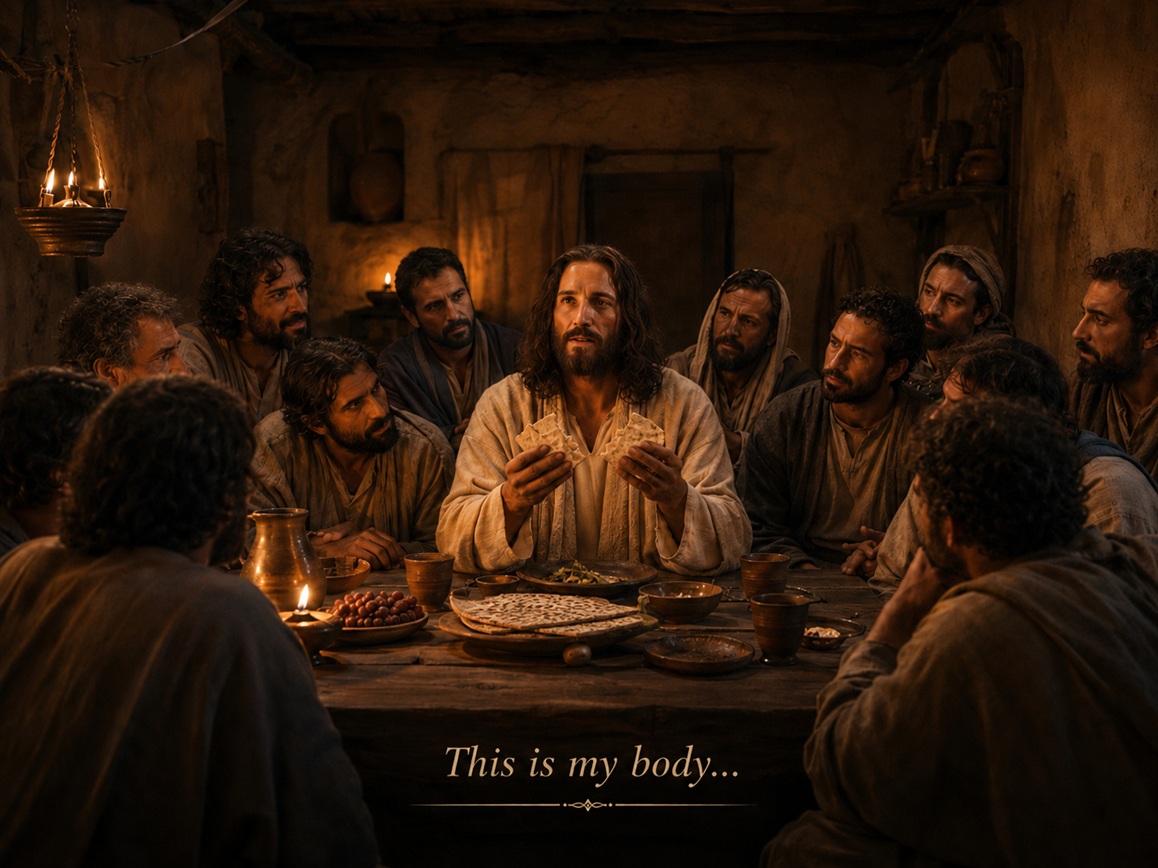
This Is My Body

“And he took bread, and when he had given thanks he broke it and gave it to them, saying, ‘This is my body which is given for you. Do this in remembrance of me.’”

On the night before He died, Jesus took bread, called it His body, and told the apostles to do what He had just done. Every Christian communion has obeyed that command in some form ever since. But obedience to it divides sharply on three questions: what the bread and wine are, how often the command should be kept, and who may keep it.

Jehovah’s Witnesses answer all three in a way that sets them apart even from most of Protestantism. They observe the Lord’s Evening Meal once a year, after sundown on Nisan 14. They hold that the bread and wine remain ordinary bread and wine, representing Christ’s body and blood but in no sense becoming them. And they teach that only the 144,000 may eat and drink — so that at a typical Kingdom Hall the emblems are passed along the rows and returned untouched. Worldwide, those who partake number in the tens of thousands against an attendance of some twenty million — on the order of one person in a thousand. The Watchtower’s position, in its own words, is set out in the Watchtower View panel.

The Catholic Church answers all three differently. She holds that the bread and wine truly become the body and blood of Christ; that the command was kept from the beginning not annually but continually; and that the invitation is addressed to every baptized believer, since Christ said plainly that without eating and drinking there is no life in us. On this reading the Mass does not repeat Calvary or add to it. It makes the one sacrifice of Calvary present, which is why the letter to the Hebrews can insist that Christ died “once for all” without that insistence counting against the Mass at all.

Much turns on a single Greek word. Where nearly every English version reads “This is my body,” the New World Translation reads “This means my body.” Whether that rendering is a legitimate translation or a doctrine written back into the text is examined in the Catholic View panel, along with the witness of Scripture, of the earliest Christians who left us a record of what they believed they were doing, and of Paul’s startling warning that to eat unworthily is to be “guilty of profaning the body and blood of the Lord.”

I invite your engagement with me on this question. You may leave comments below, but please be sure to read our policy on commenting before doing so.

Watchtower View

Jehovah’s Witnesses call the rite the Lord’s Evening Meal, or simply the Memorial. It is the only event in their calendar they regard as commanded, and the only one observed annually. Their teaching on it is set out in Insight on the Scriptures under the entry “Lord’s Evening Meal,” in Reasoning From the Scriptures, and in the Watchtower study articles published each spring before the observance.1

What They Affirm

Once a year, on Nisan 14. Witnesses hold that because Jesus instituted the meal on the night of the Jewish Passover, and because the Passover was annual, the Memorial is to be kept once a year, after sundown on the anniversary of His death by the Jewish reckoning. A weekly or daily observance is, on this view, without warrant, and the frequency of the rite is itself a mark distinguishing true worship from Christendom.2

The emblems are symbols and remain so. The unleavened bread and red wine represent the body and blood of Christ; they do not become them. Witnesses argue that Jesus was standing bodily before the apostles as He spoke, so the bread in His hands could not have been His literal flesh. They note that He elsewhere used plainly figurative language — “I am the door,” “I am the vine” — and read “this is my body” in the same way.3

“This means my body.” The New World Translation renders the Greek estin at Matthew 26:26 not as “is” but as “means,” giving “This means my body.” The Society defends this as a permissible sense of the verb, pointing to contexts where estin introduces an explanation or a signification rather than an identity.4

Only the anointed may partake. Witnesses teach that the new covenant was made with the little flock of 144,000 who will rule with Christ in heaven, and that the emblems belong to them alone. The great crowd of other sheep, who hope to live for ever on a restored earth, attend as respectful observers and pass the plate and the cup untouched. For one of the other sheep to partake would be presumption.5

How They Argue Against the Mass

Christ died once, so no sacrifice may be repeated. The central objection is that the Mass claims to be a sacrifice, and that Scripture forbids any repetition: Christ entered the holy place “once for all” and does not offer Himself repeatedly (Heb. 9:25–28; 10:10–14). Witnesses argue that to re-offer Christ is to imply His corresponding ransom was insufficient the first time, and so to detract from the very sacrifice the rite claims to honor.6

Eating blood is forbidden. Witnesses hold that God’s prohibition on consuming blood, given to Noah, repeated in the Law, and reaffirmed by the apostles at Jerusalem (Gen. 9:4; Lev. 17:10; Acts 15:28–29), stands permanently. A literal drinking of Christ’s blood would therefore command what God has forbidden. The argument carries particular weight for them because the same prohibition underlies their refusal of blood transfusion.7

The doctrine came later, and from outside. On the Watchtower account, a literal presence in the bread and wine is not apostolic teaching but a development of the post-apostolic centuries, formalized later still, and shaped by pagan sacrificial religion — part of the general corruption they hold overtook the Church once the apostles had died. The companion page Was There a Great Apostasy? sets out that larger claim.8


Endnotes
  1. The standard reference treatments are Insight on the Scriptures (Watch Tower Bible and Tract Society of Pennsylvania, 1988), Vol. 2, entry “Lord’s Evening Meal,” and Reasoning From the Scriptures (1985; rev. 1989), same entry; What Does the Bible Really Teach? (2005) treats the Memorial in connection with the ransom. The Society publishes fresh study articles each year in the weeks before Nisan 14. [Page numbers to be supplied from the printed editions.]
  2. On the annual timing and its derivation from the Passover, see Insight on the Scriptures, Vol. 2, “Lord’s Evening Meal,” and Reasoning From the Scriptures, same entry, which argues from the annual character of the Passover to an annual Memorial. The contrast with more frequent observance in the churches is a recurring theme of the pre-Memorial Watchtower articles.
  3. The argument that Christ’s bodily presence at the table rules out a literal identification, together with the appeal to “I am the door” (John 10:9) and “I am the true vine” (John 15:1) as parallels, is standard in Watchtower treatments of the emblems; see Insight on the Scriptures, Vol. 2, “Lord’s Evening Meal,” and Reasoning From the Scriptures, entry “Mass.”
  4. New World Translation, Matthew 26:26: “This means my body.” Parallel renderings stand at Mark 14:22 and Luke 22:19. The defense of “means” as a sense of estin is given in the Society’s translation appendixes and in Reasoning From the Scriptures. The counter-argument — that the same translators render estin as “is” throughout the New Testament except where doctrine requires otherwise — is taken up in the Catholic View panel and on the companion page on the New World Translation.
  5. On partaking as restricted to the anointed, see Insight on the Scriptures, Vol. 2, “Lord’s Evening Meal,” and the annual Memorial articles. The Society publishes worldwide attendance and partaker figures each year in its annual report; the disparity between the two is the practical expression of the doctrine. [Current figures to be inserted from the latest annual report.]
  6. The “once for all” objection to the Mass, resting on Hebrews 9:25–28 and 10:10–14, is set out in Reasoning From the Scriptures, entry “Mass,” and recurs throughout the Society’s literature on Catholic worship.
  7. On the permanence of the blood prohibition, see Insight on the Scriptures, Vol. 1, entry “Blood,” and Reasoning From the Scriptures, entry “Blood.” Its application to the Mass appears in the Society’s discussions of Catholic practice; its application to transfusion is treated on the companion page Blood: A Question of Life.
  8. The claim that a literal presence is a post-apostolic development of pagan derivation belongs to the wider apostasy narrative set out in Jehovah’s Witnesses—Proclaimers of God’s Kingdom (1993), ch. “Apostasy Develops,” and in Mankind’s Search for God (1990). See the companion page Was There a Great Apostasy?

Catholic View

The Catholic case does not rest on a single proof text. It rests on the convergence of what Christ said, what Paul assumed his converts already knew, what the first Christians did every week, and what they said they were doing while the apostles were still within living memory.

The Mass Does Not Repeat Calvary

The objection from Hebrews mistakes what the Church claims. She does not teach that Christ dies again, or that a new sacrifice is added to His. She teaches that the one sacrifice offered once on Calvary is made present. The Catechism is explicit: the sacrifice of Christ and the sacrifice of the Eucharist are one single sacrifice; the victim is one and the same, and only the manner of offering differs, bloody on the Cross and unbloody on the altar.1

So the Watchtower and the Church agree that Christ died once for all. That is not the point in dispute; it is the Catholic premise. What is disputed is whether an event can be re-presented without being repeated — and Scripture already answers that, because the Passover the Memorial imitates worked in exactly this way. The Israelite of a later century did not keep the Passover as the anniversary of something done to his ancestors. He was told to keep it as done for him: “It is because of what the Lord did for me when I came out of Egypt” (Ex. 13:8). The Hebrew memorial makes the saving act present to those who keep it. Christ’s command to do this “in remembrance of me” uses that same category, not the weaker English sense of recollecting an absent friend.2

John 6: Where Jesus Refused to Explain It Away

If “this is my body” stood alone, the figurative reading would be at least arguable. It does not stand alone. In the sixth chapter of John, Jesus tells the crowd that the bread He will give is His flesh, and the response is revulsion: “How can this man give us his flesh to eat?” This is the moment for a teacher who meant a symbol to say so.

“Truly, truly, I say to you, unless you eat the flesh of the Son of man and drink his blood, you have no life in you.” (John 6:53)

He does not soften the saying. He sharpens it, and the Greek sharpens with Him: the ordinary verb for eating gives way to trōgein, a blunt word for gnawing or chewing. Many of His disciples then draw the obvious conclusion — “This is a hard saying; who can listen to it?” — and they leave. Jesus lets them go, and turns to the Twelve to ask whether they will leave too. Nowhere else in the Gospels does He allow disciples to abandon Him over a misunderstanding He could have corrected with a sentence. When His hearers took “destroy this temple” literally, John tells us plainly they were mistaken (John 2:21). Here John offers no such note, because there was no misunderstanding to correct.

Paul Treats the Elements as More Than Symbols

Writing to Corinth around A.D. 55, within about twenty-five years of the crucifixion, Paul passes on what he “received from the Lord.” His warning is the difficulty for any purely symbolic reading:

“Whoever, therefore, eats the bread or drinks the cup of the Lord in an unworthy manner will be guilty of profaning the body and blood of the Lord. … For any one who eats and drinks without discerning the body eats and drinks judgment upon himself.” (1 Cor. 11:27, 29)

One cannot be guilty of profaning a person’s body and blood by mishandling a symbol of them. Paul adds that this is why some of the Corinthians are ill and some have died — a physical consequence he draws from failing to discern what is present. He asks earlier, “The cup of blessing which we bless, is it not a participation in the blood of Christ?” (1 Cor. 10:16). His answer assumes a reality, not a picture.

How Often, and Who

The same letter settles frequency. Paul writes “as often as you eat this bread and drink the cup” (1 Cor. 11:26) — language no one would use of a once-yearly observance. Luke reports that the first believers devoted themselves to “the breaking of bread” along with the apostles’ teaching and the prayers, and that they did so day by day (Acts 2:42, 46), and that the disciples at Troas gathered to break bread “on the first day of the week” (Acts 20:7). The apostolic practice was continual, and it had already moved from the Jewish calendar to the Lord’s day.

The question of who may partake is graver still. Christ’s words are not an invitation extended to a class but a condition laid on everyone: unless you eat and drink, you have no life in you. A system in which the great majority of members deliberately decline what Christ commanded — passing the bread and the cup along untouched year after year — must hold that His condition does not apply to them. Scripture offers no such exemption, and the limited class of 144,000 on which it depends is examined on the companion pages Who are Jesus’ Other Sheep? and Heavens Above!

The First Christians Left a Record

If a literal presence were a later corruption, there should be an earlier and plainer stratum without it. There is not. Ignatius of Antioch, writing about A.D. 107 on his way to martyrdom, complains that certain heretics “abstain from the Eucharist … because they do not confess that the Eucharist is the flesh of our Savior Jesus Christ.” That is not a man defending a novelty; he is treating the doctrine as the settled test of orthodoxy, and using it against those who deny it.3

Justin Martyr, describing Christian worship to a pagan emperor about A.D. 155, says the food is “not as common bread and common drink” but the flesh and blood of the incarnate Jesus. He also describes the assembly gathering “on the day called Sunday” — weekly, not annually. Irenaeus, who had known Polycarp, himself a disciple of the apostle John, argues against the Gnostics precisely from the reality of the Eucharist. The Didache, perhaps the oldest Christian document outside the New Testament, already calls the rite a sacrifice.4

Two Remaining Objections

“This means my body.” The Greek estin is the ordinary verb “is.” The translators of the New World Translation render it “is” throughout the New Testament; the departure to “means” occurs where the doctrine requires it. That is not translating a text but adjusting it. The appeal to “I am the door” does not help either: no one hearing it thought Jesus was made of wood, and no one left Him over it. Here they did.

The prohibition on blood. The command given to Noah and repeated in the Law forbids consuming the blood of slaughtered animals, whose life belongs to God. The Eucharist is not that. It is not the natural manner of eating flesh and drinking blood — which is why the Church has always rejected the charge of cannibalism — but a sacramental manner, the risen and glorified Christ giving Himself under the appearances of bread and wine. Above all, the objection proves too much: it would convict Christ of commanding what God forbade. Faced with that, the reasonable conclusion is not that He cannot have meant it, but that the prohibition was never about Him.

If the Church is right about this, the Mass is not a ceremony recalling something distant. It is the closest a human being comes to Calvary this side of heaven, offered daily, and open to anyone who will receive it. That is worth examining carefully before it is dismissed — and the references in the sidebar are a good place to begin.


Endnotes
  1. Catechism of the Catholic Church, 1366–1367: the Eucharist is a sacrifice because it re-presents (makes present) the sacrifice of the Cross, and “the victim is one and the same: the same now offers through the ministry of priests, who then offered himself on the cross; only the manner of offering is different” (quoting the Council of Trent). See also CCC 1362–1372 on the Eucharist as memorial and sacrifice.
  2. On anamnesis as more than mental recollection, see CCC 1363–1364: “In the sense of Sacred Scripture the memorial is not merely the recollection of past events … but the proclamation of the mighty works wrought by God for men.” The Passover parallel rests on Exodus 12:14 and 13:8, and on the rabbinic principle, preserved in the Passover Haggadah, that in every generation one must regard oneself as personally having come out of Egypt.
  3. Ignatius of Antioch, Letter to the Smyrnaeans 6–7 (c. A.D. 107). See also his Letter to the Romans 7 and Letter to the Philadelphians 4, on the one Eucharist and the one flesh of Christ. Texts in William A. Jurgens, The Faith of the Early Fathers, Vol. 1.
  4. Justin Martyr, First Apology 65–67 (c. A.D. 155), on the elements as “not as common bread and common drink” and on the Sunday assembly; Irenaeus, Against Heresies 4.18.4–5 and 5.2.2–3, arguing from the Eucharist against the Gnostics; Didache 14, on the Lord’s day gathering and the breaking of bread as a thysia (sacrifice), with Malachi 1:11 applied to it. On Irenaeus’s link to the apostle John through Polycarp, see Irenaeus, Against Heresies 3.3.4.

Summary

Jehovah’s Witnesses keep the Lord’s Evening Meal once a year, hold that the bread and wine only represent Christ, and reserve them to a small anointed class while the rest of the congregation passes them untouched. The Catholic Church answers each of those three points, for the following reasons.

“Once for all” is the Catholic premise, not an objection to it. The Church does not teach that Christ dies again. She teaches that the one sacrifice of Calvary is made present, the same victim and the same priest, differing only in the manner of offering. Hebrews is therefore not evidence against the Mass; it is the reason the Mass can be what it claims without adding anything to the Cross.

The Passover the Memorial imitates already worked this way. The Israelite did not keep it as an anniversary of something done to his ancestors. He kept it as done for him — “because of what the Lord did for me when I came out of Egypt” (Ex. 13:8). A memorial in the Hebrew sense makes the saving act present. Christ chose that category deliberately when He said “do this in remembrance of me.”

Jesus let disciples walk away rather than call it a symbol. When the crowd recoiled at eating His flesh, He repeated the claim more strongly, and the Greek moved from the ordinary word for eating to a blunt word for gnawing. Many disciples left, and He let them go, asking the Twelve if they would leave as well (John 6:53–68). Everywhere else a literal misreading is corrected on the spot — John pauses to explain that “this temple” meant His body (John 2:21). Here there is no such correction, because there was nothing to correct.

Paul’s warning makes no sense of a symbol. To eat unworthily is to be “guilty of profaning the body and blood of the Lord,” and to eat “without discerning the body” is to eat judgment on oneself — with real consequences, since some at Corinth were ill and some had died (1 Cor. 11:27–30). No one incurs bloodguilt by mishandling a picture. Paul was writing about twenty-five years after the crucifixion, to converts he expected to know this already.

The apostolic Church broke bread continually, not annually. Paul writes “as often as you eat this bread and drink the cup” (1 Cor. 11:26). Luke records the first believers breaking bread day by day (Acts 2:42, 46) and the disciples at Troas gathering for it on the first day of the week (Acts 20:7). Justin Martyr, describing Christian worship around A.D. 155, reports the same weekly Sunday assembly. An annual observance has to treat all of this as a departure from apostolic practice within the apostles’ own lifetime.

Christ laid down a condition, not issued a class invitation. “Unless you eat the flesh of the Son of man and drink his blood, you have no life in you” (John 6:53). The Watchtower system requires the overwhelming majority of its members to decline that command deliberately, year after year, on the ground that it was never addressed to them. Scripture records no such exemption, and the 144,000 on which it rests is a literal number lifted from a book of symbols.

The earliest witnesses are already Catholic on this point. Ignatius of Antioch, writing about A.D. 107, uses the reality of the Eucharist as the test that exposes heretics — they “abstain from the Eucharist … because they do not confess that the Eucharist is the flesh of our Savior Jesus Christ.” Justin says the elements are “not as common bread and common drink.” Irenaeus, two steps from the apostle John, argues from the Eucharist against the Gnostics. The Didache already calls it a sacrifice. If this were a later corruption, there should be an earlier and plainer layer without it. There is none.

“This means my body” is a doctrine written back into the text. The Greek estin is simply “is,” and the New World Translation renders it that way throughout the New Testament — departing from it where the doctrine demands. The parallel with “I am the door” fails for the same reason it always fails: nobody ever left Jesus over the door.