Symbolic or Literal Presence?

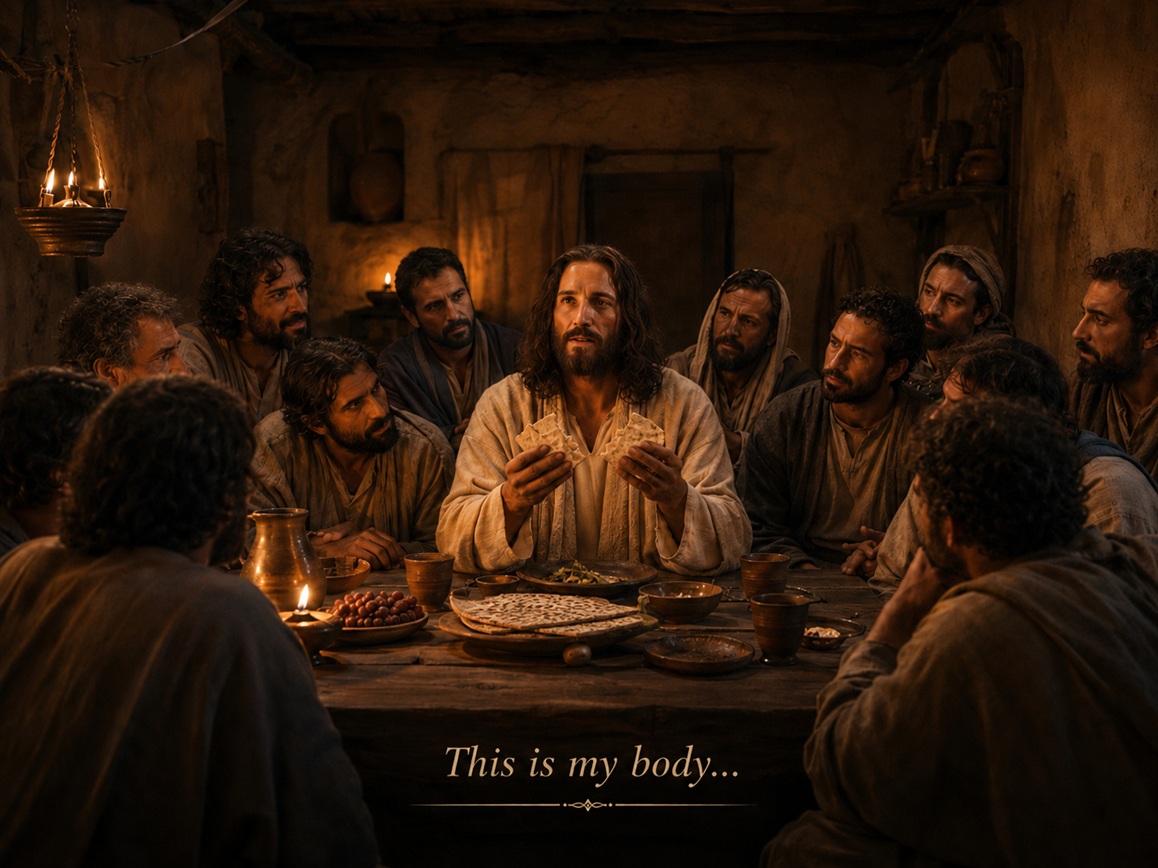
This Is My Body

“The cup of blessing which we bless, is it not a participation in the blood of Christ? The bread which we break, is it not a participation in the body of Christ?”

No question divided the Reformation more bitterly, and none divides Protestants more sharply from each other. Luther and Zwingli met at Marburg in 1529 to settle it and could not; they agreed on fourteen articles and parted over the fifteenth. Four centuries later the disagreement is still there, and it is worth stating honestly before the Catholic case is made, because the objection a Catholic actually has to answer depends entirely on which Protestant he is talking to.

Two questions are really in dispute, and they are separable. What are the bread and the wine? Lutherans answer that Christ is truly and bodily present in and under them. The Reformed answer that the faithful truly feed on Christ, but by the Holy Spirit and by faith rather than by the mouth. Much of modern evangelicalism answers that the elements are a memorial and nothing more. What unites all three is the denial that the bread ceases to be bread — the denial, that is, of transubstantiation.

And is the Mass a sacrifice? Here the Protestant answer is nearly unanimous and the objection is at its strongest. Hebrews says Christ offered Himself “once for all,” and that by a single offering He has perfected for all time those who are sanctified. A sacrifice offered daily on ten thousand altars looks, on the face of it, like the denial of that word. Both cases are set out in the Protestant View panel, in the words of the confessions themselves.

The Catholic answer to the second question is not that Christ dies again, and never has been. It is that the one sacrifice of Calvary is made present — the same victim and the same priest, differing only in the manner of offering. To the first, the Church answers that what was bread becomes the body of Christ, and says so in a technical vocabulary borrowed from philosophy for the same reason the Council of Nicaea borrowed homoousios: not to invent a belief but to fence one already held. The Catholic View panel takes the objections in turn, including the charge that adoring the host is idolatry — which, if the Church is wrong, it certainly is.

A related but different quarrel is treated separately. Jehovah’s Witnesses keep the meal once a year, restrict the bread and wine to a small anointed class, and render the words of institution “this means my body.” That dispute is taken up on the companion page Memorial or Blessed Sacrament?

I invite your engagement with me on this question. You may leave comments below, but please be sure to read our policy on commenting before doing so.

Protestant View

There is no single Protestant view of the Lord’s Supper, and any Catholic reply that assumes there is will miss its target. What the Reformers held in common was narrower than it is usually made out to be: that the bread does not cease to be bread, and that the Mass is not a sacrifice. On what the sacrament positively is, they divided at once, and have never reunited.

Three Answers, Not One

Luther kept the bodily presence. He would not surrender “this is my body,” and at the Marburg Colloquy in 1529 he chalked the words on the table and refused to move from them. What he denied was not the presence but the explanation: that the substance of the bread is annihilated. Christ is received in and under the bread, which remains bread.

Calvin taught a true feeding by the Spirit. The Reformed position is not the bare memorialism it is often mistaken for. Christ’s body is in heaven and does not descend; but the Holy Spirit truly unites the believer to it, so that the faithful receive Christ Himself and not merely a reminder of Him. The reception is real and the mode is spiritual.

Zwingli made it a memorial. The bread signifies the body as a wedding ring signifies a marriage: the sign is not the thing, and no one is confused by saying so. This is the view that has spread furthest, and in much of modern evangelicalism it is simply assumed. But it is one Reformation voice among three, not the Reformation’s voice.1

Calvary Was Once for All

On the sacrifice the Protestant answer is nearly unanimous, and this is the objection with real force behind it. Hebrews says that Christ has no need to offer repeatedly, “for then he would have had to suffer repeatedly”; that He appeared “once for all” to put away sin by the sacrifice of Himself (Heb. 9:25–26); and that by a single offering He has perfected for all time those who are sanctified (Heb. 10:14). The whole argument of that letter is that the old priesthood had to repeat its offerings because they never finished the work, and that Christ’s offering is different precisely because it is not repeated.2

The Thirty-Nine Articles put it as bluntly as it can be put: the sacrifices of masses were “blasphemous fables, and dangerous deceits.” The Westminster Confession is scarcely gentler, calling the offering of Christ in the Mass “most abominably injurious to Christ’s one, only sacrifice.” The language is of its century; the argument behind it is not, and it is still the first thing a Protestant says.

Transubstantiation Is Philosophy, Not Revelation

The doctrine is stated in the vocabulary of substance and accidents. Those are Aristotle’s categories, unknown to the apostles, unavailable in Latin theology for a thousand years, and fixed as the Church’s official term only at the Fourth Lateran Council in 1215. Whatever Christ meant in the upper room, He did not mean a distinction that would require a Greek philosopher to state.3

Nor is the distinction one anybody can observe. Westminster calls it “repugnant, not to Scripture alone, but even to common sense and reason” — a doctrine that asks a believer to affirm a change no sense can detect, on the authority of a council that met twelve centuries after the supper it claims to explain.

Do This in Remembrance of Me

Christ’s own word is remembrance. He said “do this in remembrance of me” (Luke 22:19; 1 Cor. 11:24–25), and He said it while standing bodily in front of the apostles, holding what He was calling His body. The most natural reading of a man holding bread and saying “this is my body” while his body is visibly elsewhere is the figurative one.

Paul keeps calling it bread. After the consecration, not before: “as often as you eat this bread”; “let a man examine himself, and so eat of the bread” (1 Cor. 11:26–28). If the substance were gone, the apostle chose an odd way to say so.

And Christ Himself supplies the key. At the end of the very discourse Catholics press hardest, He says: “It is the spirit that gives life, the flesh is of no avail; the words that I have spoken to you are spirit and life” (John 6:63). Having spoken of eating His flesh, He tells the disciples plainly how the saying is to be taken.

Communion in One Kind

The practical grievance should not be left out, because for ordinary people in the sixteenth century it was the whole of the dispute. Christ said “drink of it, all of you” (Matt. 26:27), and the medieval West had withheld the cup from the laity for centuries, a practice the Council of Constance confirmed in 1415 while conceding that Christ instituted the sacrament in both kinds and that the early Church received it so. The chalice became the emblem of the Bohemian reform, and the wars that followed were fought partly over it. Whatever the theology, a command of Christ was plainly being set aside by the authority of the Church.4

And It Draws the Worship Owed to God

All of this would be a quarrel among theologians but for the last step. If the consecrated host is not God, then to kneel before it, reserve it in a tabernacle, carry it through the streets and burn lamps beside it is idolatry in the strict sense: the worship of a creature, and of a creature made that morning by a baker. The Articles say the Sacrament was not by Christ’s ordinance “reserved, carried about, lifted up, or worshipped.”5

This is why the argument was never merely academic, and why the Reformers pressed it with a violence that reads strangely now. On their account the central act of Western Christian worship was not an error about a ceremony. It was the first commandment being broken every morning, in every parish, by everyone.


Endnotes
  1. On the three positions: Luther defended the bodily presence against Zwingli at the Marburg Colloquy (1529), where the two parted over the fifteenth article after agreeing on fourteen; see also his Confession Concerning Christ’s Supper (1528). John Calvin, Institutes of the Christian Religion IV.17, teaches a true participation in Christ effected by the Holy Spirit. Huldrych Zwingli, On the Lord’s Supper (1526), treats the elements as signs.
  2. Hebrews 7:27; 9:25–28; 10:10–14. On the confessional statements, see the Thirty-Nine Articles, XXXI, and the Westminster Confession of Faith (1646), XXIX.2.
  3. The term transubstantiatio was adopted at the Fourth Lateran Council (1215) and defined at the Council of Trent, Session XIII (1551). On the objection from philosophy, Westminster Confession XXIX.6.
  4. Council of Constance, Session XIII (1415), which acknowledged that Christ instituted the sacrament in both kinds and that the faithful in the early Church received it so, while forbidding the practice thereafter. The Utraquist party of Bohemia took its name from the demand for communion sub utraque specie.
  5. Thirty-Nine Articles, XXVIII. See also Westminster Confession XXIX.4, which rejects “the lifting them up, or carrying them about for adoration.”

Catholic View

The Catholic Church holds two things, and they should be taken separately because the objections to them are different. The bread and wine become the body and blood of Christ. And the Mass is not a second sacrifice but the one sacrifice of Calvary made present. Neither claim was invented in the Middle Ages; both are older than the vocabulary used to state them, and the earliest Christians we can read state them without argument, as men repeating something already settled.

“Once for All” Is the Catholic Premise

Begin with the strongest objection, because it rests on a misunderstanding the Church has corrected in every century she has been accused of it. She does not teach that Christ dies again, that His sacrifice was insufficient, or that anything is added to it. She teaches that the one offering of Calvary — the same victim, the same priest — is made present, differing only in the manner of offering. Hebrews is not evidence against that. It is the reason the Church says it.1

The category needed here is one Scripture already supplies. The Passover was not a pageant about an old deliverance; Israel was commanded to keep it as a memorial, and the rabbis drew the plain conclusion — in every generation a man must regard himself as personally having come out of Egypt (Ex. 12:14). A biblical memorial makes the past event present to those keeping it. That is the word Christ used, and the Greek anamnesis carries the same weight. If “do this in remembrance” meant only a mental recollection, it was a strange word to choose in a Passover meal.2

And Malachi had said what would come. In place of the sacrifices Israel was offering badly, God announces that “from the rising of the sun to its setting my name is great among the nations, and in every place incense is offered to my name, and a pure offering” (Mal. 1:11). A prophecy of a clean sacrifice offered everywhere, continually, among the Gentiles, is not easily read as a prophecy that sacrifice would cease.

The Word Is Late; the Belief Is Not

That “transubstantiation” borrows Aristotle’s vocabulary is true, and it is no more damaging than the parallel every Protestant accepts. Homoousios — of one substance with the Father — is philosophical vocabulary too, absent from Scripture, contested when introduced, and fixed at Nicaea in 325 to defend something the Church already believed. Nobody concludes that the divinity of Christ was invented in the fourth century because the word for it was.

The technical term does not create the belief; it fences it, and it was needed only once somebody proposed that nothing changes at all. The belief itself is on record long before. Ignatius of Antioch, writing about 107 on his way to be killed, says of certain heretics that they abstain from the Eucharist because they do not confess that it is the flesh of our Savior Jesus Christ. Justin Martyr, about 155, explaining Christian worship to a pagan emperor with no motive to overstate it, says the food is “not as common bread and common drink.” Irenaeus, about 180, argues from the Eucharist against the Gnostics — which only works if his opponents granted the premise.3

Notice what is missing from the record. If the literal understanding were a later corruption, there should be a trace of the earlier one it displaced, and of the quarrel when it came in. Doctrinal novelties leave marks: Arius left a century of them. Here there is nothing — no protest, no council, no name attached to the change.

What Paul Takes for Granted

Paul is the earliest Christian writer on the subject, and he is writing to correct abuses rather than to expound a doctrine — which makes what he assumes more telling than what he argues. The cup is “a participation in the blood of Christ” and the bread “a participation in the body of Christ” (1 Cor. 10:16), and in the next breath he compares it to the altars of Israel and of the pagans, where eating the sacrifice made a man a partner in it.

Then the warning. Whoever eats or drinks unworthily “will be guilty of profaning the body and blood of the Lord,” and eats judgment on himself if he fails to discern “the body” — which is why, Paul says, many of them are weak and ill, and some have died (1 Cor. 11:27–30). Guilt of a body, and physical consequences, are a great deal to attach to the misuse of a symbol. No one contracts guilt against a man by mishandling his photograph.4

That Paul goes on calling it bread proves less than it seems. Scripture regularly names a thing by its appearance or its origin: the rods of the magicians “became” serpents and are still called rods (Ex. 7:12), and Christ’s risen body is called a man by those who did not yet know Him. The Church has never denied that what is seen, tasted, and chemically analyzed is bread. That is precisely what the disputed word was coined to say.

John 6, and the Men Who Walked Away

This section answers the memorialist rather than the Lutheran, who does not need it. Christ tells the crowd at Capernaum that unless they eat His flesh and drink His blood they have no life in them. They understand Him to mean it literally and object on exactly that ground — how can this man give us his flesh to eat? He does not correct them. He repeats it more sharply, switching to a blunter verb for eating, and when many disciples leave over it He lets them go and asks the Twelve whether they will go too (John 6:52–67).

Set that beside how He handles every other figure of speech. When Nicodemus takes rebirth literally, He explains. When the disciples mistake the leaven of the Pharisees, He explains. When the woman at the well misunderstands living water, He explains. Here alone He explains nothing and loses a crowd. As for “the flesh is of no avail” (John 6:63), the phrase cannot mean His own flesh is useless without emptying the Incarnation; He is contrasting the merely natural way of understanding — the way that had just walked out — with the Spirit’s.5

Adoration Has No Middle Ground

The charge of idolatry is the right charge to press, and the Church has no way to soften it. If the host is not Christ, then Catholic worship is idolatrous in the strict sense, and no appeal to good intentions helps. But the converse binds just as tightly: if it is Christ, then to withhold adoration would be the sin. Thomas Aquinas put the argument in exactly that form, and it cannot be settled by taste in liturgy.

So the practice is not a separate objection at all. It is the conclusion of the argument the rest of this panel has been making, and it stands or falls with the question of what happened at Capernaum, what Paul thought a man could be guilty of, and what the men who knew the apostles believed they were receiving on Sunday.

The Cup, and an Objection That Was Answered

The grievance over communion in one kind was a real one and deserves a direct answer rather than a defense. Christ said “drink of it, all of you,” the early Church did, and the medieval West stopped — for reasons of reverence and practicality that never justified setting aside the plain form of the command. The Church’s teaching was that Christ is wholly present under either kind, so that nothing is lost to the communicant; but that answers what is received, not why the cup was withheld.

What matters now is that the complaint has been met. Since the Second Vatican Council the chalice has been restored to the laity, and communion under both kinds is ordinary in the Latin Church. On this point the Reformers were pressing for something the Church has since done.6

The Reply in Brief

The dispute is not finally about a Greek philosopher or a thirteenth-century council. It is about whether a plain sentence spoken in an upper room may be read as a figure of speech, and the New Testament will not cooperate with the reading. A crowd took Him literally and left; He let them go. Paul says a man can be guilty of a body by eating badly, and that people had died of it. Neither is how anyone writes about a symbol.

And on the sacrifice, the objection and the doctrine are not actually opposed. The Church agrees that Calvary was once for all — that is why she says the Mass makes it present rather than repeats it. Hebrews is quoted against a position nobody holds. What is left is the historical question, and the record runs one way: the men close enough to the apostles to have known them describe the Eucharist in terms no symbolic account can absorb, and describe it as men who had been taught it rather than as men arguing for it.

If this is right, the Lord’s Supper is not a ceremony recalling something distant, and the disagreement is not a technicality. It is the difference between a memory and a meeting, offered daily and open to anyone who will receive it. The references in the sidebar are a good place to test the claim.


Endnotes
  1. Catechism of the Catholic Church §§1362–1372, and especially 1367, quoting the Council of Trent: “The victim is one and the same: the same now offers through the ministry of priests, who then offered himself on the cross; only the manner of offering is different.”
  2. On anamnesis as more than recollection, CCC §§1363–1364. The Passover command is Exodus 12:14 with 13:8; the principle that each generation must count itself among those brought out of Egypt is preserved in the Passover Haggadah and reflected in Mishnah Pesahim 10:5.
  3. Ignatius of Antioch, Letter to the Smyrnaeans 6–7 (c. A.D. 107); Justin Martyr, First Apology 65–67 (c. A.D. 155); Irenaeus, Against Heresies 4.18.4–5 and 5.2.2–3 (c. A.D. 180); Didache 14, which calls the Sunday breaking of bread a thysia and applies Malachi 1:11 to it. Texts in William A. Jurgens, The Faith of the Early Fathers, Vol. 1.
  4. 1 Corinthians 10:16–21 and 11:23–30. The letter is dated to about A.D. 55, which makes 11:23–25 the earliest written account of the institution, earlier than any of the Gospels.
  5. John 6:22–71. At verse 54 the verb shifts from phago to trogo, a coarser word for chewing — a curious direction to move in if the intention were to signal metaphor. On the contrast at verse 63, compare Romans 8:5–8, where “the flesh” names a manner of judging rather than physical body.
  6. On concomitance and communion under one kind, Council of Trent, Session XXI (1562). On the restoration of the chalice, Second Vatican Council, Sacrosanctum Concilium §55, and the General Instruction of the Roman Missal §§281–283.

Summary

Protestants deny that the bread ceases to be bread and deny that the Mass is a sacrifice — while disagreeing among themselves about what the sacrament positively is. The Catholic Church holds that the elements become the body and blood of Christ, and that the Mass makes the one sacrifice of Calvary present rather than repeating it.

“Once for all” is the Catholic premise, not an objection to it. The Church does not teach that Christ dies again or that Calvary was insufficient. She teaches that the one offering is made present — the same victim and the same priest, differing only in the manner of offering. Hebrews is quoted against a position nobody holds.

A memorial in Scripture makes the past present. Israel was told to keep the Passover as a memorial, and every generation was to count itself among those brought out of Egypt (Ex. 12:14). That is the word Christ chose, at a Passover meal, and it means more than calling something to mind. Malachi had already foretold a pure offering made in every place among the nations (Mal. 1:11).

The word is late; the belief is not. “Transubstantiation” borrows Aristotle’s vocabulary, exactly as homoousios borrows Greek philosophy to defend the divinity of Christ. Nobody concludes that the doctrine was invented when the word was. Ignatius was calling the Eucharist the flesh of Christ by about 107, Justin by 155, Irenaeus by 180 — and none of them argues for it, which is how men write about what is already settled.

Paul thought a man could be guilty of a body. The cup is “a participation in the blood of Christ” (1 Cor. 10:16), and eating unworthily makes a person guilty of profaning “the body and blood of the Lord” — which is why, he says, some of them had become ill and some had died (1 Cor. 11:27–30). Nobody contracts guilt against a man by mishandling his photograph.

At Capernaum He let them go. The crowd took Him literally and objected on precisely that ground; He repeated it more sharply and lost them (John 6:52–67). Everywhere else — Nicodemus and rebirth, the leaven of the Pharisees, the water at the well — He explains the figure. Here alone He explains nothing.

Adoration has no middle ground. If the host is not Christ, Catholic worship is idolatry and no good intention repairs it. If it is Christ, withholding adoration would be the sin. The practice is not a separate charge; it is the conclusion of the argument, and it stands or falls with the rest.

And the grievance over the cup has been met. Christ said “drink of it, all of you,” the early Church did, and the medieval West stopped. The Church taught that Christ is wholly present under either kind, which answers what is received but not why the cup was withheld. Since the Second Vatican Council it has been restored, and communion under both kinds is now ordinary.

In short: the dispute is not about a thirteenth-century council but about whether a plain sentence in an upper room may be read as a figure of speech — and the men closest to the apostles read it the other way, without argument, as men who had been taught it.

See also the companion page Memorial or Blessed Sacrament?, which takes up the Watchtower’s annual observance, its restriction of the emblems to the 144,000, and the New World Translation’s “this means my body.”