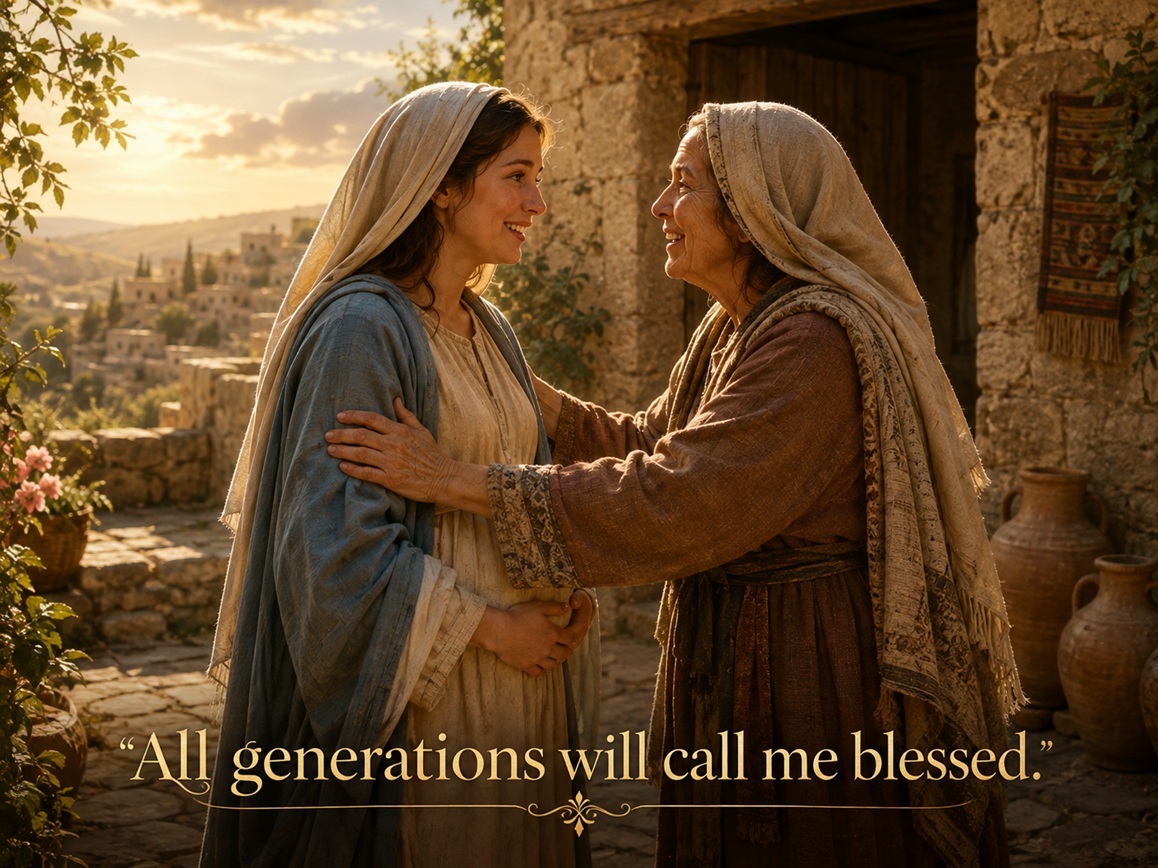
The Blessed Virgin Mary

Mary and Elizabeth

“My soul magnifies the Lord, and my spirit rejoices in God my Savior, for he has regarded the low estate of his handmaiden. For behold, henceforth all generations will call me blessed.”

Of all the women who have ever lived, one was asked to bear the Son of God, and one said yes. That much is not in dispute between Catholics and Jehovah’s Witnesses. Mary was chosen, she consented, and through her the Word became flesh. The disagreement begins immediately afterward, and it is about what follows from that.

Mary herself said something remarkable about it. Carrying the child, and greeted by her cousin Elizabeth as “blessed among women,” she answered with the song the Church has sung ever since: henceforth all generations will call me blessed (Luke 1:48). It is a prophecy, and an unusual one — not that God would be praised through her, which anyone might say, but that she would be called blessed, and not for a season but by every generation that came after.

So the question this page asks is a simple one. What did she mean? A Christian who reads that verse has to do something with it. If it is merely a description of how highly favored she was at that moment, then calling her blessed is a matter of historical acknowledgment and nothing more. If it is what it appears to be — a prophecy that the people of God would honor her in every age — then a church in which nobody ever calls her blessed has some explaining to do.

Behind that lies a larger question, and it is the one that really divides. Does Mary have any ongoing role in the drama of salvation, or was her part finished at Bethlehem? Jehovah’s Witnesses answer that it was finished: she was a faithful woman who bore Jesus, and any honor paid to her since is misplaced devotion owed to God alone. Most Protestants would not put it so bluntly — they honor her as the mother of the Lord and confess the virgin birth in the creed — but they object that the Immaculate Conception and the Assumption were defined only in 1854 and 1950, that Mary called God her Savior, and that Scripture knows one Mediator. Both cases, in their own words, are set out in the Protestant & Watchtower View panel.

The Catholic answer is that her role was not finished, because motherhood is not a task that ends when a child is grown, and because Scripture keeps returning to her at the decisive moments — at Cana, at the foot of the cross, and in the upper room at Pentecost. The Catholic View panel sets out that case: what the Church actually claims about her and what she does not, why John never once calls her by name, what the four Marian dogmas are for, and why honoring the mother has always been a way of confessing something about the Son.

I invite your engagement with me on these questions. You may leave comments below, but please be sure to read our policy on commenting before doing so.

Protestant & Watchtower View

Protestants and Jehovah’s Witnesses both reject the Marian doctrines, and here the two are closer than on most questions — but not identical. Historic Protestantism honors Mary as the mother of the Lord, and the Reformers themselves held more about her than their heirs generally do; what they denied was that any of it may be required of a Christian, or that she may be prayed to. The Watchtower denies rather more: not only the dogmas but the honor.

The Protestant Objection

The dogmas are not in Scripture, and were defined very late. This is the objection that governs all the others. The Immaculate Conception was defined in 1854 and the Assumption in 1950 — eighteen and nineteen centuries after the apostles. Neither is stated in the New Testament, and on sola scriptura a doctrine that cannot be shown from Scripture may not be imposed as necessary to believe.1

Mary herself needed a Savior. In her own song she rejoices “in God my Savior” (Luke 1:47). A sinless person does not need saving, so the Magnificat is taken to tell against the Immaculate Conception in Mary’s own words — and to come from her lips makes the objection hard to brush aside.

Prayer to Mary intrudes on the one Mediator. “There is one mediator between God and men, the man Christ Jesus” (1 Tim. 2:5). Protestants observe that Marian devotion in practice often addresses her as though she were more merciful than her Son, and that titles such as Mediatrix and Co-Redemptrix — whatever their careful definitions — are heard by ordinary people in the plain sense.2

And the plain sense of the Gospels is against perpetual virginity. Matthew says Joseph knew her not until she had borne a son (Matt. 1:25), and the Gospels name brothers of the Lord — James, Joses, Simon and Judas — along with sisters (Mark 6:3). The Catholic reading of those words as cousins or step-siblings is possible, but it is not what a reader meets on the page.3

The Watchtower Objection

Jehovah’s Witnesses hold Mary in respect but not in honor. She was a faithful woman, humble and obedient, chosen to bear Jesus in his human life — and there her role ends. She is not sinless, not a perpetual virgin, not the mother of God, and not to be prayed to, venerated, or represented in images. Devotion paid to her is understood as worship diverted from Jehovah, to whom alone it belongs. Their teaching is set out in Insight on the Scriptures under “Mary,” in Reasoning From the Scriptures, and in the Bible-questions articles on jw.org.4

What They Affirm

She was an imperfect human who needed the ransom. Mary was a descendant of Adam like everyone else, and inherited sin and death with the rest of the race (Rom. 5:12). Witnesses point out that she herself called God “my Savior” (Luke 1:47), and that after the birth she made the offering the Law required of a mother (Luke 2:22–24) — which a sinless woman, they argue, would not have needed. An immaculate conception is therefore an addition to Scripture rather than a teaching of it.5

She had other children. Witnesses read the Gospels plainly. Matthew says Joseph “did not have intercourse with her until she gave birth to a son” (Matt. 1:25); the townspeople name four brothers — James, Joseph, Simon, and Judas — and mention sisters besides (Matt. 13:55–56; Mark 6:3); and Luke calls Jesus her “firstborn” (Luke 2:7). Perpetual virginity, on this account, is a tradition laid over texts that say otherwise.6

She is not the mother of God. Because Witnesses deny that Jesus is Almighty God, the title fails at its root: Jehovah has no mother, and no creature can be the source of the Almighty. Mary was the mother of Jesus in his human life, and nothing beyond it. The title is traced to the Council of Ephesus in 431 and treated as a post-apostolic development belonging to the same period as the Arianism controversy.7

How They Argue It

Worship belongs to God alone. The central objection is religious rather than historical. Christ told Satan, “It is Jehovah your God you must worship, and it is to him alone you must render sacred service” (Matt. 4:10). Prayers to Mary, the rosary, statues and icons, and titles such as Queen of Heaven are on this view creature worship. The last is pressed hardest: Jeremiah condemns Judah for burning incense to “the queen of the heavens” (Jer. 7:18; 44:17–25), and Witnesses take the reappearance of that title in Christendom as the same false worship returning under a new name.8

Jesus redirected honor away from her. Witnesses lean on an episode in Luke. A woman in the crowd calls out, “Happy is the womb that carried you and the breasts that nursed you!” and Jesus answers, “No, rather, Happy are those hearing the word of God and keeping it!” (Luke 11:27–28). They read this as a correction: blessedness attaches to obedience, not to physical relationship. The same is drawn from his asking “Who is my mother?” and answering that whoever does the will of God is his mother and brother (Matt. 12:46–50).9

There is one mediator. Paul writes that “there is one God, and one mediator between God and men, a man, Christ Jesus” (1 Tim. 2:5). Witnesses conclude that asking Mary to intercede inserts a second mediator where Scripture allows one, and implies that the Son is less approachable than his mother — when believers are invited to come to God directly through him.10

The dogmas came late. Witnesses observe that none of the four Marian dogmas is stated in Scripture, and that each was defined long after the apostles: Mother of God in 431, the Immaculate Conception in 1854, the Assumption as recently as 1950. They take the dates as evidence of doctrine accumulating across the centuries rather than being handed down, part of the wider corruption they hold overtook the Church once the apostles had died.11


Endnotes
  1. On the Marian dogmas as unscriptural additions, see the Thirty-Nine Articles, VI, that whatever is not read in Scripture “nor may be proved thereby” is not to be required of any man as an article of faith; and the Westminster Confession of Faith (1646), I.6. The definitions are Ineffabilis Deus (1854) and Munificentissimus Deus (1950).
  2. On invocation of Mary and the sole mediation of Christ, see the Thirty-Nine Articles, XXII, and John Calvin, Institutes III.20.21–27. It should be said that Luther and Zwingli both retained a high Mariology, including the perpetual virginity; the objection is to what may be required, and to devotional practice, rather than to honoring her as such.
  3. On Matthew 1:25 and the “brothers of the Lord,” the standard modern Protestant treatments follow Helvidius rather than Jerome; the Catholic reply from adelphos and the Semitic usage behind it is given in the Catholic View panel.
  4. The standard reference treatments are Insight on the Scriptures (Watch Tower Bible and Tract Society of Pennsylvania, 1988), Vol. 2, entry “Mary,” and Reasoning From the Scriptures (1985; rev. 1989), same entry; see also the Bible-questions articles on jw.org treating the veneration of Mary and the title Mother of God. [Page numbers to be supplied from the printed editions.]
  5. On Mary as an imperfect descendant of Adam standing in need of the ransom, see Insight on the Scriptures, Vol. 2, “Mary,” with Romans 5:12, Luke 1:47, and the offering of Luke 2:22–24.
  6. On the brothers and sisters of Jesus as later children of Mary and Joseph, see Insight on the Scriptures, Vol. 2, “Mary,” and Reasoning From the Scriptures, same entry, citing Matthew 1:25; 13:55–56; Mark 6:3; Luke 2:7.
  7. The rejection of Theotokos follows from the Society’s Christology rather than standing on its own. That prior question is treated on the companion page Is God a Triune Being?
  8. Matthew 4:10 in the New World Translation. On the queen-of-heaven argument, Jeremiah 7:18 and 44:17–25 are cited in Watchtower discussions of Marian devotion; the identification of that cult with later Christian usage is an inference drawn by the Society, not a statement of the text.
  9. Luke 11:27–28 and Matthew 12:46–50, quoted from the New World Translation, whose rendering of Luke 11:28 opens “No, rather.” The Greek behind that phrase is taken up in the Catholic View panel.
  10. 1 Timothy 2:5. The argument that intercession by any creature encroaches on Christ’s mediation recurs throughout the Society’s literature on prayer; see Reasoning From the Scriptures, entry “Prayer.”
  11. The dates are correct and are not in dispute: Ephesus defined Theotokos in 431; Pius IX defined the Immaculate Conception in Ineffabilis Deus (1854); Pius XII defined the Assumption in Munificentissimus Deus (1950). What is in dispute is what a date of definition shows, which the Catholic View panel takes up. The wider claim about post-apostolic corruption is treated on the companion page Was There a Great Apostasy?

Catholic View

The Catholic Church honors Mary and does not worship her, and the distinction is not an evasion but the whole of the case. Every claim the Church makes about the mother is a claim about the Son: that He is truly God, truly man, and truly born. Take the Marian doctrines one at a time and each turns out to be guarding something about Christ — which is why they were defined when they were, and against whom.

The Woman of Genesis

Begin where the objection usually begins. At Cana, Christ addresses His mother as “woman” (John 2:4), and again from the cross: “Woman, behold your son” (John 19:26). This is offered as proof that He held her at a distance.

It cannot mean that, for a reason that ought to settle it: He kept the commandment to Honor your mother and your Father perfectly, as He kept the whole Law, and He was without sin. Whatever “woman” conveys, it cannot be disrespect without making Christ a lawbreaker.1

What it does convey emerges from a detail easily missed. In the whole of John’s Gospel the mother of Jesus is never once called Mary. She is “the mother of Jesus” or she is “woman,” and nothing else — and John, who was given charge of her, had every reason to know her name. The omission is deliberate, and it points back to the first pages of Scripture, where God tells the serpent there will be enmity “between you and the woman, and between your seed and her seed” (Gen. 3:15). John frames his Gospel between two appearances of that woman: at Cana, where the hour has not yet come, and at Calvary, where it has. He is telling us who she is.2

Mother of God

The oldest of the four titles is the one most often misheard. It does not claim that Mary is the source of the divine nature or that she existed before God. It claims that the one she bore is a single Person, and that this Person is God.

The argument is short. Jesus is God. Mary is the mother of Jesus. Therefore Mary is the mother of God. The only way to escape it is to say that she bore the humanity but not the Person — which divides Christ in two, and is precisely the heresy the Council of Ephesus condemned in 431 when it defined the title. Theotokos, God-bearer, was never a statement about her dignity in the first place. It was a wall built around His identity, and to deny it is finally to deny that the child in the manger was God.3

Preserved, Not Exempted

The Immaculate Conception is the claim that Mary was preserved from original sin from the first moment of her existence, by the merits of Christ applied in advance. Two misunderstandings clear away at once. It is not about the conception of Jesus. And it does not make her divine or self-sufficient: she was redeemed, as she says herself — “my spirit rejoices in God my Savior” (Luke 1:47) — only preserved from the sin rather than rescued out of it.4

That distinction answers the objection from her Savior and from the offering at the Temple. A woman kept from falling is saved as truly as one pulled from the pit, and rather more thoroughly. The fittingness of it is what Scripture suggests: the ark that carried the word of God in stone was overlaid with pure gold and could not be touched by unconsecrated hands, and Uzzah died for steadying it (2 Sam. 6:6–7). If God required that of the vessel bearing the tablets, the vessel that bore the Word made flesh is not a strange place for Him to have taken more care.

The Brothers of the Lord

Against perpetual virginity stand the “brothers” of Jesus and the word “until” at Matthew 1:25. Neither carries the weight.

Adelphos is not the narrow word English “brother” is. Hebrew and Aramaic had no separate term for cousin or nephew, and the Greek of Jewish writers follows suit — Lot is called Abraham’s “brother” though he was his nephew (Gen. 13:8; 14:14). And “until” in Scripture regularly marks a point without implying a change after it: Michal had no child “until the day of her death” (2 Sam. 6:23), which plainly does not mean she had one afterward.5

The strongest evidence is not lexical but narrative. From the cross Christ entrusts His mother to John (John 19:26–27), and John takes her into his own home. In a society where a surviving son’s duty to a widowed mother was absolute, that act is close to unintelligible if four brothers were standing by. Two of the named brothers, moreover, are elsewhere identified as sons of another Mary (Matt. 27:56; Mark 15:40).

All Generations Will Call Me Blessed

Which brings us to what the mother of Jesus said about herself. Filled with the Holy Spirit, Elizabeth calls her “blessed among women” (Luke 1:42), and Mary answers with a prophecy: “henceforth all generations will call me blessed” (Luke 1:48).

It is worth pausing on how odd that is if her role ended at Bethlehem. She does not say God will be praised through her, which any believer might say. She says that she will be called blessed, and by every generation. A church in which no generation ever calls her blessed has not been more careful than Scripture. It has left a prophecy of Scripture unfulfilled — and it is a prophecy the Holy Spirit prompted.6

Nor did her part in fact end. She is present at Cana, where her word to the servants — “do whatever he tells you” (John 2:5) — is the last recorded instruction she gives anyone, and points away from herself. She is present at the cross, where she is given to the disciple, and the disciple to her. And she is present in the upper room with the apostles when the Spirit comes (Acts 1:14). Scripture keeps returning her to the decisive moments, which is a strange thing to do with a woman whose role is over.

Honoring Is Not Worshipping

The objection that matters most is the religious one, and it deserves a plain answer. The Church does not offer Mary the worship due to God, and has never permitted it. Worship — latria — belongs to God alone; the honor paid to the saints, and the higher honor paid to Mary, is a different act entirely, of the kind Scripture pays freely to the faithful. To ask her prayers is what one Christian asks of another, and the fact that she is alive in Christ is precisely the point, since God “is not God of the dead, but of the living” (Matt. 22:32).7

That also answers the objection from the one mediator (1 Tim. 2:5). Christ’s mediation is unique because He alone is God and man and He alone redeemed us; no creature adds anything to it. But asking another to pray for you does not compete with it, or Paul contradicted himself three verses earlier by urging that intercessions be made for all men (1 Tim. 2:1). If asking a fellow Christian to pray usurps Christ, then every prayer request ever made is an usurpation.

As for Luke 11:28, the reply Christ gives the woman in the crowd is not a denial. The Greek menounge is not a contradiction but an intensifier — “yes, and rather” — and what He then names as the ground of blessedness is hearing the word of God and keeping it. Which is exactly what Luke has already shown her doing: “let it be to me according to your word” (Luke 1:38), and “blessed is she who believed” (Luke 1:45). Christ does not move blessedness away from His mother. He explains why it belonged to her first.8

The Reply in Brief

The dates of definition prove less than they appear to. A doctrine is defined when it is denied, which is why Ephesus spoke in 431 and not before: nobody had needed to say it. The same pattern gave us the canon of Scripture in the fourth century and the word “Trinity” in the second, and no one concludes from the dates that those were invented then.

Notice, too, what the objection has to assume about the texts it uses. The same Gospel that is quoted to keep Mary in her place is the one that records the angel calling her favored, Elizabeth calling her blessed among women, and Mary answering that all generations would say the same. A reading which treats every mention of her as a caution and none as a commendation is not letting Scripture speak plainly. It has decided in advance which verses about her are allowed to mean what they say.

This is the short answer. The full treatment adds the Fathers on the New Eve from Justin and Irenaeus onward, the ark typology in Luke’s infancy narrative set out verse by verse, the patristic and liturgical evidence for the Assumption and the silence of the relic record, what the Church has and has not defined about her mediation, the Protestant Reformers’ own Marian views, and full documentation for everything asserted here. It is available as a Word document at the end of this page.


Endnotes
  1. Exodus 20:12, the fourth commandment by the Catholic numbering. On Christ’s sinlessness and fulfilment of the Law, Matthew 5:17; John 8:46; Hebrews 4:15.
  2. John 2:4 and 19:26 are the two occurrences; the mother of Jesus is named nowhere in the Fourth Gospel. On Genesis 3:15 as the protoevangelium, and on the woman of Revelation 12 as a further development of the same figure, see the standard commentaries.
  3. The Council of Ephesus (431) defined Theotokos against Nestorius, whose objection was Christological rather than Marian: he wished to say that Mary bore the man Jesus but not God the Word. The definition is therefore about the unity of Christ’s Person. See Catechism of the Catholic Church §§466, 495.
  4. Catechism of the Catholic Church §§490–493, and Pius IX, Ineffabilis Deus (1854), which states that the preservation was granted “in view of the merits of Jesus Christ” — so that Mary is redeemed by Him, in a more perfect manner rather than a lesser one.
  5. On adelphos for kinsmen generally, Genesis 13:8 and 14:14 in the Septuagint, where Lot is Abraham’s adelphos though Genesis 11:27 makes him his nephew. On “until” not implying a subsequent change, 2 Samuel 6:23; compare 1 Corinthians 15:25. On James and Joseph as sons of another Mary, Matthew 27:56 with Mark 15:40.
  6. Luke 1:41–42 records that Elizabeth spoke “filled with the Holy Spirit,” which bears on the standing of what follows in the same scene at v. 48.
  7. On the distinction between the worship due to God alone and the honor paid to the saints, see Catechism of the Catholic Church §§971, 2096–2097, and the Second Council of Nicaea (787) on images. The companion page Saints Alive! treats intercession at greater length.
  8. Luke 11:27–28. The particle menounge carries a corrective or intensifying force depending on context; the standard lexica give “rather” but also “indeed,” “certainly,” and it appears at Romans 9:20 and 10:18 without denying what precedes. Luke 1:38 and 1:45 supply the context in which Christ’s answer is read here.

Summary

Jehovah’s Witnesses hold that Mary was a faithful woman whose role ended with the birth of Jesus, and that honor paid to her since is worship diverted from God. Protestants honor her as the mother of the Lord but object that the Immaculate Conception and the Assumption were defined only in 1854 and 1950, that she called God her Savior, and that Scripture knows one Mediator. The Catholic Church honors her without worshipping her, and holds that every claim she makes about the mother is a claim about the Son.

“Woman” is a title, not a slight. Christ kept the commandment to honor father and mother perfectly and was without sin, so the word cannot mean disrespect without making Him a lawbreaker. And John never once names her: in his Gospel she is “the mother of Jesus” or “woman,” at Cana and at the cross — framing his account between two appearances of the woman promised in Genesis 3:15, whose seed would crush the serpent.

Mother of God is a statement about Christ. Jesus is God; Mary is His mother; the conclusion follows. The only escape is to say she bore the humanity but not the Person, which divides Christ in two — the precise error Ephesus condemned in 431 when it defined the title. Theotokos was a wall built around His identity, not a compliment paid to hers.

She was preserved, not exempted. The Immaculate Conception says Mary was kept from original sin by the merits of Christ applied in advance. She is therefore redeemed, as she says herself — “my spirit rejoices in God my Savior” (Luke 1:47) — but preserved from the fall rather than lifted out of it. A woman kept from falling is saved as truly as one pulled from the pit, and rather more thoroughly.

The “brothers” do not settle it. Adelphos covers kinsmen generally — Lot is called Abraham’s brother though he was his nephew — and “until” marks a point without implying a change after it (2 Sam. 6:23). Decisively, from the cross Christ entrusts His mother to John, who takes her into his home (John 19:26–27): an act close to unintelligible if four brothers were standing there.

She said all generations would call her blessed. Elizabeth, filled with the Holy Spirit, calls her blessed among women, and Mary answers with a prophecy: “henceforth all generations will call me blessed” (Luke 1:48). Not that God would be praised through her, which any believer might say, but that she would be called blessed, by every generation. A church in which no generation ever does has not been more careful than Scripture; it has left a prophecy of Scripture unfulfilled.

Her role did not end at Bethlehem. She is at Cana, where her last recorded instruction to anyone points away from herself — “do whatever he tells you” (John 2:5). She is at the cross, given to the disciple and he to her. She is in the upper room when the Spirit comes (Acts 1:14). Scripture keeps returning her to the decisive moments, which is a strange way to treat a woman whose part is finished.

Honoring is not worshipping. Worship belongs to God alone and the Church has never permitted otherwise. Asking Mary’s prayers is what one Christian asks of another, and she is alive in Christ, for God “is not God of the dead, but of the living” (Matt. 22:32). Nor does it rival the one mediator: if asking a fellow Christian to pray usurps Christ, Paul usurped Him three verses earlier by urging intercessions for all men (1 Tim. 2:1, 5).

Late definition is not late invention. A doctrine is defined when it is denied — which is why Ephesus spoke in 431 and not before. The canon of Scripture was settled in the fourth century and the word “Trinity” coined in the second, and nobody concludes from those dates that either was invented then.

In short: each Marian doctrine guards something about Christ. If the moon is bright, no one accuses it of stealing from the sun. Mary’s light is borrowed, and she said so first — “my soul magnifies the Lord,” magnifies Him, not herself.