One Flock, One Hope: Answering the Watchtower's Division of Christians into a Heavenly 144,000 and an Earthly "Great Crowd"
by Richard Whiting
© 2026 Richard Whiting. All rights reserved. May be reproduced in whole, with attribution. See the full notice at the end of this article.
I. Two Hopes, or One?
At the heart of the teaching of Jehovah's Witnesses lies a division of all faithful Christians into two classes with two different destinies. A small group of exactly 144,000 — the “anointed,” the “little flock” — are said to have a heavenly hope: they will be resurrected as spirit creatures to rule with Christ in heaven. Everyone else — the “great crowd” of “other sheep,” which is to say the vast majority of Witnesses — has an earthly hope: they will survive Armageddon, or be raised, to live forever on a paradise earth, but never to see heaven. The two classes are marked off in practice: only the anointed may partake of the bread and wine at the annual Memorial, and, on the Watchtower's teaching, only for the anointed is Christ a mediator.1
This is not a minor point of prophecy; it shapes how a Witness understands his own relationship to God. And it has a history. The hard line between the hopes dates only to 1935, when at a convention J. F. Rutherford asked all who hoped to live forever on earth to stand and announced, “Behold! The great multitude!” From that moment the “great crowd” was assigned to earth and the heavenly calling treated as all but closed. Before that, the Watchtower had taught something quite different — that the “great company” was itself heavenly. The doctrine, in other words, is a twentieth-century development, not an apostolic inheritance.2
The question this essay asks is simple: does the New Testament know two classes of Christian with two destinies, or one people of God with one hope? The answer the Scriptures give — read plainly, and as the Church has always read them — is one. “One flock,” Jesus said; “one hope,” Paul wrote; “one body.” The two-class system divides what the gospel was given to unite.
II. The “Other Sheep” Are the Gentiles
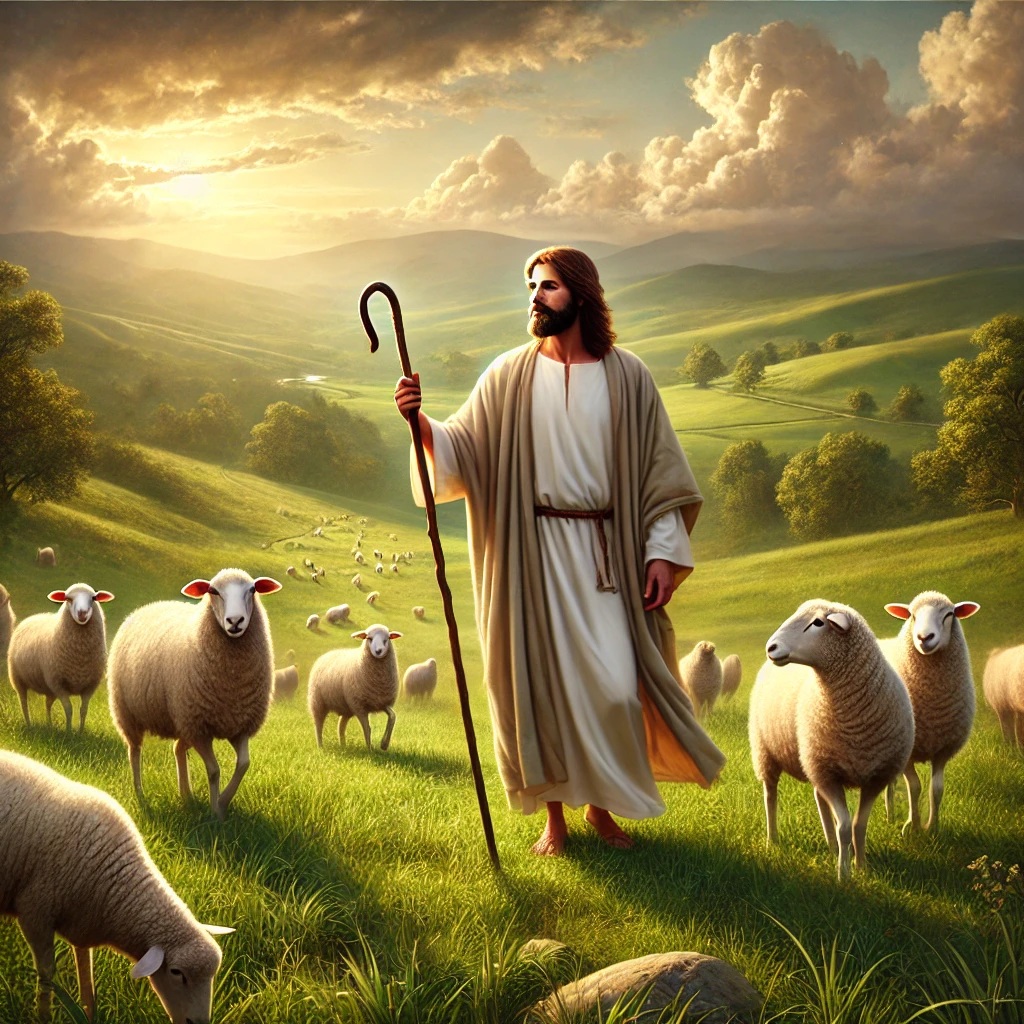
The whole “earthly class” is hung on a single verse. In John 10, the Good Shepherd says: “I have other sheep, that are not of this fold; I must bring them also, and they will heed my voice. So there shall be one flock, one shepherd” (John 10:16). The Watchtower takes the “other sheep” to be its earthly class — a body of Christians who, on their account, would not even begin to be gathered until the 1930s.
But put the question the way a first-century disciple would have heard it. Why would Jesus mention, in passing, a class of Christians his hearers would never meet in their lifetimes — and then say nothing more to explain it? The far more natural reading is the one the apostles would themselves arrive at within a few years: the “fold” is Israel, and the “other sheep … not of this fold” are the Gentiles — the nations soon to be brought into the one people of God. The very grammar points this way. Jesus says these sheep are not of (Greek ek, “out of, from”) this fold — language of origin, not of destination. The contrast is not between sheep bound for two different places, but between sheep drawn from two different starting points, Jew and Gentile, who are then made one. And the setting confirms it: Jesus speaks these words to Pharisees who took it for granted that the Jews alone were God's flock (John 9:40–10:16). To such hearers, “other sheep not of this fold” could only mean the nations.
When Peter baptized Cornelius and his household, and the gospel went out to the nations, the disciples would have remembered exactly these words — the more so as Christ had given Peter “the keys of the kingdom” to open the door first to Jews, then Samaritans, then Gentiles. John himself supplies the interpretation a chapter earlier, telling us that Jesus would die “not for the nation only, but to gather into one the children of God who are scattered abroad” (John 11:51–52). This has been the Christian reading from the first; even a modern Catholic reference work glosses John 10:16 as Christ's announcement of “the future extension of his Kingdom” to the nations. The “other sheep” are not a second class with a lesser hope; they are the Gentiles, gathered with believing Israel into one flock.3
III. “One Flock, One Shepherd”
The decisive word stands in the very verse the Watchtower relies on. Jesus does not say there will be two flocks, or one flock in two divisions with two destinies. He says the opposite: “there shall be one flock, one shepherd” (John 10:16). The entire point of bringing in the other sheep is that the two become one. To read the verse as the charter of a permanent two-class system is to make it say the reverse of what it says.4
An older English rendering, “one fold,” once blurred this; the Greek is unmistakable — mia poimnē, “one flock.” There is one Shepherd, and there is one flock that heeds his voice. The Watchtower's own favorite verse, rightly read, is one of the clearest refutations of its doctrine: the sheep of both folds are joined into a single flock under a single Shepherd, with one life and one hope between them.
IV. One Body, One Hope
What John states in the image of the flock, Paul states in the language of the body. To the Ephesians he writes the great sevenfold confession of Christian unity: “There is one body and one Spirit, just as you were called to the one hope that belongs to your call, one Lord, one faith, one baptism, one God and Father of all” (Eph. 4:4–6). One hope — named explicitly, for all the baptized. A doctrine of two hopes, a heavenly one for the few and an earthly one for the many, runs straight against the text. Paul does not say “two hopes according to your class”; he says one hope, set in the middle of a confession that hammers the word “one” seven times.5
And the unity Paul means is precisely the joining of the two folds. A few chapters earlier he had described it directly: Christ “has made us both one, and has broken down the dividing wall of hostility … that he might create in himself one new man in place of the two … and might reconcile us both to God in one body through the cross” (Eph. 2:14–16). The Gentiles, once “strangers to the covenants of promise,” have been “brought near” and made “fellow citizens with the saints and members of the household of God” (Eph. 2:12–19). The whole movement of the gospel is from two into one. The two-class system runs the gospel backward, rebuilding inside the Church the very dividing wall that Christ tore down — now not between Jew and Gentile, but between a heavenly 144,000 and an earthly multitude.6
V. Are the 144,000 a Literal Number?
The doctrine requires that the 144,000 be counted with absolute literalness: exactly that many, and no more, will ever reign with Christ in heaven. Yet the number comes from one of the most intensely symbolic books in all of Scripture, and the immediate context will not bear a literal reading. The 144,000 are “sealed out of every tribe of the sons of Israel,” and John lists twelve tribes of 12,000 each (Rev. 7:4–8). If the figure is a literal census of heaven, then heaven is open only to Israelites — and, since Revelation 14:4 says these are men “who have not defiled themselves with women, for they are chaste,” only to celibate Jewish men. The Watchtower does not actually believe this; it reads the tribes and the celibacy as symbolic while insisting the number alone is literal. That is special pleading.7
Read as Revelation asks to be read, the number is a symbol of completeness: twelve (the tribes) times twelve (the apostles) times a thousand — the squared fullness of the people of God multiplied by the cube of ten. It signifies not a cap on heaven but the whole company of the redeemed, the true Israel of God complete and entire. To turn this image of fullness into a numerical ceiling, while treating everything around it as figurative, is to mistake the genre of the book.
VI. Where Is the Great Crowd?
If the 144,000 are in heaven and the great crowd on earth, the two should appear in different places. In Revelation 7 they do not. The 144,000 are sealed (vv. 4–8); then John sees “a great multitude which no man could number, from every nation … standing before the throne and before the Lamb” (v. 9). “Before the throne” is exactly where the 144,000 are said to be (Rev. 14:3). And the scene is unmistakably heavenly: “all the angels stood round the throne … and fell on their faces before the throne and worshiped God” (7:11). Either the angels and the throne are on earth with the great crowd, or — far more naturally — the great crowd is in heaven with the angels and the throne. The vision is one continuous scene; it cannot be split down the middle, the 144,000 lifted to heaven and the great crowd left on earth, without doing violence to the text.8
Two further details settle it. The great crowd “serve God day and night in his temple,” and God “will spread his tabernacle over them” (Rev. 7:15). But Revelation itself tells us where God's tabernacle is: those who “dwell in heaven” are his tabernacle (Rev. 13:6). And in Revelation 19:1 John hears “the loud voice of a great multitude in heaven.” Read as it stands, Revelation places the great crowd exactly where it places the 144,000: before the throne, in heaven, worshiping the Lamb.9
The Watchtower's escape is to read “temple” in 7:15 as merely an outer, earthly courtyard. But the Greek will not permit it. There are two words for the temple. Hieron means the whole temple complex, including the outer courts open to all worshippers; naos means the inner sanctuary itself, which only the priests could enter. Revelation 7:15 uses naos. The great crowd are not in an outer court; they are in the sanctuary — the holy place, in heaven, with the 144,000. The Watchtower knows this distinction well: its own publications explain that hieron is the whole complex and naos the sanctuary proper, and its New World Translation elsewhere renders naos in Revelation as “temple [sanctuary].” Only at 7:15, where the rendering would place the great crowd in heaven, does it quietly drop the bracketed word.10
The attempt to prove otherwise has not gone well. In 1980 the Watchtower argued that naos could mean the outer court, citing as proof the cleansing of the temple — claiming that the money-changers Jesus drove out were in the naos. But the Gospels use hieron for that scene, not naos; the proof-text said the opposite of what it was quoted to say. By 2002 the Watchtower itself conceded, in its “Questions From Readers,” that the great crowd are in the naos and not in any “Court of the Gentiles” — yet still, without explanation, kept them on earth. The lexical evidence had been granted; the conclusion that follows from it had not.11
There is a further confirmation. Every descriptive phrase John uses of the great crowd in Revelation 7 is applied, elsewhere in Revelation and by the Watchtower's own reading, to the heavenly ones. They are “before the throne” (7:9) — so are the 144,000 (14:3) and the angels (7:11). They wear “white robes” (7:9) — so do the martyred souls under the altar (6:11). They cry “salvation to our God” with a great voice — which is the cry of “a great multitude in heaven” (19:1). Term for term, the great crowd is described exactly as the heavenly company is described. The two are not in two places; they are one worshiping multitude before the throne.12
VII. The Table Withheld
The two-class system is not merely an idea; it is enacted, painfully, once a year. At the Watchtower's annual Memorial of Christ's death, the bread and wine are passed — but only those who profess the heavenly calling may partake. Out of the millions who attend, only a few thousand eat and drink; everyone else watches the emblems pass by untouched. The great majority of Jehovah's Witnesses have never once received the body and blood of the Lord.13
Set this against the words of Christ himself: “Unless you eat the flesh of the Son of man and drink his blood, you have no life in you. He who eats my flesh and drinks my blood has eternal life” (John 6:53–54). Jesus makes partaking the very condition of life — not a badge worn by a spiritual elite. And his command at the Last Supper was given to all his disciples: “Do this in remembrance of me” (Luke 22:19). A system that forbids most of its members to obey that command, and tells them they have no need of the table at which life itself is given, has inverted the gospel. What Christ gave as the bread of life for all, the Watchtower reserves for a few thousand — and in doing so withholds from millions the very thing he said they could not live without.
VIII. One Mediator for All
The division reaches even to the mediation of Christ. The Watchtower has taught that Jesus is the “mediator” of the new covenant only for the 144,000; the “other sheep” relate to him as “friends,” benefiting from his ransom but not standing within the covenant he mediates. Whatever the refinements, the effect is a tiered access to Christ.14
Paul allows no such tiers: “There is one God, and there is one mediator between God and men, the man Christ Jesus, who gave himself as a ransom for all” (1 Tim. 2:5–6). The mediation is “between God and men” — not between God and 144,000 men — and the ransom is “for all.” To restrict Christ's mediation to one class is to contradict the apostle at the point where he is most emphatic about its universality. There is one Mediator, and he mediates for all who come to God through him.
IX. No Room for the Martyrs
The doctrine collapses under the simple weight of history. If only 144,000 human beings in all of time are taken to heaven, and the heavenly calling was essentially closed by 1935, then the number must somehow contain the entire company of the redeemed from Abel to the twentieth century. It cannot. In the first three centuries alone, hundreds of thousands of Christians went to their deaths rather than deny Christ. Were they not in heaven? Revelation itself shows them there: under the altar, “the souls of those who had been slain for the word of God,” crying out and given white robes (Rev. 6:9–11). Tertullian, near the year 200, already read the “blood of the saints” with which Babylon is drunk (Rev. 17:6) of the Christian martyrs.15
Ask the question the early Christians' own writings force: whom did they believe those martyrs to be, and where did they believe them to be? They believed them to be faithful Christians, and they believed them to be with Christ in heaven. A 144,000-seat heaven, mostly filled long before the modern “great crowd” was ever identified, simply cannot accommodate the saints whom the New Testament and the earliest Church already place before the throne. The arithmetic of the two-class system fails against the witness of the martyrs.
X. Conclusion: The One People of God
Scripture does divide humanity at the last — but not into a heavenly class and an earthly class. It divides them into those whose names are written in the Lamb's book of life and those whose are not (Rev. 20:15). For all the redeemed there is one destiny, and it is neither a disembodied heaven for a few nor a merely earthly paradise for the many, but the union of the two: “a new heaven and a new earth,” “the holy city, new Jerusalem, coming down out of heaven from God,” where at last “the dwelling of God is with men” (Rev. 21:1–3). The biblical hope is not heaven-or-earth, sorted by class; it is heaven and earth made one in Christ, for the one people of God.16
“Fear not, little flock,” Jesus told his disciples, “for it is your Father's good pleasure to give you the kingdom” (Luke 12:32). The flock was “little” because, at the first, the disciples were few — not because it was one tier of a two-tier people. As the other sheep are brought in, the little flock becomes the one flock of the one Shepherd, called to the one hope, baptized into the one body, fed at the one table, saved by the one Mediator. That is the gospel's own arithmetic, and it has no place for a second-class Christian.17
To the Witness who has been told all his life that he may hope only for earth, and may not eat the bread of life, the New Testament holds out something immeasurably greater: a place in the one flock, a share in the one hope, and a seat at the table where Christ gives himself “for the life of the world” (John 6:51). There are not two kinds of Christian. There is one Lord, one faith, one baptism — and one flock, gathered from every fold into the household of God.
There is one body and one Spirit, just as you were called to the one hope that belongs to your call, one Lord, one faith, one baptism, one God and Father of all.
— Ephesians 4:4–6
Copyright and Distribution
© 2026 Richard Whiting. All rights reserved.
This essay may be reproduced and distributed freely, in printed or electronic form, provided that it is reproduced in whole and without alteration, and that the author's name is retained. Excerpts may be quoted in reviews, scholarly works, or other writings consistent with fair use, with attribution. For any other use, including translation, adaptation, or partial republication beyond fair use, please contact the author.
Endnotes
- For the Watchtower's own statement of the two-class doctrine, see “Who Really Have a Heavenly Calling?” (The Watchtower) and the chapter “The Great Crowd to Live in Heaven? Or on Earth?” in Jehovah's Witnesses—Proclaimers of God's Kingdom (Watch Tower, 1993), 159–167. The 144,000 “anointed” (the “little flock,” Luke 12:32) are said to have a heavenly hope; the “great crowd” of “other sheep” (Rev. 7:9; John 10:16) an earthly one. The terms “anointed class” and “other-sheep class” are Watchtower coinages; neither phrase appears in Scripture. ↩
- On the dividing of the hopes from 1935, see Proclaimers of God's Kingdom (1993), 165–166: at a 1935 convention J. F. Rutherford asked all who hoped to live forever on earth to stand, and declared, “Behold! The great multitude!” From that point the “great crowd” was identified as an earthly class and the heavenly calling treated as all but closed. The earlier Watchtower position had been the opposite — that the “great company” was itself a heavenly spirit class: “all the facts and the scriptures … show that those who form the great multitude constitute a spirit class, born on the spirit plane” (The Watch Tower, January 15, 1927, 19–20); “must be spirit creatures” (Vindication, vol. 3, 1932, 204). Founder C. T. Russell's associates had even numbered the “Great Company” in the hundreds of millions in heaven (The Finished Mystery, 1917, 103). The reversal to an earthly class came only with Rutherford in 1935. ↩
- John 10:16. The “other sheep … not of this fold” are most naturally the Gentiles, who together with believing Jews become “one flock, one shepherd.” The Greek “not of” (ek) this fold denotes origin, not destination: sheep from a different starting point, not bound for a different place. The words are spoken to Pharisees who assumed Israel alone was God's flock (John 9:40–10:16), and John supplies the interpretation: Jesus would die “not for the nation only, but to gather into one the children of God who are scattered abroad” (John 11:51–52). The reading is as old as the Fathers; see Augustine, Tractates on the Gospel of John 47.2–4, who identifies the other sheep with the Gentiles called into the one Church. So too the New Catholic Encyclopedia, s.v. “Christianity,” which reads John 10:16 as Christ's announcement of “the future extension of his Kingdom” to the nations (cf. Matt. 8:11; 28:19). ↩
- John 10:16, “one flock, one shepherd” (Greek mia poimnē, heis poimēn). The verse the Watchtower cites to establish two classes in fact declares the opposite: the bringing in of the other sheep produces one flock, not a flock of two permanently distinct destinies. The older Bishops' and King James rendering “one fold” obscured this; the Greek is “one flock.” ↩
- Ephesians 4:4–6: “There is one body and one Spirit, just as you were called to the one hope that belongs to your call, one Lord, one faith, one baptism, one God and Father of all.” Paul names one hope for all the baptized, not two. A system of two hopes — heavenly and earthly — cannot be squared with this sevenfold confession of unity. ↩
- Ephesians 2:11–22, esp. 2:14–16: Christ “has made us both one, and has broken down the dividing wall … that he might create in himself one new man in place of the two … and might reconcile us both to God in one body through the cross.” Paul's gospel is the abolition of the wall between Jew and Gentile into a single Body. The two-class doctrine re-erects a dividing wall the cross was meant to destroy. ↩
- Revelation 7:4–8. The 144,000 are “sealed out of every tribe of the sons of Israel,” and the list names twelve tribes of 12,000 each. If the number is pressed as a literal census of all who go to heaven, then by the same literalism the saved are exclusively Israelite, male (cf. Rev. 14:4, “not defiled with women”), and celibate — conclusions the Watchtower itself does not draw. The number is plainly symbolic: 12 × 12 × 1,000, the squared completeness of the tribes multiplied by the cube of ten, a figure of the whole people of God. See G. K. Beale, The Book of Revelation (NIGTC; Grand Rapids: Eerdmans, 1999), 416–423. ↩
- In Revelation 7 the 144,000 (vv. 4–8) and the great crowd (vv. 9–17) are shown in the same place and the same act of worship: both stand “before the throne and before the Lamb” (7:9; cf. 14:3, the 144,000 “before the throne”). The continuous vision (7:11, “and all the angels … fell on their faces before the throne”) is a heavenly scene; to place the great crowd on earth while angels, elders, and the throne are in heaven breaks the single setting. See the argument of Lorri MacGregor, “Who Are the Great Crowd of Revelation Chapter 7?” ↩
- Revelation 7:15, the great crowd “serve him day and night in his temple, and he who sits upon the throne will shelter them with his presence” (literally “will spread his tabernacle over them,” skēnōsei ep' autous). Revelation 13:6 locates God's “tabernacle” (“those who dwell in heaven”) in heaven; and Revelation 19:1 hears “the loud voice of a great multitude in heaven.” The Watchtower's restriction of naos to an “earthly courtyard” is an interpretive device unsupported by the text, which knows no outer court here at all. ↩
- The New Testament distinguishes two words for the temple. Hieron (Strong's 2411) denotes the whole temple complex, including the outer courts open to all worshippers; naos (Strong's 3485) denotes the inner sanctuary — the Holy and Most Holy — which only the priests could enter. Revelation 7:15 uses naos. The Watchtower acknowledges the distinction in The Watchtower, August 15, 1960, 493 (“Hieron referred to the entire temple grounds, whereas naos applied to the temple structure itself”), and its New World Translation renders naos as “temple [sanctuary]” elsewhere in Revelation (e.g., 11:19; 14:15; 15:5–8), dropping the bracketed “[sanctuary]” only at 7:15. The scholar Jason BeDuhn, whom the Watchtower elsewhere cites approvingly, likewise identifies naos as the inner chamber and enōpion as “face to face” before the throne. ↩
- In The Watchtower, August 15, 1980, 14–16 (“The ‘Great Crowd’ Renders Sacred Service Where?”), the Society argued that naos could mean the outer court, asserting that Jesus drove the money-changers from the naos. But John 2:14–15 (with Matt. 21:12; Mark 11:15) uses hieron for that scene, as the Society's own Kingdom Interlinear shows. In “Questions From Readers,” The Watchtower, May 1, 2002, 30–31, the Society conceded that the great crowd are in the naos and not in any spiritual “Court of the Gentiles,” while still placing them on earth. A later article (March 15, 2010, 26) reverted to the “outer courtyard” language without addressing the lexical point. ↩
- Each term describing the great crowd in Revelation 7:9–17 is applied to the heavenly company elsewhere: “before the throne” (7:9; cf. the 144,000 in 14:3 and the angels in 7:11); “white robes” (7:9; cf. the souls under the altar in 6:11); and the great-voiced cry of “salvation to our God” (7:10; cf. “a great multitude in heaven” in 19:1). The cumulative effect is that every descriptive marker the text gives the great crowd is, by Revelation's own usage, a marker of those in heaven. ↩
- John 6:53–57: “Unless you eat the flesh of the Son of man and drink his blood, you have no life in you.” Christ makes partaking the condition of life, not the badge of an elite. Yet the Watchtower forbids the “great crowd” — the overwhelming majority of its members — to partake of the bread and wine at its annual Memorial, restricting the emblems to those professing the heavenly calling. Of the millions who attend, only a few thousand partake. On the institution and the universal command, see Luke 22:19–20 (“do this in remembrance of me”) and 1 Corinthians 11:23–26. ↩
- 1 Timothy 2:5–6: “There is one God, and there is one mediator between God and men, the man Christ Jesus, who gave himself as a ransom for all.” The Watchtower has taught that Christ is mediator only for the 144,000, the “other sheep” relating to him as “friends” rather than as those for whom he mediates the new covenant (see The Watchtower, April 1, 1979, and the discussion in Insight on the Scriptures, “Mediator”). Paul says the ransom is “for all” and the mediation “between God and men” without qualification. ↩
- If only 144,000 in all of history are taken to heaven, and the calling was all but closed by 1935, the count cannot accommodate the Christian dead of the first three centuries alone, when hundreds of thousands suffered martyrdom rather than deny Christ. Tertullian already reads Revelation 17:6 — Babylon “drunk with the blood of the saints” — of the Christian martyrs (Scorpiace 12); the martyrs under the altar in Revelation 6:9–11 are in heaven, crying out and given white robes, long before any modern “great crowd.” The two-class arithmetic cannot find room for the very saints the New Testament already places before the throne. ↩
- Scripture knows a single division of humanity at the last, not two tiers of the saved: those whose names are written in the Lamb's book of life and those whose are not (Rev. 20:15; 21:27; cf. 3:5). All the redeemed inherit the same consummation — the new heaven and the new earth united, “the holy city, new Jerusalem, coming down out of heaven,” where “the dwelling of God is with men” (Rev. 21:1–3). The biblical hope is not heaven-or-earth for two classes, but the marriage of heaven and earth for the one people of God. ↩
- Luke 12:32, “Fear not, little flock, for it is your Father's good pleasure to give you the kingdom.” The Watchtower takes “little flock” as the 144,000 over against the “other sheep.” But in context Jesus addresses all his disciples; the flock is “little” because the disciples are then few, not because it is one tier of a two-tier people. John 10 envisions the joining of the folds into one, not their permanent separation. ↩