The Undiscovered Country: The Soul, the Three States, and What Awaits Us — Heaven, Hell, and Purgatory
by Richard Whiting
© 2026 Richard Whiting. All rights reserved. May be reproduced in whole, with attribution. See the full notice at the end of this article.
I. The Question That Decides the Rest
Ask a Catholic and a Jehovah's Witness what happens after death, and you will get answers so different they seem to describe different universes. The Catholic speaks of a soul that meets God at death, of heaven and hell and a purifying fire. The Witness speaks of an unconscious sleep, an earthly paradise for most of the saved, a heaven reserved for 144,000, and no hell of torment at all. It can look like a tangle of unrelated disputes.
It is not. Beneath the three famous disagreements — over heaven, over hell, over purgatory — lies a single question, and it decides all the others: what happens to the person at the moment of death? Does anything of us survive, conscious, to meet God before the resurrection? The Witness says no; the Catholic says yes. Settle that, and the rest follows almost automatically. This article therefore begins where the real disagreement begins — with the state of the dead — and only then turns to the three states that depend on it.
II. The State of the Dead: Does the Soul Survive?
The Watchtower teaches what theologians call soul sleep, or mortalism. The human “soul” is not an immortal spirit but simply the living person; when the person dies, the soul dies, and nothing conscious remains. “When we die, we cease to exist,” the Society states plainly; “the dead can't think, act, or feel anything.” The dead are not anywhere — not in heaven, not in torment, not being purified — but simply nonexistent, awaiting a future resurrection in which God will re-create them.1
This is the linchpin of the entire Witness picture of the afterlife, and it is essential to see that before going further. If no one is conscious between death and resurrection, then there is no one in heaven now, no one in hell, no one in purgatory — and the traditional Christian map of the afterlife must be redrawn from scratch. So everything turns on whether the claim is true. And the New Testament, read plainly, says it is not.
Jesus tells the criminal beside him, “Truly, I say to you, today you will be with me in Paradise” (Luke 23:43) — today, not after some far-off re-creation. Paul desires “to depart and be with Christ, for that is far better” (Phil. 1:23), and is confident that to be “away from the body” is to be “at home with the Lord” (2 Cor. 5:8) — hopes that make no sense if death is mere unconsciousness. John sees “under the altar the souls of those who had been slain,” fully conscious, crying out and being answered (Rev. 6:9–11). At the Transfiguration, Moses and Elijah — long dead — appear alive and in conversation with Christ (Matt. 17:3). And Jesus settles the principle itself: God “is not God of the dead, but of the living,” for he remains the God of Abraham, Isaac, and Jacob (Matt. 22:32). The patriarchs, then, live.2
The Catholic teaching is simply this: God creates each human soul immortal, so that though the body truly dies, the soul does not perish but subsists, conscious, until the resurrection reunites it with a glorified body. This is not the pagan idea of a divine, self-existent soul; the body's resurrection remains the Christian hope, and the person is incomplete until then. But the soul lives in the meantime — and that is the very thing the Witnesses must deny, because so much else depends on it.3
III. “The Dead Know Nothing”: Reading Ecclesiastes Rightly
The Witness case for soul-sleep rests above all on a handful of Old Testament texts, chiefly Ecclesiastes 9:5 — “the dead know nothing at all” — and Psalm 146:4, “his thoughts perish.” Taken as bare proof-texts, these seem to settle the matter. But read in context they do not bear the weight placed on them.
Ecclesiastes is Wisdom literature, and its refrain is life “under the sun” — the view from unaided human observation. From that vantage the dead indeed “know nothing” of what passes here: “never again will they have a share in all that is done under the sun” (Eccl. 9:6). The book is describing the appearance of death to the living and the limits of earthly wisdom, not delivering a developed revelation of the world to come; that is why, a verse later, it counsels simply to eat your bread and enjoy your toil (Eccl. 9:7–10). To take a proverb about the boundaries of what the living can see, and use it to cancel the explicit teaching of Christ and the apostles on the conscious life of the soul, is to let the dim light put out the bright one. Progressive revelation runs the other way: the New Testament does not retract Ecclesiastes; it surpasses it.4
IV. Heaven: For 144,000, or for All the Blessed?
With the soul question in view, the three states can be treated in turn — beginning with heaven. The Watchtower teaches that heaven is not the destiny of Christians generally, but of a limited class: exactly 144,000, the “anointed” or “little flock,” who will rule with Christ. The rest of the saved — the “other sheep,” the “great crowd” — will live forever on a paradise earth. The number comes from Revelation, read as a literal census.5
But the text that supplies the number refutes the literal reading. If the 144,000 are to be counted literally, then by the same passage they are also literally “the sons of Israel,” twelve thousand from each tribe (Rev. 7:4–8), and literally male virgins who “have not defiled themselves with women” (Rev. 14:4). On those terms the Apostle Peter, who was married, is excluded; the Virgin Mary, not being male, is excluded; and Charles Taze Russell, the Watchtower's own founder, not being a Jew, is excluded. A reading that shuts the founder of the movement out of heaven has gone wrong somewhere.6
It has gone wrong by taking a symbol for a statistic. The number is twelve squared times a thousand — a figure of completeness and fullness, the fullness of God's people. And the same vision proves heaven is not capped at that figure: immediately after counting the 144,000, John sees “a great multitude that no one could number, from every nation,” standing “before the throne” (Rev. 7:9) — the heavenly court — with the twenty-four elders around it (Rev. 4:4). Heaven, in Revelation's own imagery, is innumerable. And the hope held out to Christians is everywhere the same: “Blessed are the pure in heart, for they shall see God” (Matt. 5:8); “we shall see him as he is” (1 John 3:2). That vision of God — the beatific vision — is the one hope of all the redeemed, not the privilege of a numbered few.7
V. Hell: Annihilation, or Eternal Loss?
On hell the Watchtower again begins from soul-sleep. Since the dead are unconscious, there can be no conscious torment; “hell” (the Hebrew Sheol, the Greek Hades) is taken to mean simply the common grave. The wicked who are not raised are not tormented but annihilated — “Gehenna” standing for everlasting destruction, that is, nonexistence. Eternal conscious punishment, the Society argues, would be incompatible with a God of love and is a borrowing from pagan philosophy.8
The moral intuition deserves respect: a God who delighted in endless torture would not be the God of love. But the Catholic doctrine of hell is not that caricature, and the texts will not reduce to annihilation. Jesus — who speaks of hell more often than anyone in Scripture — sets the two eternal destinies side by side in a single sentence: “These will go away into eternal punishment, but the righteous into eternal life” (Matt. 25:46). One and the same word stands over both; if the life is everlasting, so is the punishment, and the symmetry breaks the annihilationist reading. He speaks of the fire “that never shall be quenched,” where “their worm does not die” (Mark 9:48); of the “outer darkness” with its “weeping and gnashing of teeth” (Matt. 8:12); and, in the account of the rich man and Lazarus, of a man conscious “in anguish in this flame” immediately after death (Luke 16:23–24) — which the Watchtower can only set aside by calling it “merely a parable,” though Jesus does not teach by means of impossibilities.9
What, then, is hell? Not a torture God inflicts on those who longed for him, but the definitive, self-chosen separation from God of those who refuse his love to the end — “eternal loss,” as the Church puts it, freely entered. That such a state is conscious and unending, the words of Christ require; that it is a horror, the Church agrees; that it is chosen, not imposed, is what keeps it consistent with the love of God. Annihilation would be, if anything, a mercy by comparison — but it is not what Jesus describes.10
And the rich man and Lazarus cannot be waved away. Even granting it is a parable, Jesus draws his parables from the way things really are, not from scenarios he regards as false; he does not teach truth by painting a picture he believes to be a lie. The framework he assumes — the dead conscious, remembering, either comforted or in anguish, at once upon death — is exactly the framework soul-sleep denies, and it fits seamlessly with “today you will be with me in Paradise.”11
VI. Purgatory: The Purification of the Saved
Purgatory the Watchtower rejects outright — and, given its premises, consistently: if the dead are nonexistent, there is plainly no one to be purified. The rejection follows from soul-sleep as surely as everything else. So here, too, the prior question governs; grant the conscious survival of the soul, and purgatory becomes at least possible — and, the Catholic argues, biblically warranted.12
First, what purgatory is not. It is not a second chance for the damned, not a third destination alongside heaven and hell, not a way of earning a salvation Christ has already won. It is the final cleansing of those who die in God's friendship — already saved — but not yet perfectly freed from the effects of sin, so that they may be made ready for the holiness of heaven. It is a purification of the saved, not a reprieve for the lost.
Its biblical roots are firmer than is often supposed. Paul describes a man whose work is tested by fire: “he will suffer loss, though he himself will be saved, but only as through fire” (1 Cor. 3:15) — saved, yet through a purifying fire. The Second Book of Maccabees records Judas Maccabeus making “atonement for the dead, that they might be delivered from their sin” (2 Macc. 12:44–46), a practice that presumes the dead can still be helped. Jesus speaks of a sin that will not be forgiven “either in this age or in the age to come” (Matt. 12:32), implying that some forgiveness is possible in the age to come. And the principle is fixed at both ends: “nothing unclean shall enter” heaven (Rev. 21:27), yet “without holiness no one will see the Lord” (Heb. 12:14). For the saved who die imperfectly holy, something must bridge the gap between a real but unfinished sanctity and the purity heaven requires. That bridge is what the Church calls purgatory.13
VII. One Disagreement Beneath Three
Step back, and the unity of the whole becomes plain. The three disputes are not independent; they are three branches of one root. Deny the conscious survival of the soul, and the entire afterlife must be rebuilt to fit: there can be no hell of conscious punishment, so the wicked must be annihilated; no one is in heaven now, and heaven is recast as a limited government of 144,000 over a paradise earth; and purgatory is impossible by definition, since there is no one there to purify. Every distinctive Watchtower position on the last things flows from the single premise of soul-sleep.14
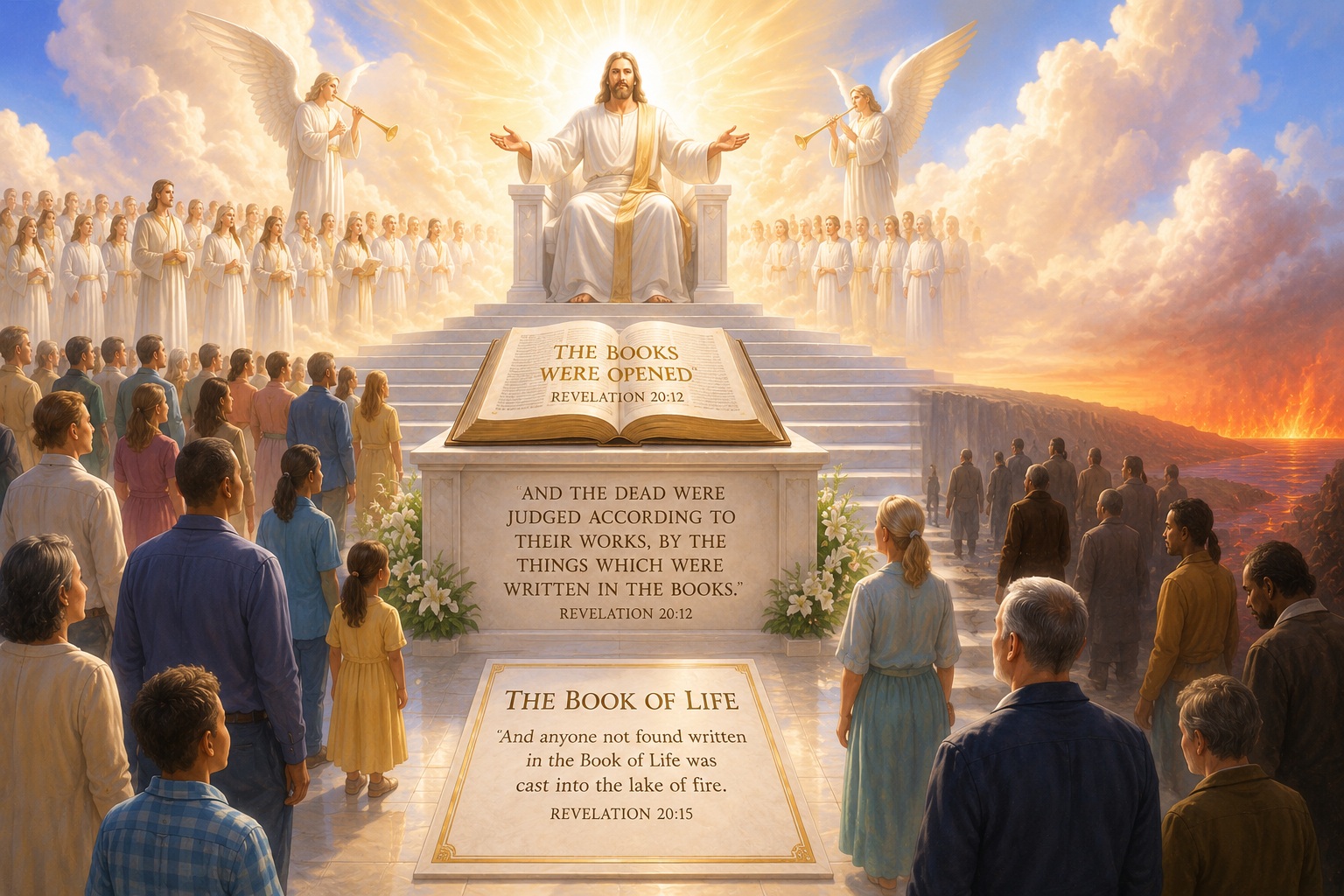
Restore that premise to what the New Testament teaches — that the soul lives on, conscious, to meet God — and the traditional three states fall back into place of themselves. The faithful dead are with Christ (heaven); those who finally refuse him are in eternal loss (hell); and those who die in grace but imperfectly purified are made ready for the vision of God (purgatory). The Catholic also distinguishes the particular judgment each soul meets at death from the general judgment at the resurrection, when body and soul are reunited — the very scene of the books being opened before the throne (Rev. 20:12). The two judgments are not rivals; the first concerns the soul in the interim, the second the whole person at the end.15
VIII. Conclusion: The Hope of Seeing God
The argument can be gathered in a sentence. Whether the soul survives death, conscious, decides everything else about the last things — and Scripture says it does: “today you will be with me in Paradise.” Once that is granted, heaven opens to all the blessed and not to a numbered few; hell stands as the real and eternal, but freely chosen, loss of God, not a mere annihilation; and purgatory takes its place as the merciful purification by which the saved are made ready to see him. The Watchtower's rebuilt afterlife is the necessary consequence of a single mistaken premise; correct the premise, and the house of the older faith stands again.
And what stands at the end of it is not a ledger or a verdict but a Person. “Blessed are the pure in heart, for they shall see God.” The whole Christian hope for the dead — the survival of the soul, the purification of the imperfect, the resurrection of the body — is ordered to that one end: to look at last upon the face of the God who made us and loved us, and in that vision to find our rest. “Now we see in a mirror dimly,” Paul says, “but then face to face” (1 Cor. 13:12). That is the country we are bound for; and the road to it runs not through nonexistence, but through the hands of a living God who is God “not of the dead, but of the living.”
“Blessed are the pure in heart, for they shall see God.”
— Matthew 5:8
Copyright and Distribution
© 2026 Richard Whiting. All rights reserved.
This essay may be reproduced and distributed freely, in printed or electronic form, provided that it is reproduced in whole and without alteration, and that the author's name is retained. Excerpts may be quoted in reviews, scholarly works, or other writings consistent with fair use, with attribution. For any other use, including translation, adaptation, or partial republication beyond fair use, please contact the author.
Endnotes
- The Watchtower teaches “soul sleep” (mortalism): the soul is not immortal, and at death the whole person ceases to exist until a future resurrection. “When we die, we cease to exist … The dead can't think, act, or feel anything” (“What Happens When You Die?”, jw.org). The argument rests chiefly on Ecclesiastes 9:5 (“the dead know nothing at all”) and Psalm 146:4 (“his thoughts perish”), together with the claim that “soul” (nephesh) simply means the person, who dies (Ezek. 18:4). On this view there is no conscious intermediate state of any kind — no one in heaven, hell, or purgatory now. ↩
- Against soul-sleep, the New Testament repeatedly presents the faithful dead as consciously alive with God before the resurrection: “Today you will be with me in Paradise” (Luke 23:43; see the separate study on the New World Translation's relocation of the comma here); “I desire to depart and be with Christ” (Phil. 1:23); “away from the body and at home with the Lord” (2 Cor. 5:8); the souls of the martyrs “under the altar” who cry out and are told to “rest a little longer” (Rev. 6:9–11). At the Transfiguration, Moses and Elijah appear alive and conversing (Matt. 17:3), and Jesus argues that God “is not God of the dead, but of the living,” since he calls himself the God of Abraham, Isaac, and Jacob (Matt. 22:32). ↩
- The Catholic teaching is not the pagan Greek notion of a soul that is divine and self-existent, but that God creates each spiritual soul immortal, and it does not perish with the body, awaiting reunion with it at the resurrection. See Catechism of the Catholic Church §§362–368, 1022. The body truly dies; the person is incomplete until the resurrection of the body (1 Cor. 15); but the soul subsists and is conscious. So Catholics affirm both what the Witnesses rightly stress — the resurrection of the body as the Christian hope — and what they wrongly deny: the soul's survival in the meantime. ↩
- Ecclesiastes is Wisdom literature describing life and death “under the sun” — from the vantage of unaided human observation, in which the dead indeed do nothing visible and are cut off from the activities of this world (Eccl. 9:6, 10). It is not a developed revelation of the afterlife; the same book counsels eating, drinking, and enjoying toil precisely because more was not yet known (Eccl. 9:7–10). To build a doctrine that overturns the explicit New Testament texts on the conscious survival of the soul, on the strength of a proverb about the limits of earthly observation, is to read the lower light as cancelling the higher. ↩
- The Watchtower teaches that only 144,000 — the “anointed” or “little flock” — go to heaven to rule with Christ, while the rest of the saved (the “other sheep,” the “great crowd”) live forever on a paradise earth. The number is taken from Revelation 7:4 and 14:1, 3 and read literally. See the separate study “One Flock, One Hope?” on the other-sheep doctrine. ↩
- That the 144,000 is symbolic is shown by the text itself. Read literally, the group would be only Jewish male virgins “of the sons of Israel,” 12,000 from each named tribe (Rev. 7:4–8; 14:4) — which would exclude the Apostle Peter (married), the Virgin Mary (not male), and the Watchtower's own founder Charles Taze Russell (not a Jew). In the very same vision John then sees “a great multitude that no one could number, from every nation,” also standing before the throne (Rev. 7:9) — the heavenly court — along with the twenty-four elders (Rev. 4:4). The number is 12 × 12 × 1,000, a figure of fullness and completion, not a membership cap on heaven. See “How Do I Refute the Jehovah's Witness Claim About the 144,000?” (catholic.com). ↩
- Scripture makes the vision of God the universal hope of the blessed, not the privilege of a class: “Blessed are the pure in heart, for they shall see God” (Matt. 5:8); “we shall see him as he is” (1 John 3:2); “now we see in a mirror dimly, but then face to face” (1 Cor. 13:12). The Church calls this the beatific vision (CCC §§1023–1029). Heaven is communion with the Triune God, offered to all the redeemed. ↩
- The Watchtower denies any hell of conscious punishment. “Hell” translates Sheol/Hades, which it defines as merely “the common grave of mankind” where the dead are unconscious; eternal torment is called “unscriptural,” of pagan (Platonic and Egyptian) origin, and “an insult to” God's love (1 John 4:8). The wicked who are not resurrected are said to be annihilated — “Gehenna” symbolizing everlasting destruction (nonexistence), not torment. See “Is Hell Real? What Does the Bible Say About Hell?” (jw.org). ↩
- Jesus speaks of hell more than anyone in Scripture, and as a state of conscious and unending loss, not annihilation. Decisively, Matthew 25:46 sets the two destinies in exact parallel: “These will go away into eternal punishment, but the righteous into eternal life” — the same word (Greek aiōnios) governs both, so if the life is everlasting and conscious, so is the punishment. He speaks of “the fire that never shall be quenched,” where “their worm does not die” (Mark 9:48); of “the outer darkness” where “there will be weeping and gnashing of teeth” (Matt. 8:12; 22:13); and in the account of the rich man and Lazarus, the rich man is conscious “in anguish in this flame” immediately after death (Luke 16:23–24). Revelation says “the smoke of their torment goes up forever and ever, and they have no rest, day or night” (Rev. 14:11). ↩
- Annihilationism (the wicked are destroyed into nonexistence) has had some Christian defenders, and the Witnesses are not alone in holding it; but it cannot easily survive Matthew 25:46's parallel of “eternal punishment” with “eternal life,” nor Revelation's “forever and ever … no rest, day or night” (Rev. 14:11; 20:10). “Destruction” (apoleia) in Scripture regularly means ruin or loss, not extinction — the “lost” (apollumi) sheep and coin of Luke 15 still exist. The Catholic teaching is that hell is the self-chosen, definitive exclusion from communion with God (CCC §§1033–1037): real, eternal, and freely entered, never a torture God inflicts on those who sought him. ↩
- The Watchtower dismisses Luke 16:19–31 as “merely a parable” and so not evidence of conscious survival. But even if it is a parable, Jesus' parables draw on real states of affairs, not impossibilities, to teach truth; he does not illustrate spiritual realities with scenarios he regards as false. The detail that the dead are immediately conscious — Lazarus comforted, the rich man in torment, both aware and remembering — is precisely the framework Jesus assumes and his hearers accepted. It coheres with the rest of his teaching (Luke 23:43; Matt. 22:32) and tells decisively against soul-sleep. ↩
- The Watchtower rejects purgatory entirely — consistently, given its premises, since if the dead are unconscious and nonexistent there can be no intermediate purification. It treats purgatory as an unscriptural Catholic invention (“What Happens to the Soul at Death?”, jw.org). ↩
- Purgatory is not a “second chance” or a third destiny beside heaven and hell, nor a way of “earning” heaven; it is the final purification of those who die in God's grace and friendship but still imperfectly purified, so as to be made ready for the joy of heaven (CCC §§1030–1032). Its scriptural roots: those saved “but only as through fire,” their work tested and purified (1 Cor. 3:11–15); the ancient and inspired practice of praying and making atonement “for the dead, that they might be delivered from their sin” (2 Macc. 12:44–46); Jesus' implication that some sins may be dealt with “in the age to come” (Matt. 12:32); and the principle that “nothing unclean shall enter” heaven (Rev. 21:27) while “without holiness no one will see the Lord” (Heb. 12:14). Purgation makes the saved fit for the vision of God. ↩
- The structural point: the three states stand or fall with the conscious survival of the soul. Deny it, and one must rebuild the whole afterlife — annihilation in place of hell, an earthly paradise for most in place of heaven, and no purgatory because no intermediate state exists. Restore the soul's survival, as the New Testament plainly teaches, and the three states fall back into place. The disagreement over heaven, hell, and purgatory is, at root, a single disagreement about what happens to the person at death. ↩
- Catholic teaching distinguishes the particular judgment — each soul, at death, meets Christ and enters heaven (immediately or through purification) or hell (CCC §§1021–1022) — from the general judgment at the resurrection of the dead, when soul and body are reunited and the justice of God is made manifest before all (CCC §§1038–1041; John 5:28–29; Rev. 20:12–13). The two are not rivals: the first concerns the soul in the interim, the second the whole person at the end. ↩